
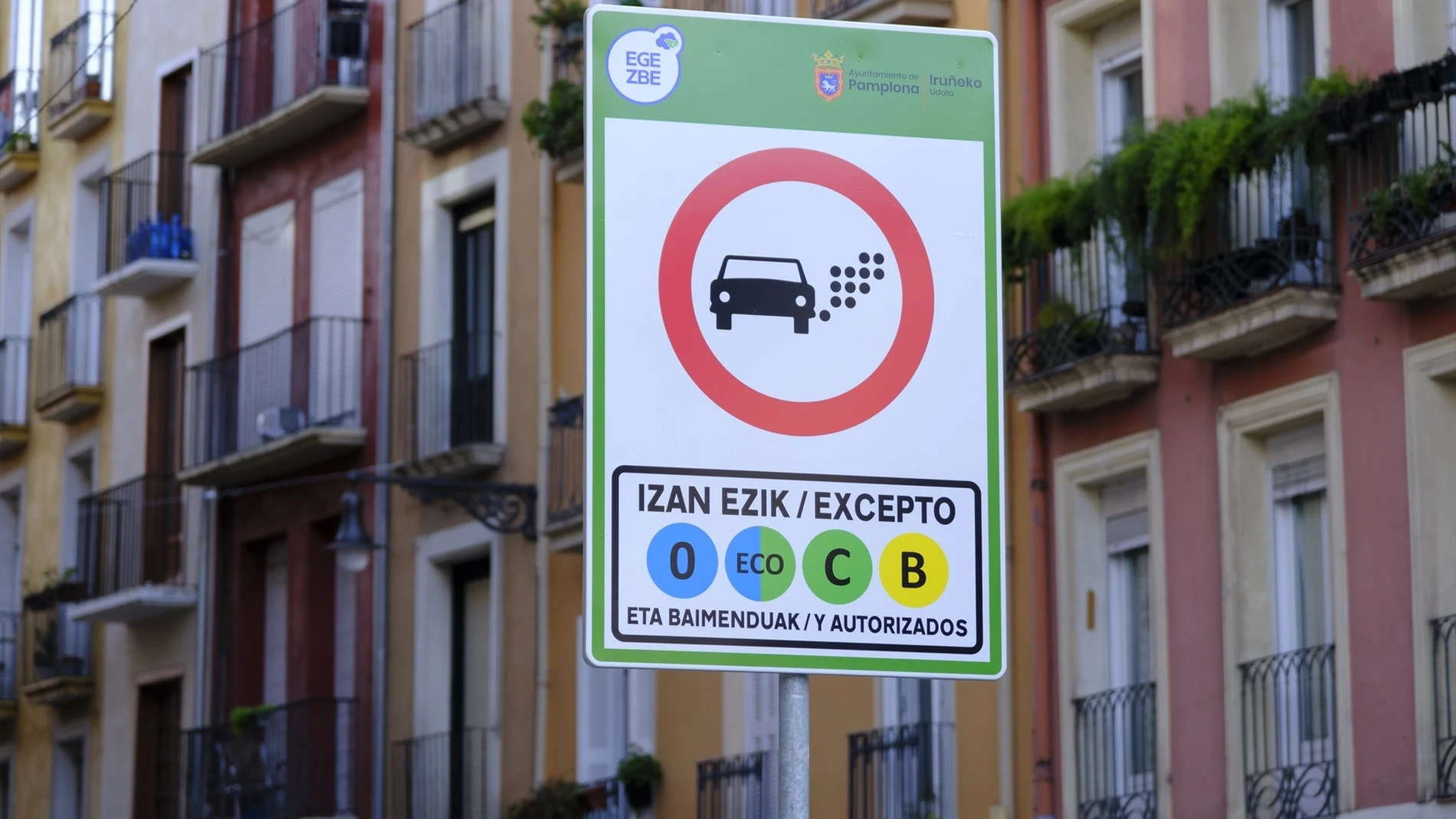
The Chamber of Comptos of Navarra, the equivalent of the Court of Accounts, has verified that Pamplona City Council did not fully implement a Low Emissions Zone (ZBE) in accordance with current regulations until the end of 2025despite the fact that state legislation required it to be done at least a year and a half before.
Although the environmental plan began with a previous government, EH Bildu has been in charge of the City Council since December 2023. This is stated in the inspection report on the ZBE in the city between 2022 and 2025, published in March 2026.
It must be taken into account, first of all, that Spain, as a member of the European Union (EU), committed to Brussels to promote actions to mitigate climate change through, mainly, the reduction of greenhouse gas emissions. In this sense, the European Green Deal, approved by the Commission in 2019, and Spain’s Strategic Energy and Climate Framework stand out.
It is estimated that approximately Urban transport is responsible for 23% of EU greenhouse gas emissions; Hence, the importance of correctly applying the ZBE by the City Councils of each autonomy. These limit access, circulation and parking of vehicles to certain urban areas.
In Spain, the Climate Change Law requires that the sustainable urban mobility plans of municipalities with more than 50,000 inhabitants include the establishment of ZBEs before 2023. But, in Navarra, it was extended to municipalities with more than 10,000 inhabitants. This obligation must also be fulfilled within a maximum period of two years.which ended in April 2024, although the royal state decree determined June of that same year as the deadline.
According to the report, as of December 2024, Pamplona did not have a sustainable mobility plan applied to these municipalities and in accordance with the regulations required by the Government. In fact, the ZBEs were not applied correctly and following state regulations until December of last year. That is to say, the City Council did not adapt this previous regulation within the transitional period established by the regulations until after a year and a half of delay.
Until then, there was a previous regulation called ZBE-ZAC (Low Emissions Zone and Controlled Access Zone), but this did not meet the requirements established by the Climate Change Law and the royal decree that regulates ZBEs.
European funds
The problem goes further because Part of the project was financed with ‘Next Generation’ funds from the European Union and the Ministry of Transport, Mobility and Urban Agenda was then forced to ask the Navarra city council for explanations for two issues: the delay in the execution of the project and the technical contradictions found in it. According to the Chamber, as of March of this year, it is not clear whether the ministry led by Óscar Puente has considered the explanations valid.
The technical project was prepared by a specialized company in 2023 and approved by the Local Government Board in 2025, with relevant modifications, especially in the execution schedule.
One of the most critical aspects highlighted in the report is the lack of adequate planning. Specifically, it stands out that The Sustainable Urban Mobility Plan did not initially include the ZBE, despite the fact that its incorporation was mandatory according to state and provincial legislation. This omission evidences, according to the supervisory body, an irregularity in the municipality’s global sustainable mobility strategy.
Furthermore, the Chamber of Comptos assures that the study of costs and benefits cannot be considered complete or balanced. While the benefits of the ZBE are estimated for society as a whole, the costs are mainly limited to the expenditure assumed by the City Council, without taking into account the economic impact on citizens, companies or other affected actors. This lack of balance in the evaluation prevents, according to the report, having a complete vision of the efficiency of the measure.
Added to all this is that, according to the report, the technical system for managing ZBEs and monitoring their effects has been in operation since January 2024, but the “corresponding impact assessment relating to data protection” has not been carried out. This, in the opinion of the Court, “may present unidentified risks to people’s rights and freedoms”.
However, the Chamber urges the City Council to improve strategic planning, fully integrate the ZBE into urban mobility instruments and carry out more complete and balanced impact analyses. It also recommends strengthening the mechanisms for monitoring and evaluating the effects of the ZBE, in order to guarantee its long-term effectiveness.