
A few decades ago, radio stations spoke to their listeners, but since then there has been a slight change and we began to talk about listeners. The difference is subtle and yet evident. Hearing is a passive act, however, listening is an active gesture, a decision. Technological mythology (so to speak) makes us believe that the key is headphones: the better they are, the clearer the sound will be. But the reality is that headphones are just the passive part of the sound, the listeners. Microphones, on the other hand, are the listeners. Without the latter the sound would be just a skeleton of noises.
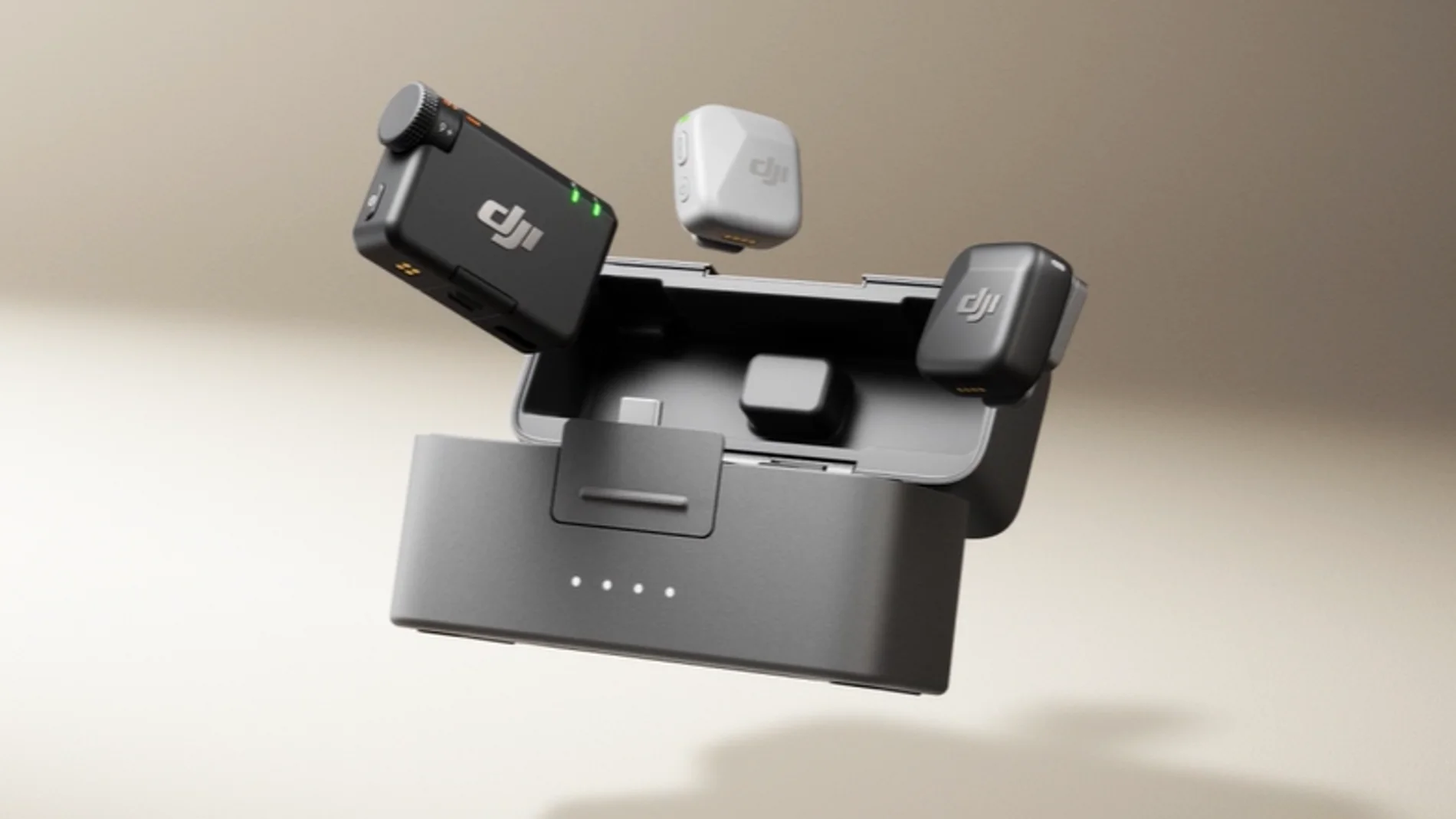
For years, the big Achilles heel of video creators has been audio. Even with excellent cameras or cutting-edge smartphones, sound is often relegated to the background. That’s why compact wireless microphones have become one of the favorite tools of YouTubers, mobile journalists and content creators. In this context appears the DJI Mic Mini, a surprisingly small wireless system that tries to solve an old problem: How to capture clean, professional audio without cables, but without carrying bulky equipment.
The first impression is literally the size. The transmitter weighs just about 10 grams, making it one of the lightest wireless microphones on the market. That lightness is not a minor detail: When recording for hours the microphone practically disappears into clothing. It can be attached with a clip or magnets, making it easy to place discreetly without ruining the aesthetics of the recording.
But the Mic Mini is not limited to being small. DJI has opted for a complete system designed for modern video creation. The kit includes two transmitters and one receiver, which allows you to record interviews or conversations with two people at the same time. The entire set is stored in a portable charging case that, in addition to protecting the equipment, considerably extends the autonomy during long days of recording. And it takes up the space of a mobile phone. But there is more.
The key to any wireless microphone is its stability. In this aspect, the system uses digital transmission in the 2.4 GHz band, capable of reaching up to 400 meters in ideal conditionsa figure more than enough for most situations. This means a creator can walk, move, or even record wide shots without audio loss or degradation. For vloggers, reporters or travel content creators, this freedom of movement is essential.
The microphone also integrates an omnidirectional pattern, designed to capture the voice naturally even when the person moves or turns their head slightly. And for complicated environments, it incorporates noise reduction modes, designed to minimize background sounds such as traffic, wind or crowded environments. One of the aspects that most worries those who record video outside the studio is the battery and taking into account the size of this device we might think that there would be a problem here. And we would be wrong.
Each transmitter can operate for approximately 11.5 hours on a single charge, while the receiver achieves approximately 10.5 hours of continuous use. The charging case, for its part, allows you to recharge the system several times, extending total autonomy during filming days or trips. In practice, this means that many creators can record for an entire day without worrying about power outlets or external batteries. Ah! Five minutes of charging is enough to get an extra hour of use and, to reach a full charge, it takes about 90 minutes.
Importantly, the system integrates especially well with devices in the DJI ecosystem (such as action cameras or stabilizers), allowing you to synchronize recordings or control certain functions directly from the microphone. The difference compared to the audio integrated into a phone is immediate (listeners vs. listeners, we return to the same thing). The microphones built into mobile phones usually pick up ambient sound, reverberations or wind noise. A system like the Mic Mini, when placed close to the voice, reduces these problems and offers a much clearer and more defined sound.
To this we must also add a rare detail: the Mic Mini has a gain system that allows you to adjust up to five different levels. And this is one of the keys to the quality of this device. In audio, gain and volume look like the same thing because they both make something sound louder or quieter. But they actually act at different times in the sound chain, and that difference is crucial when working with microphones.
When a microphone picks up a voice, the electrical signal it produces is extremely weak. Before it can be recorded or sent to a camera or phone, That signal has to go through a preamplifier that raises it to a usable level. That first increase is what is called gain or gain level.
Volume, on the other hand, is the adjustment that is applied later, when the signal is already amplified and ready to be played or mixed. If the gain is too low, the voice will be recorded very weak, and turning up the volume later will also amplify the background noise. The result is often muffled, hissing, or interfering audio. On the other hand, if the gain is too high, the signal saturates: The loudest parts of the voice “clip” the sound wave and distortion appears, that harsh and broken sound that cannot be fixed in editing. A good level of gain allows you to capture a clear voice, with enough energy, but without saturation. In short, thanks to this, the DJI Mic Mini turns us into listeners and not passive subjects of sound.
Verdict:
If we are really committed to sound and the qualities of this microphone do not seem enough, the price of the DJI Mic Mini should suffice: €79. At this time it is the most accurate, economical and reliable way to go from being a listener to turning others into listeners.