
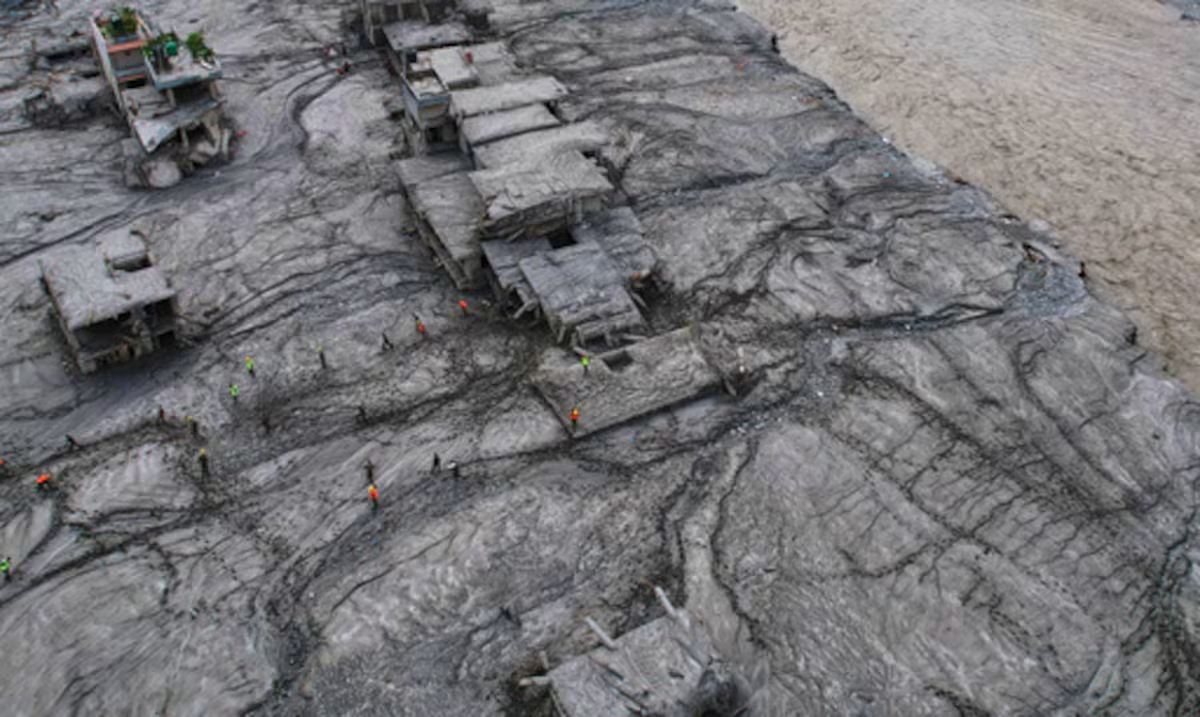
When an avalanche of water, rocks and mud devastated their remote village in NepalPema Tamang and her neighbors fled into the hills, to a Buddhist shrine that had been rebuilt the previous year after the 2015 earthquake.
The steep mountain folds of the Himalayasalready prone to earthquakes, have been the scene of increasingly frequent flash floods as high mountain glaciers melt, changing the course of rivers at a speed that is sometimes frightening. Residents have had little time to rebuild their lives between disasters, raising concerns about whether their communities will be able to endure as climate change accelerates.
“It wasn’t until last year that we were able to rebuild the stupa, after it was destroyed during the earthquake,” Tamang told The Associated Press, referring to the shrine. “Taking refuge there was what saved our lives from the floods,” he said from a makeshift shelter in a Kathmandu monastery.
The August 26 floods in Nepal and neighboring China have killed more than 1,000 people and left thousands missing, including hundreds of people feared trapped in hydroelectric power plant tunnels. The floods were triggered after a landslide of rock and glacial ice caused an avalanche of debris and water to rush down multiple Himalayan rivers.
Scientists say it is too early to directly link Wednesday’s disaster to global warming. However, as the Earth’s temperature rises at a faster rate due to the burning of oil, gas and coal, the likelihood of such disasters increases, especially in the Himalayas, which are warming considerably faster than many other parts of the world.
“Climate change has played an important role in the Hindu Kush-Himalaya mountain range, causing these types of complex disasters that have severely affected downstream communities and investments,” said Saswata Sanyal, a disaster risk resilience expert at the Kathmandu-based International Center for Integrated Mountain Development.
The effects of global warming
Sanyal stated that the region is increasingly facing risks that are triggered one after another.
Rising temperatures cause high mountain glaciers to melt, leading to increasingly frequent rockfalls, avalanches and floods. An avalanche can clog a river before causing a flash flood. Torrential rains following an initial disaster can exacerbate the destruction.
Last year’s flash floods in the same region of Nepal claimed nine lives and caused millions of dollars in damage. Across the Himalayan region, the 2013 Kedarnath floods, the 2021 Chamoli disaster, the 2023 South Lhonak glacial lake outburst flood, and other recent landslides and floods have killed thousands of people and caused hundreds of billions of dollars in damage.
Nepal’s people were still recovering from last year’s floods, Sanyal said, “and before they could fully adapt, the next one came.”
The Hindu Kush-Himalaya spans parts of Afghanistan, Pakistan, India, Nepal, Bhutan, Bangladesh, Myanmar and China, and is home to the largest concentration of ice outside the polar regions. The river systems that originate in these mountains supply water to almost 2 billion people.
Ice loss from glaciers has accelerated considerably since 2000, according to the Sanyal Intergovernmental Climate Research Group. Another risk is thawing permafrost — ground that has been frozen for long periods — which can weaken mountain slopes.
Satellite images of last week’s glacial collapse indicate that a huge mass of rock and glacial ice rushed into the valley below, triggering an avalanche of water and mud several stories high that devastated communities many kilometers (miles) downstream.
Adaptation has its limits
Climate experts say that in some places, the danger could become so great that rebuilding would no longer be viable, forcing residents to relocate. Climate change could also affect efforts to develop the region through the construction of roads, bridges and hydroelectric plants.
“In some areas the adaptation threshold has been exceeded,” said Manjeet Dhakal, a Nepali climate policy expert and United Nations climate negotiator.
“When an earthquake destroys a home, sometimes it is possible to recover belongings,” he said. A catastrophic flood can destroy not only the home, but also the land on which it sits, along with roads, water supply networks, schools and electricity supplies. He said future resettlements would have to take climate risks into account from the start.
The consequences can be mitigated by stricter land use regulations, better pre-approval assessments of infrastructure, more rigorous cross-border monitoring and early warning systems.
However, Sanyal noted that of the 670,000 people who received SMS alerts about the August 26 floods, some were visitors or migrant workers who did not understand Nepali, while others downplayed the risk. Other systems designed to measure river flow overflowed or were washed away.
Chanda Lal Chitrakar, a 62-year-old resident of Nuwakot, Nepal, told the AP that he did not pay much attention to the warning messages. As the water level rose, he ran uphill to safety.
Nepal suffers the consequences
Sanyal stated that these types of alerts should offer more information about the measures to be taken. He also suggested prioritizing development in less dangerous areas, evaluating infrastructure for multiple risks and incorporating the knowledge of indigenous communities in disaster planning.
Dhakal, the climate negotiator, noted that Nepal has emitted less than 0.1% of the greenhouse gases that cause global warming, even though it faces some of its most serious effects.
“We should blame those responsible for rising global temperatures, those who have benefited from the fossil fuel economy for so long,” he said. “At least we can use this devastating example as inspiration to urgently reduce carbon emissions.”