
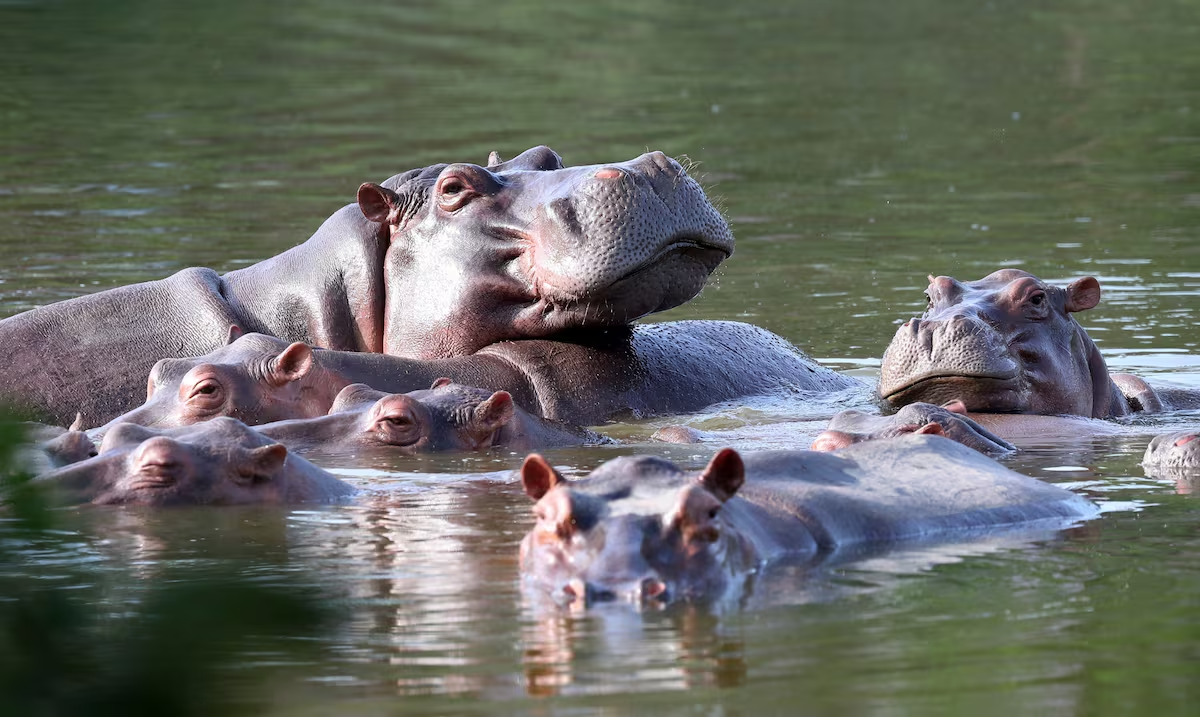
The future of dozens of hippos that today inhabit the Magdalena River basin entered a decisive phase. The Government of Colombia formalized the conditions under which it could authorize his transfer to Indiain response to the interest expressed by the Vantara rescue centerproperty of the businessman Anant Ambani.
The measure, as ‘Portafolio’ revealed, marks a turning point in the management of a species declared invasivewhose growth has led to an environmental emergency with impacts on ecosystems and communities.
A process between States, not between private parties
According to the information published by ‘Portafolio’, the Ministry of Environment and Sustainable Development sent an official communication to the CITES Management Authority of India in which it establishes three mandatory pillars to advance in the eventual translocation of 80 specimens of Hippopotamus amphibius.
The portfolio was emphatic on a key point: it is not an agreement between individuals, but rather a operation that must comply with international standards and have validation from both States.
1. First requirement: international permits and legality
The first filter is legal in nature. Colombia asked India to confirm whether it can grant the required import permitsin accordance with the Convention on International Trade in Endangered Species (CITES).
According to the document cited by ‘Portafolio’, this is equivalent to a kind of “visa” for the animals, without which no transfer could begin. International regulations require that the receiving country demonstrate that it has regulations to manage potentially invasive species.
2. Technical capacity and animal welfare, at the center
The second pillar focuses on the conditions that the Vantara center, located in Jamnagar, Gujarat, would offer.
Colombia requires technical certifications that guarantee the well-being of animals.
Among the aspects evaluated are:
- Availability of adequate space for 80 copies.
- Existence of specialized personnel, such as veterinarians and biologists.
- Management and care protocols under international standards.
- Defined health treatments for animals.
This point becomes relevant if we consider that hippos can weigh up to two tonswhich implies significant logistical and health challenges.
3. State supervision: indispensable condition
The third requirement points to avoid control gaps. The Ministry requests that the Government of India confirm that it has full knowledge of the fate of the animals and that it will exercise supervision over its management.
The intention, according to the information cited, is for the receiving State to assume direct responsibility and guarantee that the Vantara center complies with local regulations throughout the duration of the specimens’ stay.
An expanding invasive species
The hippos were declared invasive species in Colombia in 2022after its rapid expansion was evident in the Magdalena basin. This situation has generated impacts on:
- River ecosystems.
- native species.
- Safety of communities, especially fishermen.
The offer from India arises in the midst of this context, as an alternative to other population control measures within the country, including euthanasia.
The process, however, is not yet defined. According to the Ministry of the Environment, The response of the Indian Government is the enabling requirement to move forward.
Although the dialogues have been held since 2023, it will be India’s formal validation that will determine whether this operation, considered unprecedented due to its scale and complexity, can be carried out.