
Located at 1,604 meters high, that of Greeks, in the Sierra del Albarracín (Teruel), presumes to be the second highest town in Spain and also the coolest. The nights of the summer here are spent on average Between 9 and 11 degrees; “With a rebel,” confesses its mayor Daniel Martínez. In addition, «there are only 6-7 days in which 30 degrees are exceeded. If this happens it is because in the rest of Spain a heat wave is being suffered. Nor is there any tropical night in which the thermometer exceeds 20 degrees, ”says Jaime Lahoz, agent for the protection of the nature of the area. Lahoz has been registering temperatures for 20 years and, although he recognizes the privilege of the fresco that lives in the town neighboring and tourists, warns that “the measured temperature (7th) has risen between 1st and grade and a half.”
Greeks is attached to the cold triangle, that geographical area composed of locations such as Calamocha or Molina de Aragón, which receives its name because in winter they record the lowest temperatures of the entire peninsula (-30 degrees). On the contrary in summer they get rid of the cannula. Nothing to do with the areas that pass more heat: «The Guadalquivir Valley -Córdoba and Sevilla-, the South Peninsular Interior (Jaén, Badajoz) and some southeast regions, such as Murcia. These areas not only record high day temperatures, but also tropical nights. Also the Ebro and Interior Valley of Galicia, specifically the province of Ourense records maximum values normally above 40ºC, ”says Mar Gómez, a doctor in physical and responsible for the Eltiempo.es meteorology area.
It is soon to label the summer of 2025, but the forecasts suggest that it will be a record station of both maximum and minimum temperatures. Already on May 30, the average temperature was 24.08ºC, The highest registered in May since 1950 and almost 41 degrees were reached in Córdoba, Sevilla or Zaragoza. The State Meteorology Agency (AEMET) in its seasonal forecasts claimed that there is 70% probability that heat exceeds June to August in the north and this peninsular. “According to the thermal anomalies maps, the center and the interior are expected to register temperatures higher than average, while in the north -galicia and the Cantabrian cornice-, as well as in the Balearic Islands and the Canary Islands, the heat could be more accused and with more prominent anomalies,” says Gomez.
As for the minimums, «tropical nights increase, and this not only causes lack of rest, but also has negative health consequences. This happens in cities, in general, due to the heat island effect and because green or shadow areas and public spaces are missing that have the possibility of becoming climatic shelters in situations of extreme heat, ”says Carles Ibáñez, director of the center in climate resilience. The cities absorb and retain more heat due to the asphalting, which means that temperatures rise from one or three degrees above the average compared to green areas. An example of this is Mexicali in Mexico that this week exceeds for the first time this summer 50 degrees. The authorities recommend not to leave in the central hours of the day and have installed hydration points. Tehran or Cairo are cities that also exceed 45 degrees, but there are studies that predict that Spanish cities such as Madrid are on their way to becoming common in the ranking of hottest cities in the world. Without going more, Córdoba keeps the maximum temperature record in Spain, with 46.9 ° C. «If we look at our studies, we see that Madrid, Zamora and Vigo star in the greatest increases in their extreme heat thresholds: up to 3.5ºC higher. With the data, it is evident that the current heat is much higher than that of 60 years ago in almost the whole country. What does this mean? That the heat that was previously extreme (overcoming the 95 percentile), is now normal. The extreme heat threshold is, today, greater, ”says Mar Gómez.
Populations that are not lucky enough to be high as Greeks are trying to adapt to increasingly high temperatures. In the case of the American city of Portland. In 2008, the “inaspass” movements was born and since then about 33,000 square meters of asphalt have been withdrawn and parkings and degraded or disuse have been replaced by small gardens or vegetation. In 2023, NASA joined the project and have measured the effects of these small green group, the average decrease is at least one degree.
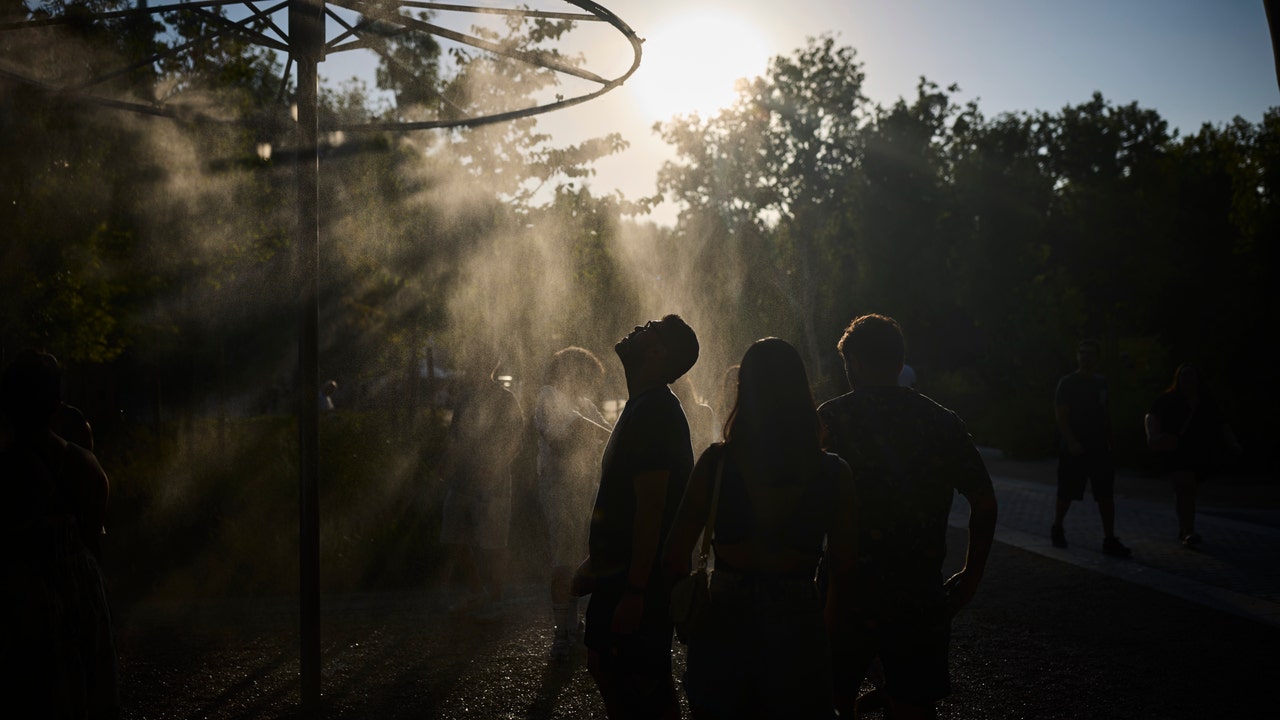
The fever to remove cement and give space to the green has spread. In Leuven (Belgium), according to the BBC 6,000 m² of concrete have been raised. Paris has considered removing 40% of its asphalt against heat peaks up to 50º waiting in the city at the end of the century. In July 2019 the city reached 42.6 degrees, its record. «Remove asphalt also serves to filter rainwater and avoid flooding … and favors biodiversity. There are good examples of projects in cities although it is pending to apply these solutions in a massive way, ”says Carles Ibáñez. The director comments on the appearance of climatic shelters in cities such as Barcelona or Valencia and warns that “in addition to interiors, exterior spaces must be enabled to house more people in case of extreme temperatures, more and more common. Either parks, gardens, street areas with well thought out to reduce insolation, where air currents are generated and water is sprayed. There is much to do in urban design, starting to forget the cement ».
A circular garden where the wind runs
The proposal of the Urban Ecosystem Architecture Study could be defined. Polinature is a hexagonal scaffolding structure covered with pots that have internal bubbles that generate wind and shadow. One of these mini gardens has just been installed at Harvard University. “The design has humidity, temperature, solar radiation, wind speed and air quality and, thanks to them, bubbles are activated that create an air stream,” explains Belinda Tato, associated teacher in landscape architecture at the Harvard Graduate School of Design and founder of this architecture study. Everything is fed with photovoltaic panels.