
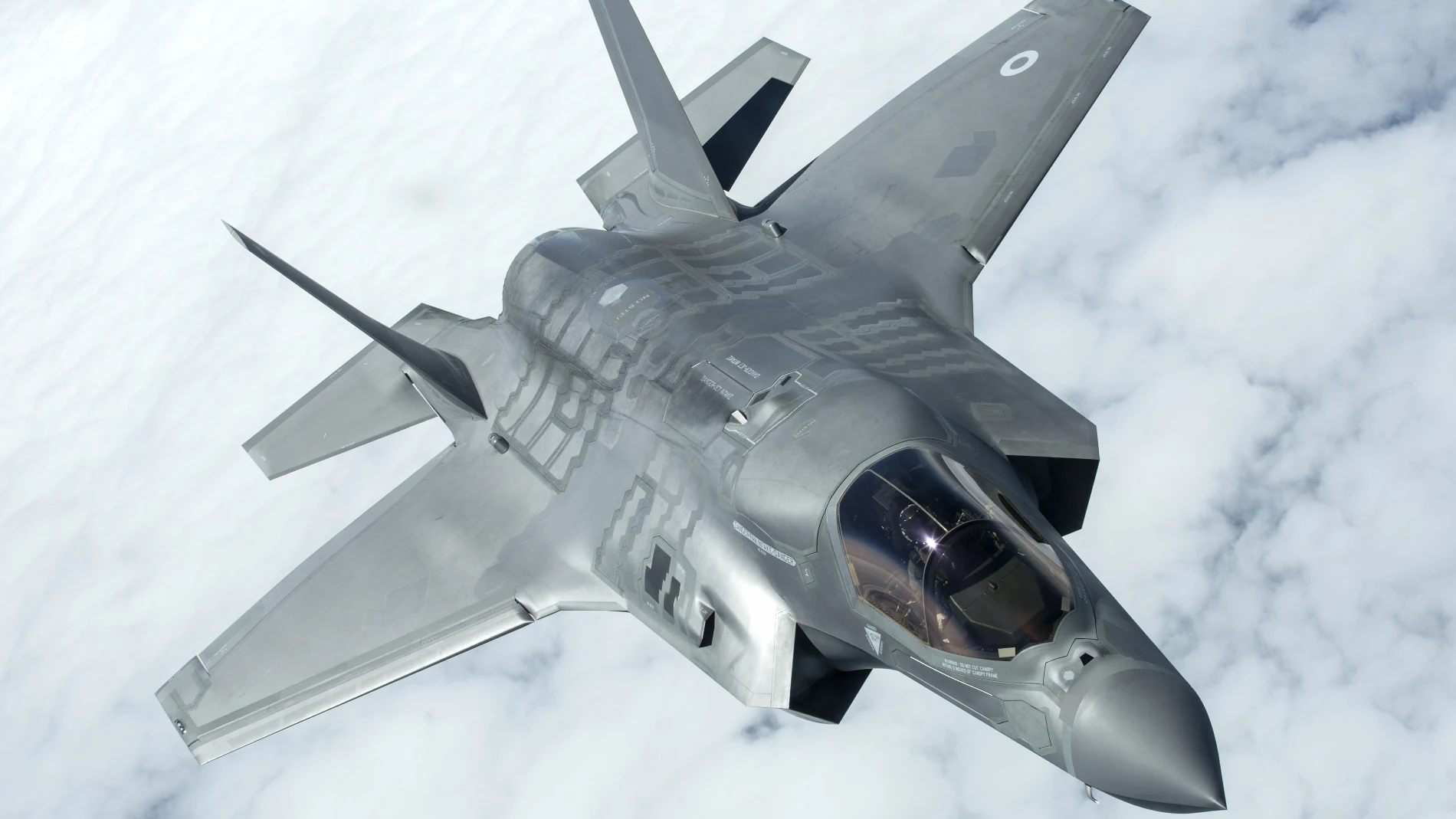
A fighter approaching at almost 2,000 kilometers per hour is not an easy target to find. Much less if it has been designed precisely to be difficult to detect. The American F-35 bases a good part of its survival on reducing its signature against conventional radars. But a team of Chinese scientists has proposed an alternative: instead of searching for it with radio waves, shining a laser on it and waiting for the tiny flash to come back. According to their calculations, a single-photon lidar system could detect it at 61.5 kilometers at night.
The figure comes from a study published in Aero Weaponry and has been led by Li Zhiyuan from the Chinese Airborne Missile Academy. The study does not describe a finished weapon nor does it demonstrate that a missile equipped with this sensor already exists. It is a mathematical model intended to study whether a lidar capable of detecting individual photons could be used as a search and tracking system against a stealth aircraft like the F-35C.
The principle is simple to explain. A lidar (acronym for Detection and Measurement by Light) It emits pulses of light and measures the time it takes for a small part of that light to return after reflecting off an object. With that information you can determine its distance and, depending on the system, reconstruct details of its shape. The difference in this case is in the sensitivity: The Chinese model uses a single-photon system, designed to extract information even when the light echo is extraordinarily weak.
To try to get closer to the limitations that a device installed on a missile would have, the Zhiyuan It used laser pulses of just 1 millijoule and a 100 millimeter diameter lens, in addition to a system that works at a wavelength of 1,064 nanometers. In the calculations Factors such as light transmission through the atmosphere, background light from the sky, atmospheric dispersion and noise produced by the detector itself were taken into account.
And that is precisely where the night appears. With the conditions used in the simulation, the system would reach a maximum detection distance of 27.7 kilometers during the day, while at night it could reach 61.5 kilometers. The difference has a fairly intuitive physical explanation: the less ambient light there is, the easier it is to distinguish a few photons from the objective among the background noise. It’s like trying to hear a coin drop on a table: it’s much easier in a quiet room than in a crowd. At 27.7 kilometers, the study authors calculate that The system could achieve a precision of about 20 centimeters in depth and a transversal resolution of approximately 50 centimeters. These are, again, computer-calculated results, not measurements obtained during a flight.
The choice of laser also has a reason related to the nature of the F-35. The stealth of the plane is especially aimed at reducing its radar section, so replacing radio waves with light opens a different way to try to locate it. The lidar also does not need to rely on the aircraft’s thermal radiation like a passive infrared sensor would: it sends its own signal and looks for the echo.
For now, the F-35 remains the same stealth aircraft. What has changed is the question posed by this study: Can even an aircraft designed to disappear under radar leave a small reflection when illuminated with light? The Chinese answer, for now, is mathematical. The next step would have to demonstrate it in the air.