
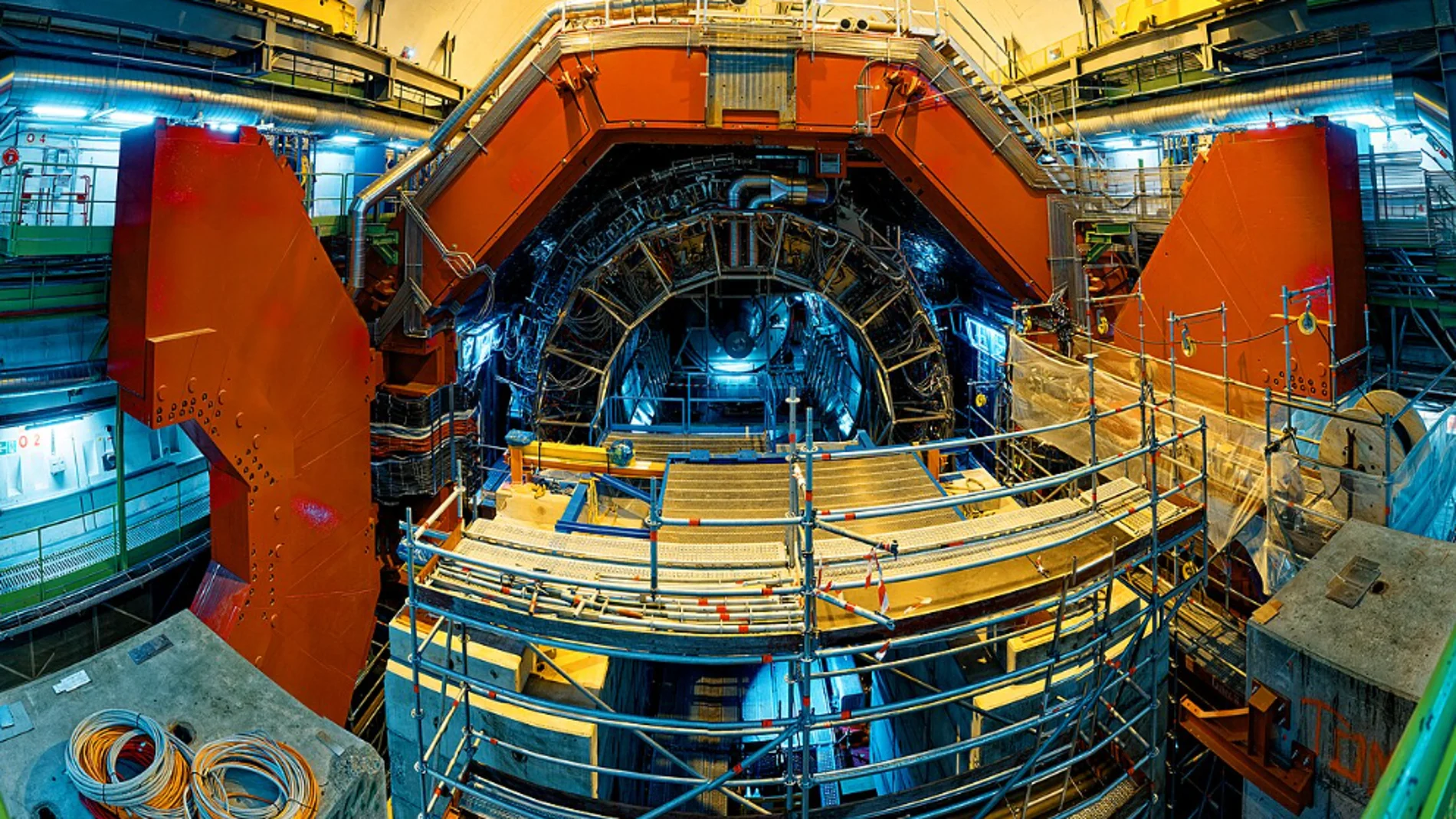
Inside an atomic nucleus, protons and neutrons are not stationary nor are they the most elementary particles we know. They are made up of quarks, linked by gluons, the particles that transmit the strong nuclear force. Now, CERN’s ALICE experiment has managed to look inside a nucleus with extraordinary precision and has found something unexpected: When the scale is reduced to regions of just 0.2 femtometers (two ten-thousandths of a billionth of a meter) gluons appear to stop behaving independently.
To achieve this, scientists at the University of Kansas studied the production of a particle called J/ψ. In LHC collisions, two lead nuclei pass very close without colliding. Its enormous electromagnetic fields generate photons capable of interacting with one of the nuclei and producing the J/ψ particle. This works like a probe: By observing how it is produced, scientists can obtain information about the distribution of gluons inside the nucleus. The key is that those responsible for progress, published in Physical Review Lettersthey can change the resolution with which they observe the nucleus. In this case they studied three scales: 0.6, 0.3 and 0.2 femtometers. The latter is equivalent to approximately a quarter of the diameter of a proton.
“Our experiments using incoherent production are like going from a blurry image to a high-resolution microscope,” explains Daniel Tapia Takaki, in a statement. By increasing the resolution, it is possible to observe smaller and smaller regions and study local gluon fluctuations.
And then the surprise appears. As energy increases, gluons tend to multiply. But the theory that describes the strong nuclear force predicts that at sufficiently high densities they can begin to recombine with each other. At that point, their number stops growing freely. This is what is known as gluon saturation.
An easy way to imagine this is to think of a room. As long as there are few people, introducing more does not change the situation much. But when it’s crowded, Each new person begins to meet the others and the behavior of the entire group changes.. Gluons could find themselves in a similar situation: so close together that their collective interactions begin to dominate.
That’s precisely what the new data suggests. The J/ψ production decreases significantly at the smallest scales studied. The suppression reaches a statistical significance of about three standard deviations and rIt is difficult to explain only through the so-called nuclear shadowinga conventional explanation in which gluons from different nucleons overlap and reduce the probability of certain interactions.
The results, however, follow a pattern similar to that predicted by gluon saturation models. “At these extraordinary scales we see evidence that gluons begin to behave collectively,” adds Takaki. It does not mean that known physics has stopped working or that a new particle has appeared. What Takaki’s team has found is something more subtle: by looking at the nucleus with sufficient resolution, gluons seem to enter a regime in which it is no longer enough to treat them as independent particles.
And understanding that behavior matters far beyond this experiment. The strong interaction and energy of gluon fields are responsible for a fundamental part of the mass of ordinary matter. Understanding how gluons behave inside nuclei is essential to understanding how matter acquires its mass and structure.
For now, the result is a clue, not a definitive sentence. But it is a clue obtained by looking where we have never been able to look with such precision: a place so small that, in there, gluons seem to stop behaving like individuals and start behaving like a crowd.