
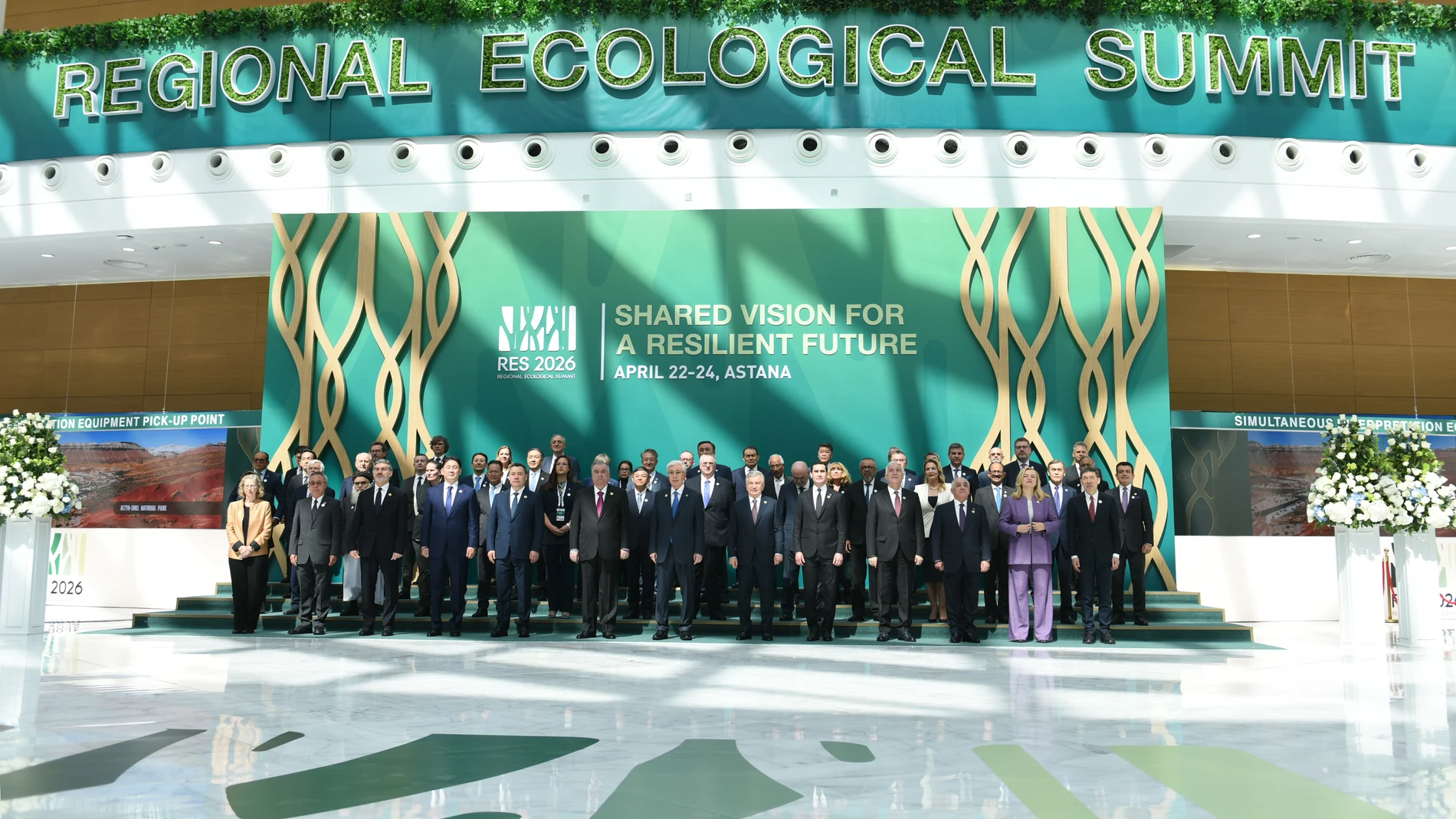
The Regional Ecological Summit 2026 (RES 2026), held from April 22 to 24 in Astana, has marked a turning point in the environmental agenda of Central Asia with the adoption of the so-called Astana Declaration of Ecological Solidarity. The document, supported by the heads of state of the region and associated countries, not only consolidates an unprecedented cooperation framework, but also places water at the center of the new regional and global geopolitical architecture.
The meeting, promoted by the president of Kazakhstan, Kassym-Jomart Tokayev, brought together leaders such as Mikheil Kavelashvili (Georgia), Sadyr Japarov (Kyrgyzstan), Serdar Berdimuhamedow (Turkmenistan), Shavkat Mirziyoyev (Uzbekistan), Emomali Rahmon (Tajikistan), Vahagn Khachaturyan (Armenia) and Ukhnaagiin Khürelsükh (Mongolia) configuring a political photograph that reinforces the will to move towards coordinated environmental governance in one of the regions most vulnerable to climate change.
However, the main milestone of the summit has not only been the signing of the declaration, but the formal launch of international consultations to the creation of an International Water Organization under the umbrella of the United Nations. This is an ambitious proposal that aims to transform the current “UN-Water” coordination mechanism into a specialized agency with real capacity for intervention and articulation of global policies.
The initiative responds to an increasingly evident reality: Water has become the strategic resource of the 21st century, especially in regions like Central Asia, where water systems are shared and tensions over their use can escalate quickly.
The Astana summit is part of this strategy, connecting regional priorities with international processes such as the next United Nations Water Conference, scheduled for December of this year in Abu Dhabi (United Arab Emirates).
«We meet in a moment of profound transformation within the United Nations system, marked by reform processes that are involving significant adjustments: reduction of programs, budget cuts and personnel restructuring. In this context, it is essential not to lose confidence in the role of the UN. On the contrary, it is necessary to strengthen its agencies and cooperation mechanisms, as well as strengthen coordination between its different structures, supporting a shared vision that allows it to respond more effectively to global challenges,” urged the chief technical advisor of UN-Water, Federico Properzi, during the discussion of the proposal within the framework of RES 2026.
The Astana Declaration reflects this approach by underlining the need to strengthen cross-border cooperation, restore critical ecosystems such as the Aral Sea and move towards green diplomacy based on mutual trust. It also incorporates a regional action program for the period 2026-2030, aimed at translating political commitments into concrete projects regarding water management, energy transition and environmental protection.
However, the path towards an international water organization is not without challenges. The very logic of this organization would imply that States give up part of their sovereign control over a strategic resource, a historically complex concession. The international response, although positive, has been cautious.
In his speech during RES 2026, the Under-Secretary-General for Economic and Social Affairs of the United Nations, Li Junhua, commented: “We look forward with great interest to the next United Nations Conference on Water, which will mark a milestone by placing this resource at the center of the international agenda, including at the level of the Security Council. Water is one of the most essential elements for life and acts as a fundamental link between the oceans and water supply systems. Translating our global goals into concrete water policies requires countries to closely monitor the changes underway. In this context, we trust that the upcoming debates at the United Nations level, especially in relation to the ocean sector, will promote more coordinated and effective action.
The creation of an International Water Organization could become the instrument that allows us to overcome historical fragmentation and move towards more effective governance. But its success will depend on key factors: sustained political will, institutional capacity, adequate financing and, above all, the willingness of countries to prioritize collective interest over national interest.
Europe and the Summit
European participation in the RES 2026 in Astana demonstrated strong – yet pragmatic – support for cooperation with Central Asia on sustainability. The European Union insisted that Shared major challenges, such as water, energy and climate change, require coordinated responses and based on the exchange of knowledge and technology.
The Italian special envoy for climate, Francesco Corvaro, stressed that Europe is in a position to provide technical expertise and solutions applicable on the ground, especially in a region where climate pressure is especially intense.
For his part, the EU special representative for Central Asia, Eduards Stiprais, highlighted that the summit consolidated the European commitment to an integrated approach, in which water, energy and climate systems are addressed together.
In this sense, the initiative “Team Europe” emerged as a key tool to strengthen policy coherenceimprove regional coordination and increase the impact of actions on the ground, supported by platforms such as the Environment and Water Cooperation between the EU and Central Asia.
Likewise, the European Union reaffirmed its alignment with the Paris Agreement, highlighting the need to intensify both mitigation and adaptation measures, as well as to update national commitments against climate change.
The summit made it clear that Europe seeks not only to accompany, but also to co-produce solutions with the Central Asian countries, in an increasingly strategic relationship that will continue, at least, until the next high-level meeting scheduled in Europe in 2029.
The RES 2026 has thus concluded that Central Asia has cooperation frameworks, but the challenge remains its implementation. Astana has not solved all the problems, but it has redefined the debate. It has elevated ecology from rhetoric to strategy and placed water at the center of the geopolitical agenda. If the commitments made can be translated into concrete actions, the 2026 summit could be remembered as the beginning of a new stage for Central Asia, in which environmental cooperation stops being an aspiration and becomes a tangible reality.