
There is questions that seem like a table game and end up being a crack in the way we understand the universe. In the same way that we are surprised to understand that we are stardust (the chemical elements that make up our body originated in supernovae) or that the universe is 13 billion years old, but its size is 90 billion light years (basically space is not limited by the speed of light), the measurements of the universe also have the ability to leave us speechless.
And, in this case, the question is direct: If we take the human body as a reference, are we closer, in size, to the smallest thing that exists or the largest thing that exists in the universe?
Intuition pushes in a very clear direction. We look at the sky, we think of galaxies, of impossible distances, of numbers with too many zeros. All of this seems so enormous that it is logical to conclude that we are much closer to the microscopic. That the infinitely large is, in some way, out of scale. And yet, the answer is the opposite.
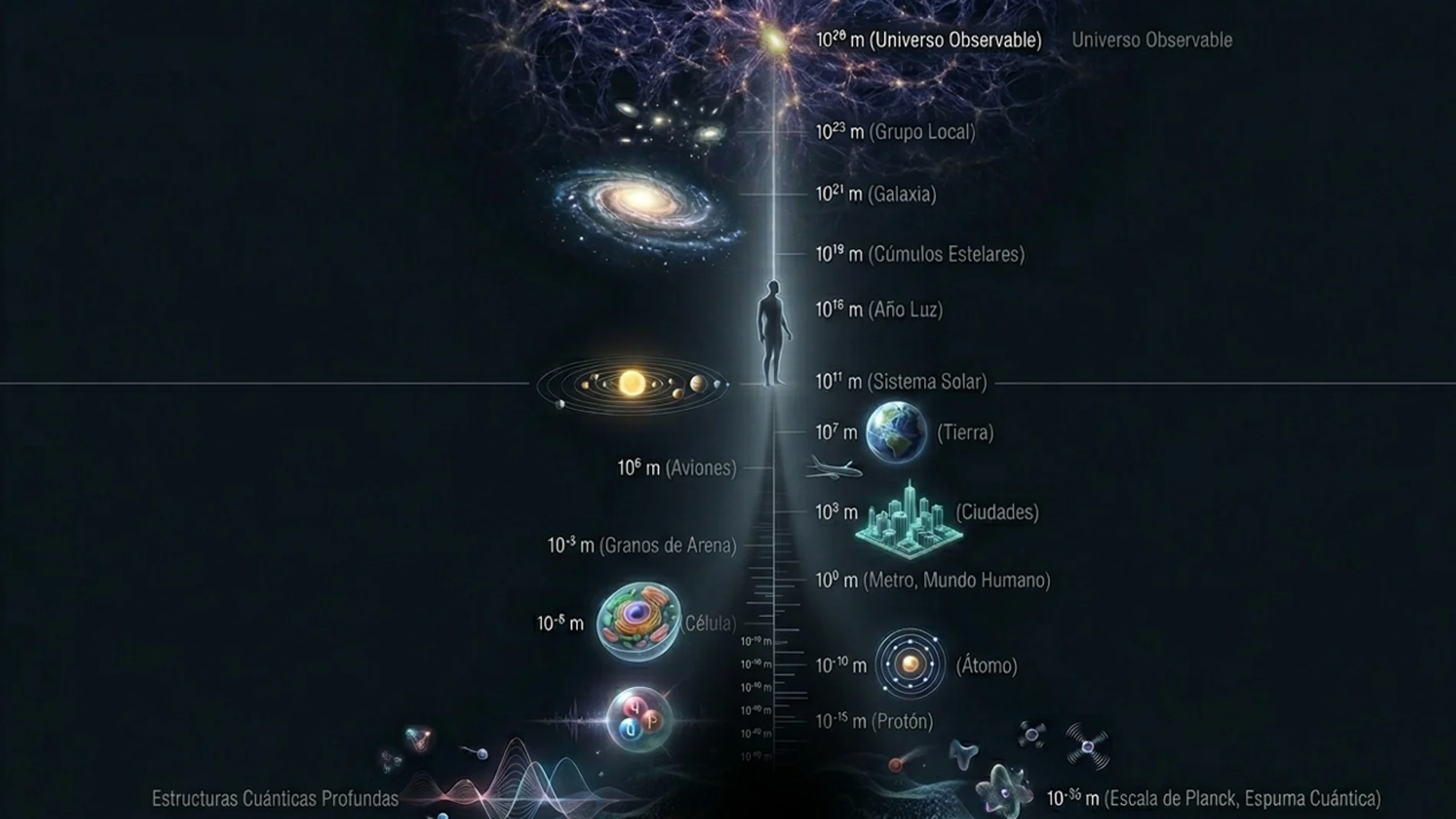
To understand why, you have to abandon images and start thinking in powers of ten, in that somewhat cold, but mathematically unambiguous way of measuring the cosmos. Suppose a human being is one meter tall. That will be our reference: 1.
If we go down to the small, the first important jump takes us to the cell, around one ten-thousandth of a millimeter: 10⁻⁵ meters. a little mtoyes below iston molesandasses: 10⁻⁹. Afterands the tovolumes: 10⁻¹⁰. And if we continue descending, we reach the norcleo ateithermonkey and, mtoyes theretoto the partsYosubat asseseithermicas, until we approach a bordereitherrich: the Planck length, about 10⁻³⁵ meters. It is, as far as we know, the scale mtos smallña with meaning fYosico
If we go bigger, the path is just as dizzying, but in the opposite direction. The Earth measures about 10⁷ meters. The Sun, 10⁹. The solar system extends to about 10¹³. Our galaxy, the Milky Way, reaches 10²¹ meters. AND The observable universe, the largest “everything” that we can access, is around 10²⁶ meters.
In short: between us and the mtoIf large, there is a distance of about 26 orders of magnitude, but with the smallest we are separated by 35 orders of magnitude. We are a billion times further from the minimum than from the maximum. How much is a billion on this scale? Approximately the number of seconds in 31 years. If we go to 35 orders of magnitude, we must talk about all the seconds in a thousand years.
It is a difficult idea to accept because it contradicts everyday experience. The big overwhelms us, the small seems close to us. But The scale of the universe is not designed for our intuition. It works in logarithms, not in sensations. But this, although surprising, is not the most interesting.
The middle point between the largest and the smallest is not on the human scale. If this “center” is calculated, the geometric mean between 10⁻³⁵ and 10²⁶— appears around 10⁻⁴ or 10⁻⁵ meters, compared to humans. That is, in the world of candlulas. That means in a nutshell that we are not the center of anything. We are displaced towards the big, between 10 thousand and one hundred thousand times.
We believe that we are the natural measure of the world: small enough to explore the tiny, large enough to encompass the immense. But the reality is different. We are creatures closer to galaxies than to the fundamental bricks of the universe.
Perhaps that is why particle physics is so elusive. Not only because it is complex, but because it occurs in a region of reality extraordinarily far from our natural scale. Understanding an atom requires a much greater conceptual effort than imagining a star, even if it is infinitely larger. Which means that The strangest thing in the universe is not in the distance, but in what is closest to us, although we cannot see it… Still.