
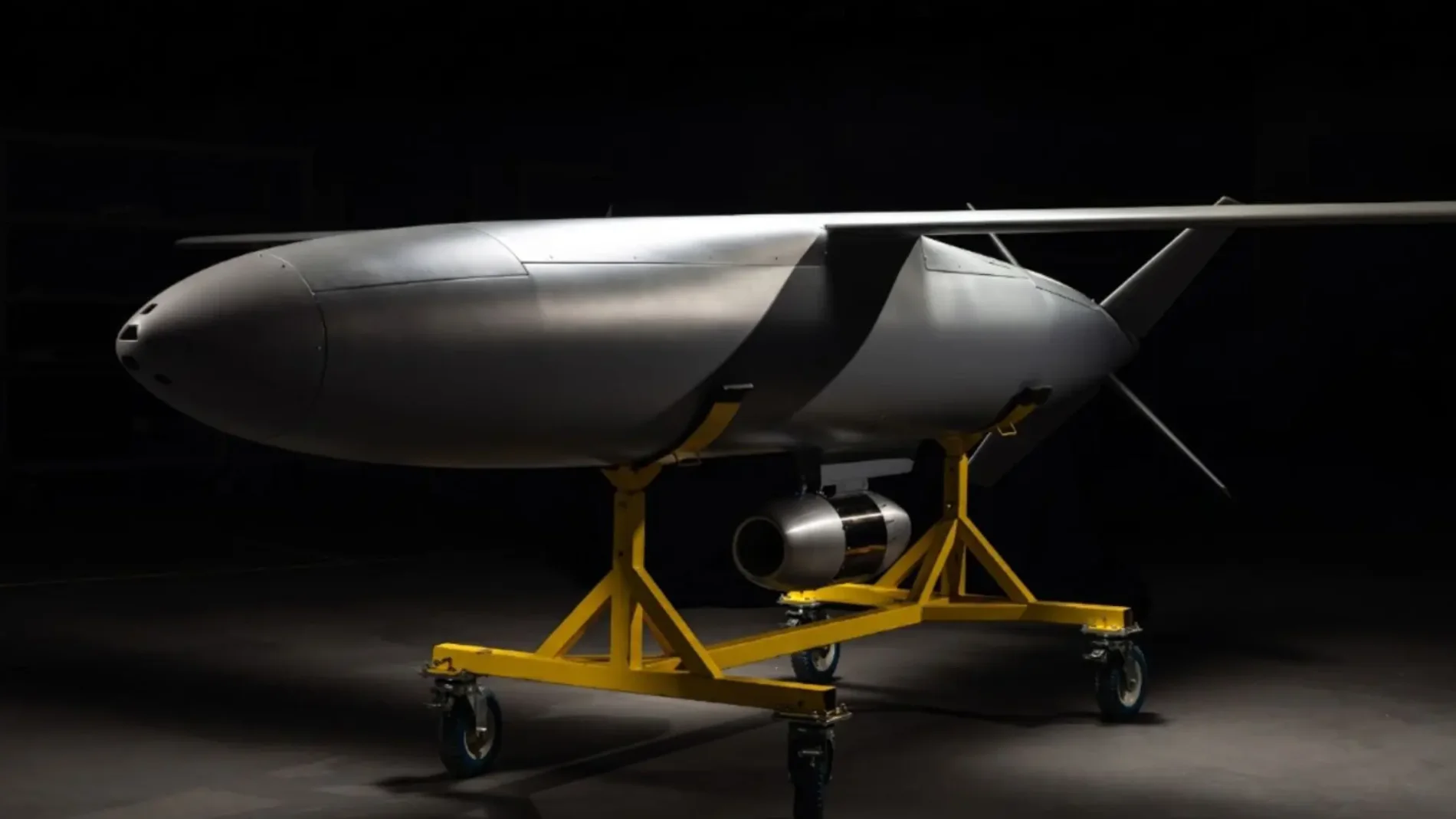
For decades, long-range cruise missiles have followed a fairly simple logic: the more sophisticated the weapon, the more expensive it is and the more limited its production. Anthem, the new system presented by the American company Covenant, aims to break that relationship. Your bet is not only on hitting targets at long distances with a heavy load, but on being able to manufacture the weapon in quantities that have hitherto been unusual for this type of system.
Covenant emerged this week from two years of near-secret development to unveil Anthem, a ground-launched cruise missile that, according to the company, can carry more than 200 kilograms of payload. The company has not officially revealed its maximum range, although some information places it around 1,500 kilometers. What it has confirmed is that the system has carried out more than 200 test flights during the last year.
The missile’s architecture combines two propulsion systems. To leave the launcher, a solid fuel rocket motor is used, which provides the necessary thrust during the initial phase. Once in cruise flight, a jet engine designed to use heavy fuel comes into operation. This combination allows us to separate the needs of the two phases of the flight: a large amount of thrust for launch and efficient propulsion during long-distance travel.
But perhaps Anthem’s most important feature is not its engine or its payload. It is in a much less spectacular figure: 5,000. Covenant has opened in Texas a facility of about 9,750 square meters in which it plans to begin serial production during the first quarter of 2027 and reach a capacity of approximately 5,000 missiles per year. The company also has facilities in Germany and Israel and intends to use these factories to expand production and supply allies.
The reason for this strategy lies in a lesson that recent wars have made especially visible: an army can have extremely sophisticated weapons and still run out of them. Precision missiles are consumed much faster than traditional industries can replace them.
Covenant has designed Anthem around that problem. The company says it wants to offer a long-range, high-payload weapon at a fraction of the price of comparable legacy systems. To achieve this, it relies on a supply chain different from the traditional one. Anthem uses numerous commercial off-the-shelf components, while Covenant has established long-term agreements for other critical elements. lThe idea is to reduce bottlenecks that appear when each missile depends on parts manufactured specifically for the military industry.
To this we must add the software. Covenant has developed its own mission planning and command and control tools to coordinate launches. That is, Anthem is not conceived solely as a projectile, but as part of a system that allows its use to be planned and managed.
The company has already secured approximately $150 million in contracts, including research, development, qualification and production agreements. The US Army is working with Covenant through an agreement to accelerate testing and qualification of the system, while the Navy’s Rapid Capabilities Office has contracted the development of a naval version. This last program is around 70 million dollars and intends to adapt Anthem for use from maritime platforms.
The other big bet is in Europe. Covenant has a facility of approximately 10,200 square meters in Saxony, Germany, supported by a European supply chain. The company claims that More than 95% of the components destined for European production come from Europe and aims to progressively eliminate non-European elements.
All of this makes Anthem more than just a new cruise missile. It is an attempt to solve one of the most difficult problems of modern warfare: how to have precision weapons capable of reaching far, carrying a considerable load and, at the same time, be produced quickly enough so that the arsenal does not disappear after a few weeks of combat.
The name Anthem, “anthem,” may seem strange for a weapon. But its real message is in another word that appears again and again in the company’s plans: scalability. It is not about making a few extraordinarily expensive missiles. It is about manufacturing thousands. And in a protracted war, that difference can be as important as the kilometers each one is capable of traveling.