
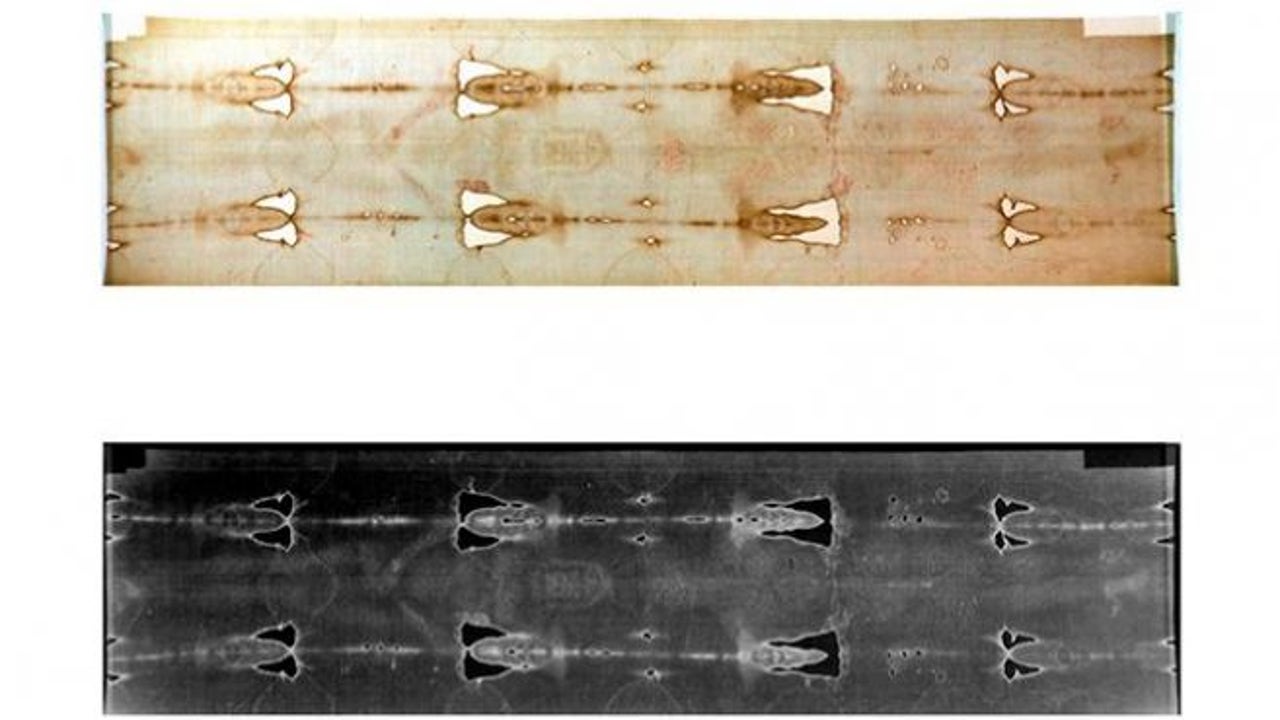
The Holy Southeet of Turin, which shows the image of a man with brands and physical traumas of a crucifixion, is one of the most controversial Christian relics in the world. The controversy over its date and the brands it presents has led to innumerable investigations on the Holy Sable that, for Christians, wrapped the body of Jesus Christ after his death has more than 2,000 years.
Faced with the theory that this 4.42 -meter long linen
The radiocarbon dating carried out in a 1989 study on the Holy Southeet of Turin dated it between 1260 and 1390, which coincides with medieval theory. Subsequently, in 2005, a team led by Raymond Rogers argued that the show analyzed by radiocarbon dating came from an area that had been repaired and, therefore, was more recent than the original fabric.
The last controversy has emerged after a recent analysis carried out by three -dimensional modeling that states that this fabric would not have covered a real human body, but would have been molded on a figure in bas -relief, probably as part of a medieval artistic representation.
Another study, carried out in 1998, determined that Jesus’ body was washed before his burial. That report ensures that the vast majority of blood stains in the Holy Southeet corresponded to post -mortem blood that had supposed wounds due to body washing.
Now, an investigation carried out by Kelly Kese, immunologist at Johns Hopkins University, demonstrates not only that the trustee covered a human body but that corpse presented characteristics that coincide with the way of burying in the time of Jesus and with the Scriptures.
Burial without washing the body
According to Jewish funeral customs, The bodies could not be washed before their burial and, in addition, the Bible says that Jesus’ body was only involved in spices.
Through ultraviolet photography, Kese analyzed human blood samples in post -mortem conditions, such as reduced coagulation and high acidity, and how it is transferred to the fabric.
Thus, his investigation, published in the Sciencepg, has established the presence in the Holy sheet of authentic blood components from wounds and They have demonstrated the existence of numerous serum edges, indicating the transfer to the crusher of fresh blood and in a gelatinous state, or dry and that was re -rexdied in the humid environment of a grave in a cave.
And it is that these halos or serum edges are only formed if the blood began to coagulate before touching the fabric, which shows that the blood came directly from fresh and unwashed wounds.
In the event that the wounds had been washed, Coagulation inhibition prevents serum edges in blood spotsobservation incompatible with what is obtained in the holy sheet. In addition, the “washed” blood dries but rarely coagulates, which makes that transfer impossible. However, the direct emission of the blood of the wounds make the transfer possible even hours after the death.
Therefore, the data published now indicate that It is unlikely that the main blood transfer mechanism implied body washing and the subsequent post mortem emission of the wounds.