
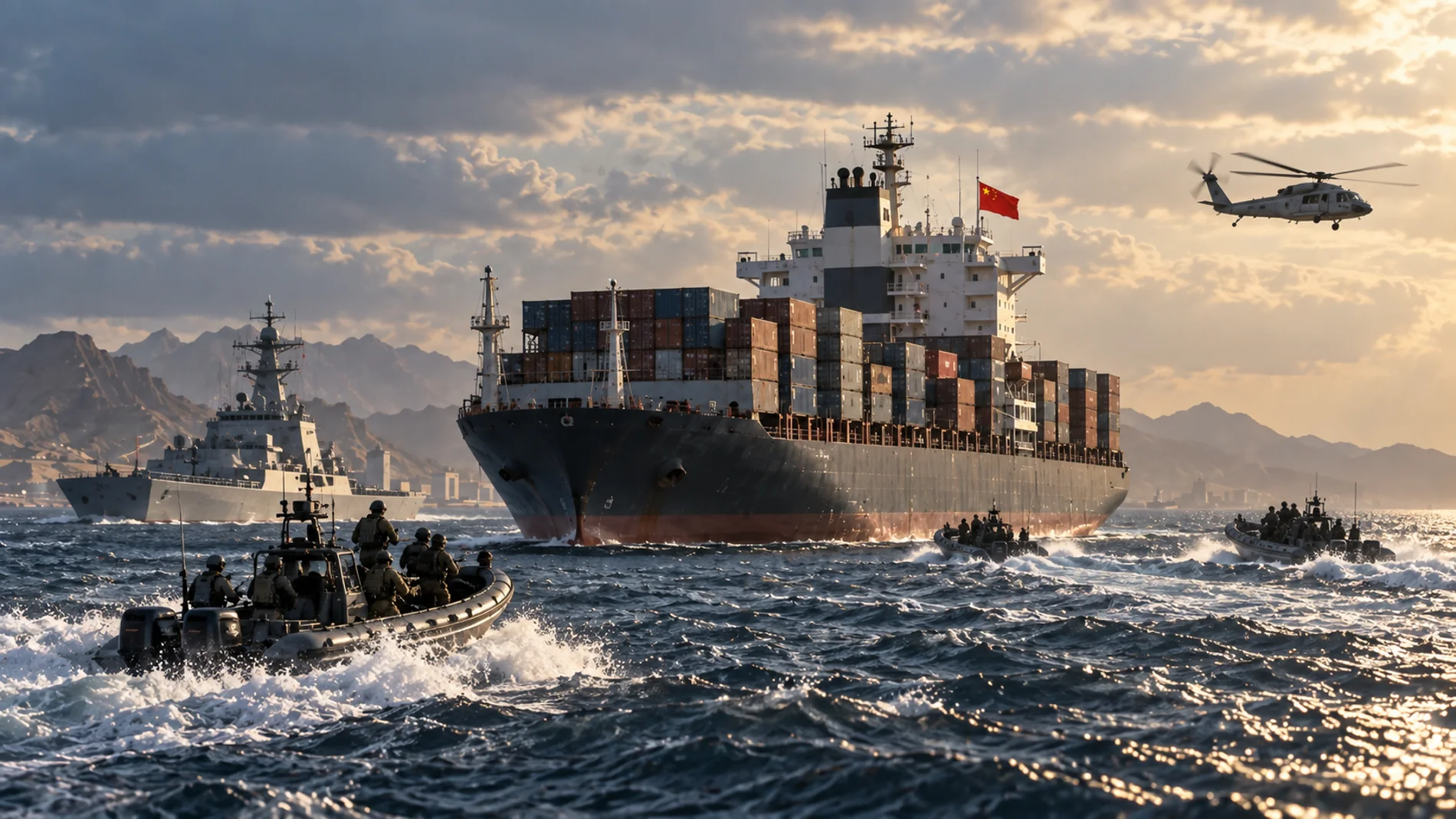
USA nearly intercepted and boarded a Chinese ship after it an artificial intelligence will mistakenly identify its cargo as components destined for a nuclear weapons program. The error ended up included in an official intelligence report and went far enough for the US military to They will begin to prepare the operation.
The incident occurred during the spring and has now been revealed by CNN based on the testimony of four people familiar with what happened. An analyst of United States Special Operations Command was studying information related to the cargo manifest of a Chinese ship passing through the Middle East when decided to turn to a chatbot to help with the analysis.
The tool combined information obtained from open sources with classified signals intelligence stored in US Government systems. From this data, the AI concluded that the ship was transporting materials related to a nuclear weapons program, but the conclusion was false.
The problem did not end with the chatbot’s incorrect response. The analyst then used AI to convert his findings into a conventional intelligence report that was distributed through regular channels.. The information thus acquired the appearance of an official document without sufficient verification of how the tool had reached that conclusion.
The reaction of the US Army shows how far the error went before being detected. According to sources consulted by CNN, There were armed personnel preparing to board the ship and US military aircraft were already in the air to support the operation..
The intervention was canceled when those responsible discovered that the chatbot used to prepare the report had ‘incorrectly identified the material the ship was carrying’. One of the sources described the document as ‘completely false’ and assured that the incident ‘almost started a war’.
The episode also shows that Keeping a person in the decision process is not necessarily enough to avoid AI errors. There was human intervention in all phases, but the false information passed from the chatbot to the analyst, then to an official report and finally to those responsible for preparing a military operation.
One of the difficulties in detecting this type of hallucinations is that they can mix with true information. In this case there really was a ship, a cargo manifest and intelligence data on its trajectory. The error was in the interpretation made by the system.
The case has also put the spotlight on the procedures used by the Armed forces Americans to verify information generated with AI. According to CNN, there is currently no single verification standard that applies to all military branches. Different units may use different models and follow their own internal rules.
The military accesses these tools through GenAI.milthe secure generative AI platform that the Pentagon launched in December 2025 to make business models available to military and civilian personnel. It started with Geminiof Googleand since the end of August it also offers Grokof xAIand ChatGPT Milof OpenAIall adapted to work within the Department’s protected infrastructure. Outside of GenAI.mil, Claudeof Anthropichas also been widely used in classified military and intelligence networks for tasks such as intelligence analysis, operational planning, simulations, and cybersecurity operations.
Dependency on these tools is increasing at the same time that these types of problems appear. The United States takes several years introducing artificial intelligence in tasks of analysis, planning and preparation of military documents, with the aim of processing more information and accelerating decision-making.
Precisely that speed can become a problem when conclusions are not verified before acting. One of the sources consulted by CNN summarized the risk with a simple phrase, ‘AI allows us to get to a bad idea faster’.