
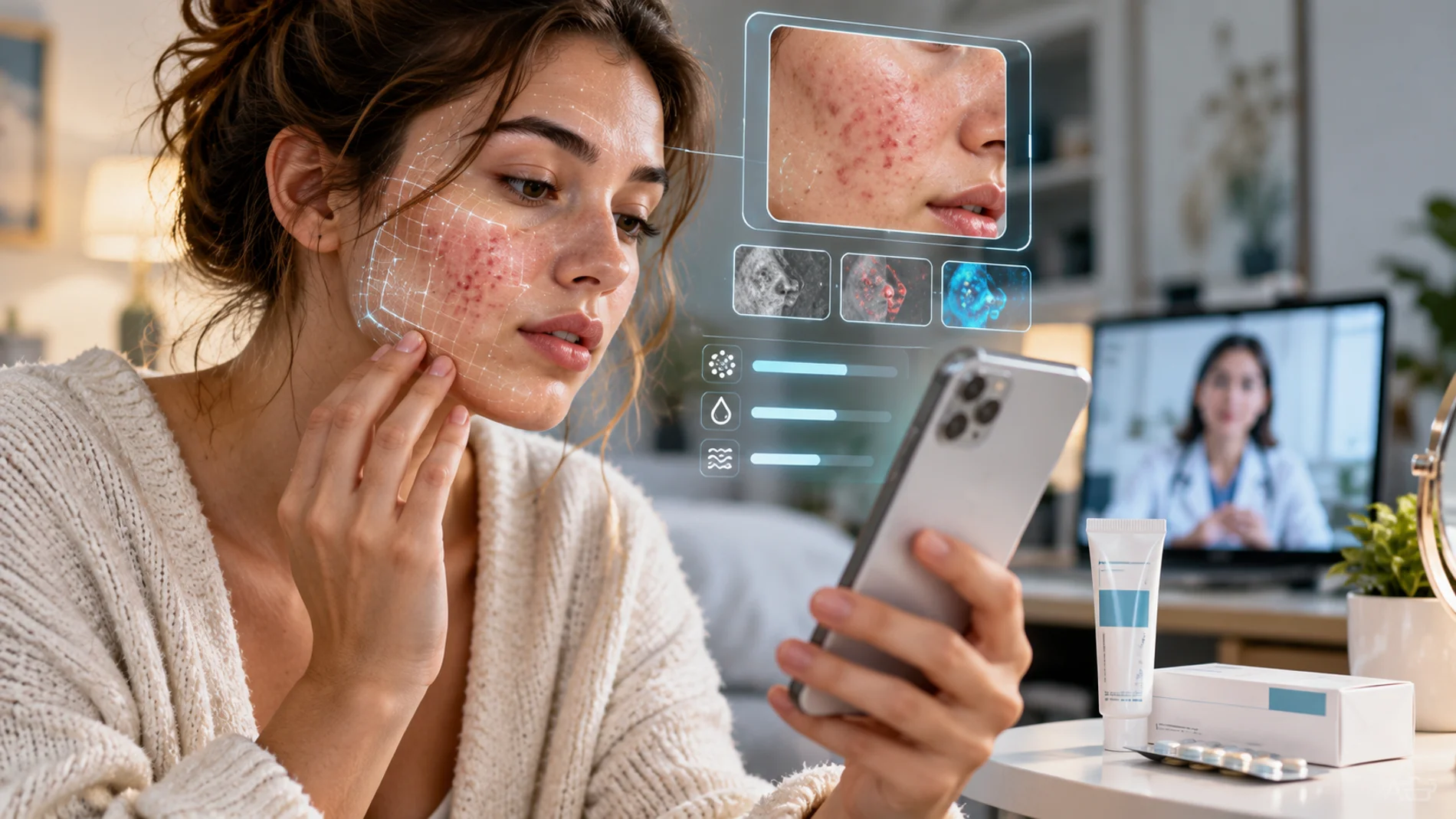
Artificial intelligence is already used to help doctors diagnose diseases or decide on treatments, but Utah has taken a much more delicate step forward. The US state has authorized a pilot program for the company Nolla Health in which An AI will be able to issue a first medical prescription without a doctor having to previously approve it. For now, it is limited to the treatment of mild or moderate acne in adults.
In a conventional telemedicine consultation, software can be used to collect symptoms, analyze images or assist the professional, but it is still a doctor who decides what prescription. The Nolla Derm application is designed to make that decision within very specific limits and refer the case to a doctor when you cannot act with sufficient safety..
To access, Utah patients 18 years or older must fill out a questionnaire, verify your identity, and scan your face from multiple angles. AI analyzes images along with clinical information and select one of the treatments previously approved by doctors. You cannot make them up or choose freely among all available medications and situations such as severe acne, pregnancy, or certain medical conditions. force you to stop the process and turn to a professional.
‘AI cannot improvise. You can only choose from a short list of doctor-approved topical treatments. The moment a patient falls outside those limits, they stop and refer them to a doctor,’ explained the Nolla Health medical advisor, Zaid Fadul.
The service does not offer complete autonomy from day one, but rather introduces it gradually. During the first phase, two Utah doctors will review and approve all prescriptions for the first 100 patients before they are shipped. In the second, the following 500 patientsthe AI will be able to start prescribing on its own and the cases will be reviewed daily, while in the last phase the control will be reduced to a sample of at least the 10% of prescriptions every week and in all cases with side effects or requiring additional intervention.
To move from one phase to the next, Nolla must reach at least 95% agreement with doctors and not record serious adverse events, in addition to obtaining written authorization from the state. The company itself ensures that professionals currently agree with the recommendations of its system in more than 96% of real cases and that discrepancies are usually limited to issues such as modifying the concentration of a topical treatment.
The program works through a subscription $4.99 monthly because the service does not end when the first prescription is issued. The application allows you to perform periodic scans to follow the evolution of the skin, review and adapt the treatment and contact directly a licensed doctor without paying an extra fee. Medications can be received at home or picked up at a pharmacy.
Acne might just be the first testing ground for this model. Fadul considers that other skin diseases such as rosacea would be a natural extension and it also mentions the flu and uncomplicated urinary infections among conditions that could be studied in the future, provided there are clear boundaries and sufficient objective data.
‘Medicine is not simply about matching symptoms with treatments. Ideally, AI will relieve doctors of more of the routine work so we have more time to focus on the patients and decisions that really need us.‘, says Fadul. Nolla’s medical director believes that within a decade these systems could handle an important part of the most routine care, although he believes that serious diagnoses, higher-risk medications and ambiguous cases should continue in the hands of doctors.