
There is a temperature at which one stops thinking about ice and starts thinking about fire. At 100ºC, water boils. At 1,000ºC, any puddle has long since turned into steam. And at more than 2,000 ºC, common sense tells us that water should have stopped being water to become, to a large extent, a mixture of atoms and particles. But common sense has never been inside Uranus.
A team of scientists, led by Alexis Forestier, a physicist at the Atomic Energy and Alternative Energies Commission in Paris, has observed a new form of ice in conditions so extreme that they seem like a contradiction: solid water at more than 2,000 ºC. The experiment reached 2,630 kelvin, equivalent to about 2,357 ºC, and a pressure of 219 gigapascals, more than two million times the atmospheric pressure at the Earth’s surface. The results, published in Physical Review Lettersreveal an ice structure that had been theoretically predicted but until now had not been unequivocally observed.
The key to this “ice” is in one word: pressure. When we heat water on Earth, its molecules acquire energy, separate, and the liquid ends up turning into vapor. But if at the same time we compress the water with extraordinary force, the behavior changes. The pressure prevents the particles from separating as they would under normal conditions and forces the oxygen atoms to stay extraordinarily close together.
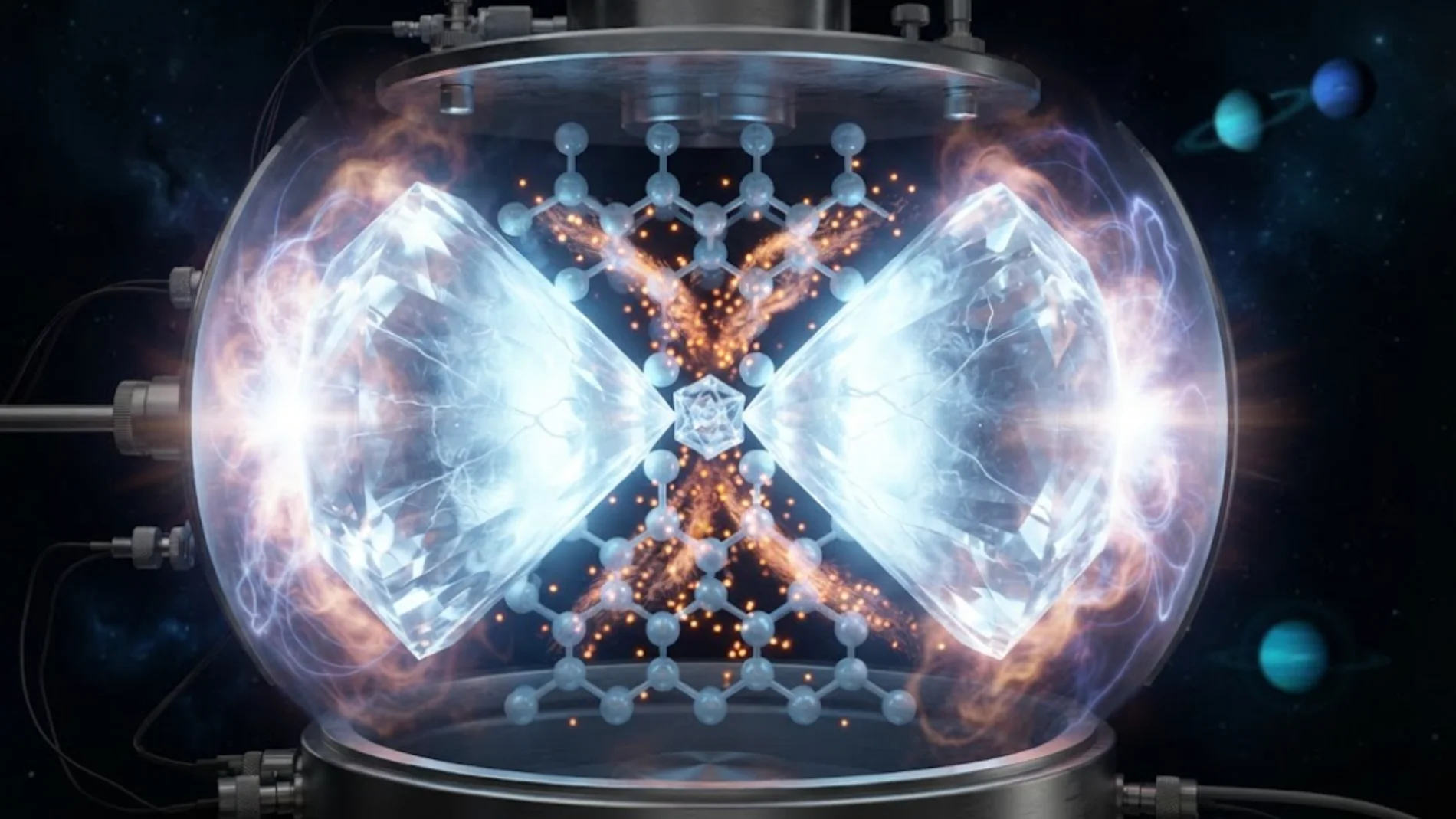
To reproduce something similar to what can happen inside the so-called ice giants, Forestier’s team introduced small samples of water between the tips of two diamonds. These devices, known as diamond anvil cells, allow tiny amounts of matter to be compressed to unimaginable pressures. They then used lasers to raise the temperature and an X-ray beam from a synchrotron to observe how the atoms organized. What they found was a structure known as hcp, which stands for hexagonal close-packed (or compact hexagonal structure). It is not an ice that looks like the cube we put in a drink. The name only describes how the oxygen atoms are arranged in the crystal lattice.
The discovery is even more strange because this form of ice appears within a state of matter known as superionic. Something happens in it that seems impossible if we think about everyday ice.: oxygen atoms remain relatively fixed, forming a solid structure, while hydrogen nuclei can move through it with much greater freedombehaving in a liquid-like manner. It is, in a certain sense, a material that combines characteristics of a solid and a liquid.
The authors of the study observed that, as pressure and temperature increased, the hcp structure gained ground against another known form of superionic ice, called fcc, (face-centered cubic structure). TO 155 gigapascals and 1,727 ºC a mixture of both structures appeared. TO 197 gigapascals and 1,977 ºCthe signal corresponding to hcp ice was much more evident. Finally, to 219 gigapascals and 2,357 ºCthe hcp structure clearly dominated while the fcc ice signal practically disappeared., the hcp structure clearly dominated while the fcc ice signal practically disappeared.
The phenomenon is not just a laboratory oddity. It can help understand what happens inside Uranus and Neptune. Both planets are called ice giants. although the word “ice cream” is misleading if we associate it with low temperatures. At its depths, the combination of pressure and temperature can generate states of matter that do not exist naturally on the Earth’s surface. Superionic ice is one of them and is considered a possible component of its interiors.
And here a particularly interesting consequence appears. Superionic water can conduct electricity, because the hydrogen nuclei are free to move through the oxygen structure. This ability could be related to the generation of the magnetic fields of Uranus and Neptunewhich are extraordinarily strange: they are inclined with respect to the axis of rotation of the planets and have a much more irregular geometry than that of the Earth’s magnetic field.
The new hcp structure could force us to revise some models of how matter and electrical charge move inside these worlds. If its electrical conductivity turns out to be different from that of fcc ice, it could also change our understanding of how those magnetic fields are generated. But Scientists still do not know precisely all the properties of the new ice and they point out that new experiments and theoretical calculations will be necessary to determine its stability, electrical conductivity and mechanical behavior.
There is, furthermore, a small irony in the discovery. The researchers reviewed previous experiments and found that an X-ray diffraction signal observed above 130 gigapascals probably already corresponded to hcp ice. The ice was there; They just didn’t know how to recognize it yet. The new study suggests that above about 200 gigapascals, this structure could become the most stable form of superionic ice.
So yes: we can say that they have created ice at more than 2,000 ºC. But the real story is even more fascinating. They have shown that, when the pressure reaches levels typical of the interior of a planet, the temperature is no longer sufficient to tell us what state the water will adopt. On Earth, ice melts when we heat it. In the depths of Uranus and Neptune, perhaps water has another answer. It’s not that the ice has defeated the heat. The thing is that, under planetary pressure, ice stops obeying our intuition.