
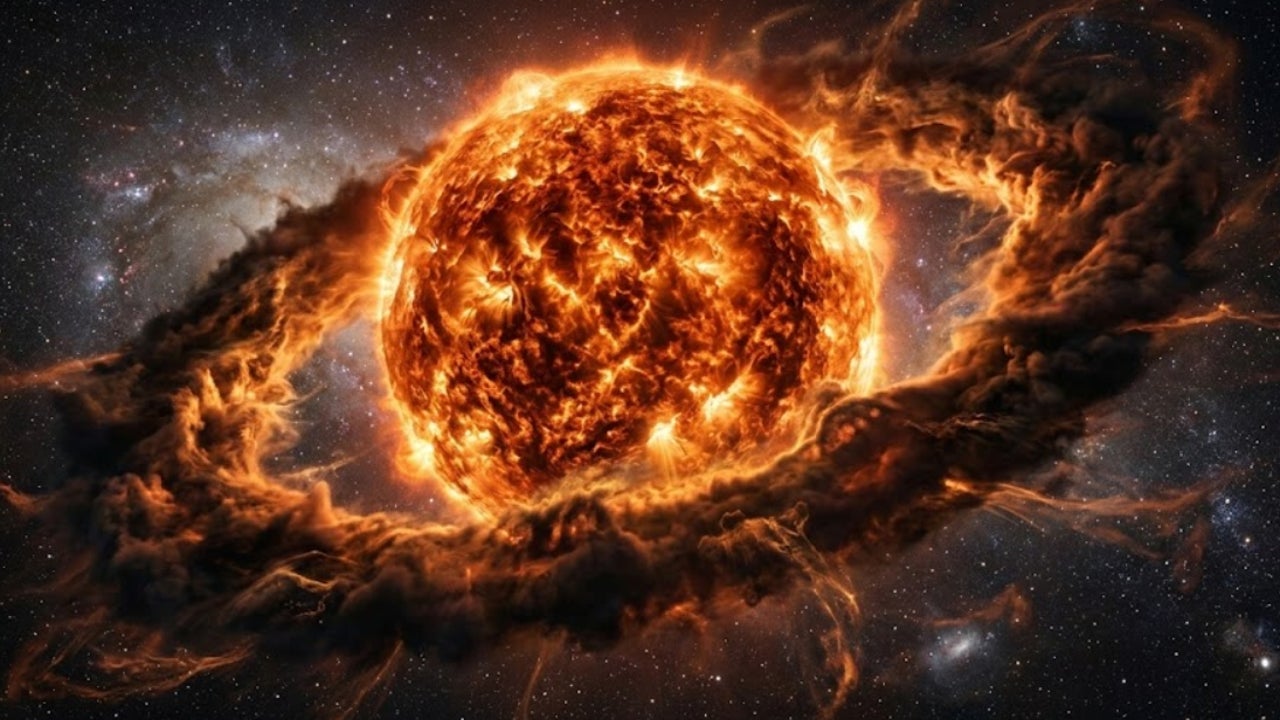
It was not a cinematic blockbuster but rather nature itself that offered a visual and scientific spectacle: A monster star (WOH G64), about 1,500 times larger than our Sun, has suffered a spectacular collapse that scientists have observed directly from Earth.
These types of events are not only impressive in their magnitude, but they also help us better understand how giant stars are born and die, the most energetic cosmic explosions, and the ingredients that forge heavy elements in the universe.
In this case WOH G64, about 160,000 light years away, was a red hypergiant, a type of extremely massive and luminous star. who is in the final phases of his life. If we brought it to our solar system, it would be large enough to enter Jupiter’s orbit.
Red hypergiants are rare in the galaxy and live fast and die young in cosmic terms: they consume their nuclear fuel so intensely that their short lifespan is reduced to a ten million years, while those similar to our Sun extend about 10,000 million years. But what has made this case unique is that astronomers have captured the very moment when this enormous star began to collapse and disperse its material into space, a phase that can precede a supernova or other types of high-energy stellar explosions. And we have seen it. Live.
An international team of astronomers, led by Gonzalo Muñoz-Sánchez, was analyzing the star for signs of instability when they detected a dramatic change in its brightness and the characteristics of its light spectrum. The exciting thing is that The event was captured “live”, that is, in almost real time for the scale of the phenomenon, thanks to a combination of observations from the ground and cutting-edge telescope technology.
Taking into account the distance that separates us from WOH G64, the light we receive from it means that What we are seeing is a story written a long time ago, although within reach of our eyes and technological sensors right now.
When a massive star like this exhausts the nuclear fuel that powers its core, It can no longer hold itself against the gravitational force that tends to collapse it. In many massive stars, this collapse gives rise to a supernova, an explosion so powerful that it can shine brighter than an entire galaxy for days or weeks.
In the process, The star generates and expels heavy elements (iron, gold, silver) that do not form in calm environments like that of our Sun. These elements are part of the materials that, billions of years later, form planets, moons and even components of life. In that sense, stellar explosions are the factories of the universe.
The analysis of the event, published in Nature, details that this star has not only suffered one of those final collapses, but that Its behavior before the explosion is offering unprecedented data on the internal physics of extremely massive stars.
One of the big questions of astronomers is whether this hypergiant will explode in a true supernova visible from Earth with the naked eye. Muñoz-Sánchez’s team points out that we are seeing signs of extreme instability that could precede a supernova by years or decades, but the exact timing cannot be precisely predicted.
“We conclude that WOH G64 is a binary symbiosis systemeithermassive and unusual atticorn where the red hypergiant has transitioned to a yellow hypergiant – the study concludes -. This drtostatic transformationeithern can be explained by the ejectioneitherpartial n of the pseudoatmeithersphere during an envelope phaseorn or by the return to a state of rest after an eruptioneitherexceptional n of mtos from 30 toñdurationeithern. WOH G64 offers the opportunity to observe the evolutioneither“n stellar in real time.”
What is clear is that capturing the phase prior to a large-scale stellar explosion offers a unique scientific opportunity. So far, most supernovae are detected after they have already occurred and the star has disappeared. But Observing the previous moments, knowing how a giant star behaves just before its death, is like having a live record of the end of a stellar life.