
Sometimes, to discover something billions of miles away, you don’t need to send a spacecraft. It is enough to look very closely at a grain of dust that has reached the Earth. That’s what a team of scientists has done by analyzing microscopic particles collected in the stratosphere. Its composition contains an unexpected clue: They come from a region beyond the giant planets and preserve traces of a reservoir of water with an unusual ratio of oxygen isotopes. The discovery, published in Science Advancesprovides some of the strongest evidence yet that the outer solar system hosted a large reserve of water enriched in heavy oxygen.
To understand the importance of the discovery, we must stop at an element that seems to have no secrets. Oxygen has different versions, called isotopes, that have the same number of protons, but a different number of neutrons. The most abundant on Earth is oxygen-16. There are also oxygen-17 and oxygen-18, which are heavier because they contain one and two additional neutrons.respectively. They are all stable, non-radioactive and participate in the same chemical reactions, but their proportion can vary depending on the place and conditions under which they were formed.
In the water we know, oxygen-16 is predominant. However, Models about the birth of the solar system have long suggested that, in its most distant regions, water relatively enriched in oxygen-17 and oxygen-18 could have existed.. The difficulty was finding unequivocal evidence of that reservation. Meteorites offer some clues, but they are rare samples and it is not always possible to determine precisely which region they come from.
The authors, led by Lindsay Keller, have looked for an alternative in interplanetary dust: they examined 12 particles collected in the Earth’s stratosphere, where some grains arrive from space that survive passage through the atmosphere. They were not just any particles: they had a high density of microscopic marks produced by energetic particles from the Sun. These footprints allow us to estimate how long they have been exposed to solar radiation and, due to their abundance, relate them to objects in the Edgeworth-Kuiper belt.the region of icy bodies that extends beyond Neptune.
The analysis revealed that the particles studied mainly contained hydrated minerals, that is, materials that had reacted with water. Among them were phyllosilicates, clay minerals that form when certain rock materials come into contact with fluids. Iron and magnesium carbonates also appeared. Its composition and structure allowed us to reconstruct the conditions in which they had been formed: reactions between mineral materials, carbon dioxide and water at very low temperatures.
But the decisive clue was in the isotopes. By measuring the oxygen composition of these minerals and comparing it with that of their possible source materials, the scientists were able to estimate what characteristics the water that had participated in the reactions must have. The result pointed to a high concentration of oxygen-17 and oxygen-18. According to the team’s calculations, The original water had an isotopic composition very different from that which characterizes much of the materials in the inner solar system.
Keller’s team maintains that these particles provide “direct evidence for the presence of a significant reservoir of heavy water in the outer solar system,” which would have remained largely isolated from materials from the interior regions. The expression does not mean that they have found a mass of liquid water floating in space. It refers to water incorporated into ice and minerals from frozen bodies, whose composition preserves the isotopic signal of that reserve.
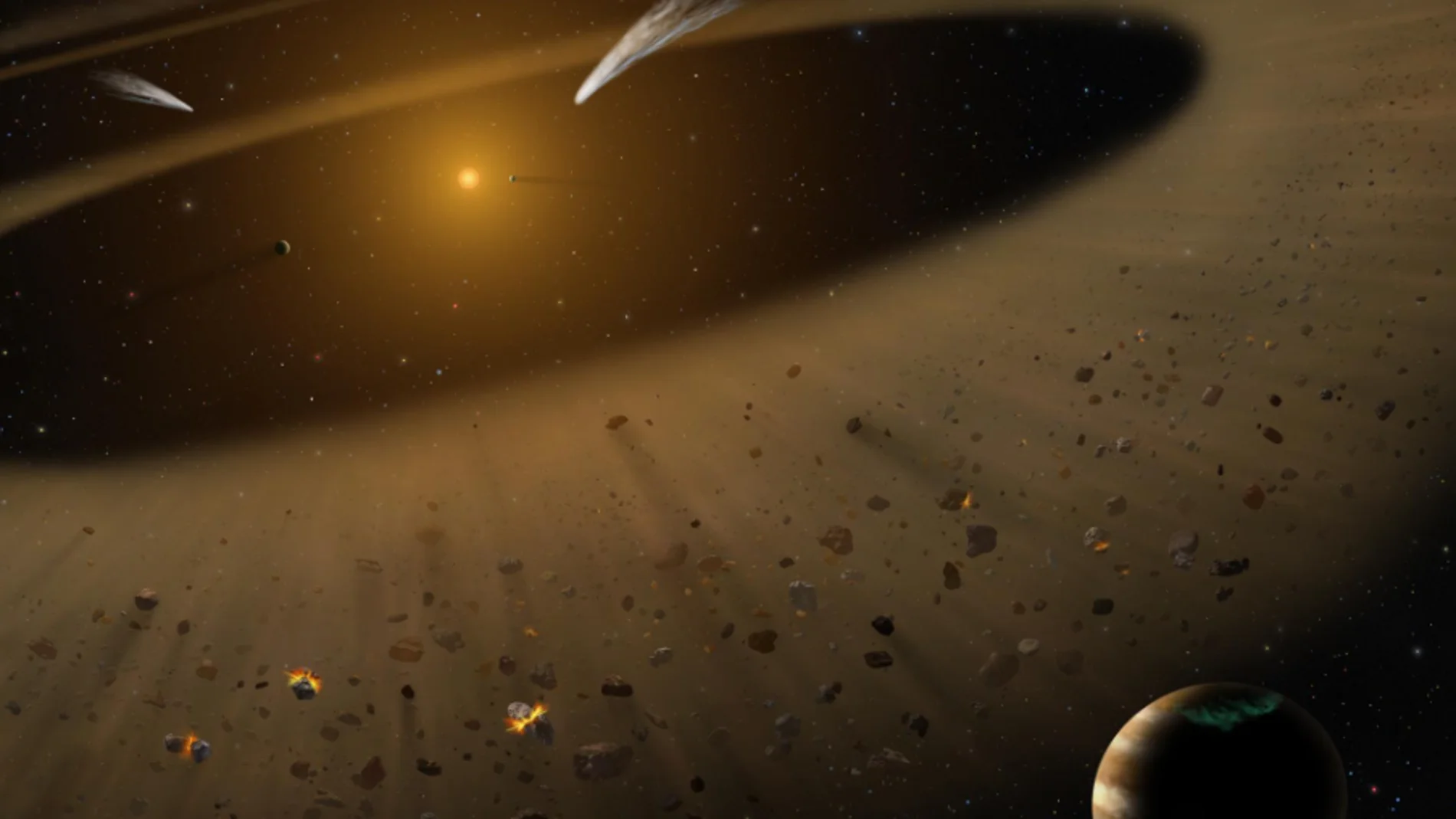
The separation could have an explanation in the architecture of the newborn solar system. During its first few million years, the disk of gas and dust surrounding the Sun did not have a uniform composition. Ultraviolet radiation could selectively alter carbon monoxide molecules, favoring some oxygen isotopes to end up incorporated into the water. Later, the formation of giant planets and their gravitational effects could limit the exchange of materials between the outer and inner regions. In their models, Keller’s team suggests that Saturn, possibly along with the icy giant planets, would have contributed to maintaining that separation.
The importance of the discovery goes beyond identifying a peculiar chemical composition. Water is one of the fundamental materials to reconstruct how planets, comets and other bodies in the solar system were formed. Comparing their different isotopic signatures allows us to follow the path of the materials and find out to what extent the regions closest to the Sun mixed with those furthest away. In this case, a handful of particles that ended up falling on our planet preserve a signal from a reservoir that would otherwise have been extraordinarily difficult to study. Dust has traveled a much longer path than its size allows us to imagine. And in its composition it keeps a chemical memory of the early days of the solar system: a time when water did not have a single identity, but rather different traces depending on the place where it was formed.