
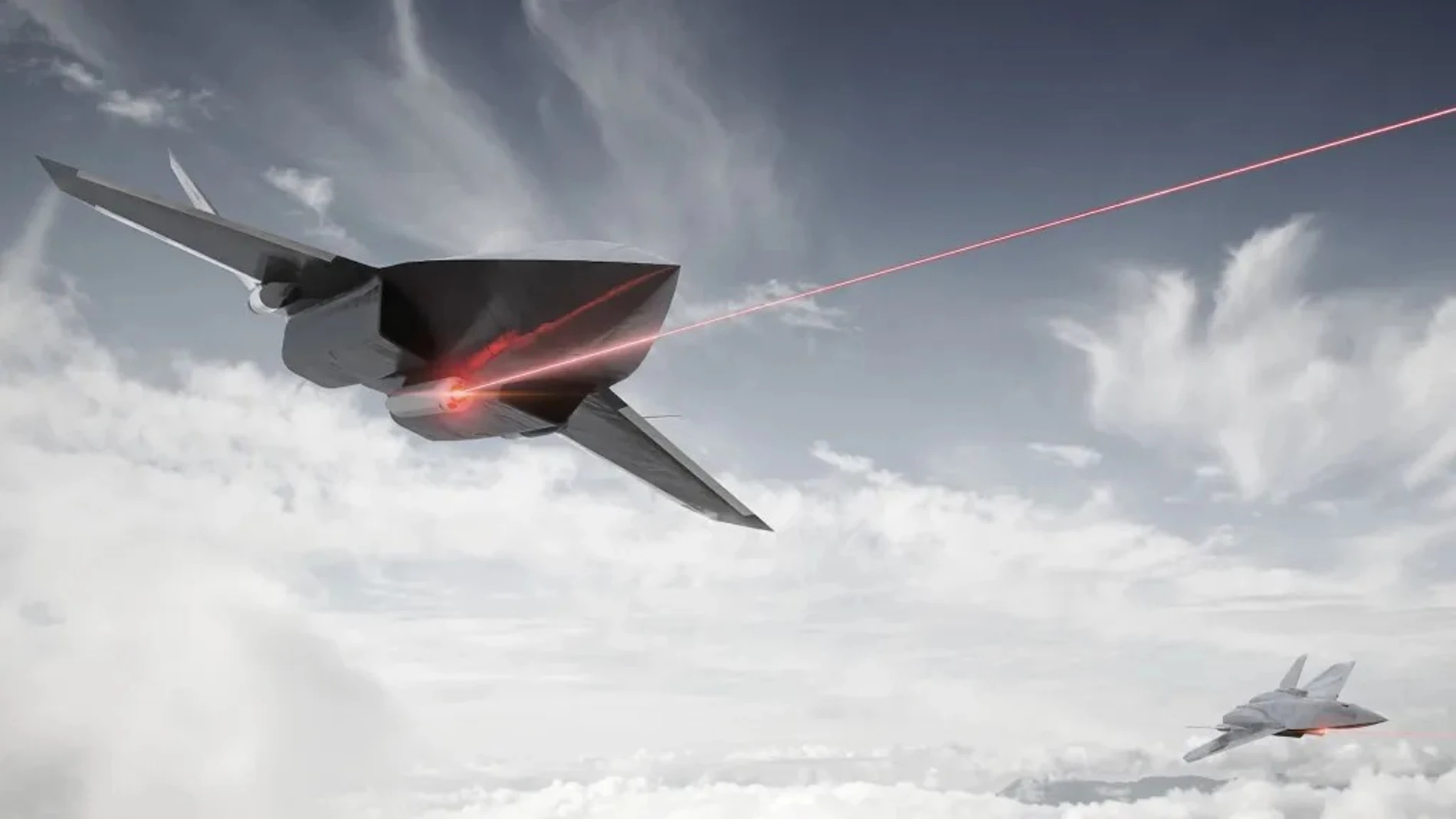
Germany has been awarded to MBDA Deutschland a contract to develop a laser weapon demonstrator housed in an external container that can be attached to an aircraft. The objective is to lay the foundations to equip its military aircraft in the future with a system capable of shoot down drones and cruise missiles.
MBDA defines the development of airborne lasers as the ‘supreme discipline’ of this technology, due to the demands of size, weight and resistance that flight imposes. The company, which has been working on laser weapons technology since 2008has pointed out that this area constitutes a strategic priority for Germany since 2019.
The project will take advantage of the experience acquired in the maritime domain together with Rheinmetallwith which MBDA received a contract in 2021 to develop a naval demonstrator. The system was installed on the German frigate Sachsen in June 2022 and its tests continued until September 2023.
First live fire exercise of a laser weapon used by the German Navy. The Frigate “Sachsen” successfully shot down a UAV. https://t.co/WG8AMfwhnw
— (((Tendar))) (@Tendar) October 28, 2022
During six campaigns, he carried out more than a hundred shots against different targets in increasingly complex conditions, including the downing of a drone. The tests also verified the tracking of very agile targets and the integration with sensors and command systems.
Transferring this technology to an airplane requires fitting the laser, its power supply, cooling, sensors and the mechanism that directs the beam into a small space. In addition to providing sufficient power, The considerable heat generated must be dissipated without compromising the operation of the weapon or the aircraft.
The set must also withstand vibrations, accelerations, aerodynamic loads and temperature changes, keeping the beam precisely aimed on a moving target. Humidity, dust and turbulence can also reduce the energy that reaches the target, whose destruction requires keeping the laser on it for a sufficient time.
Overcoming these obstacles would allow threats to be intercepted without consuming conventional missiles, with a firing capacity conditioned only by the electricity and cooling available. However, American history shows that a successful demonstration does not guarantee a reliable weapon in combat.
The program SHIELD of the US Air Force intended to protect fighters against missiles using an external laser, but ended up not demonstrating a complete system on board one of these aircraft. He AHELintended to attack ground targets from the AC-130J Ghostrideralso suffered technical problems and HE They abandoned their planned flight tests.
On land, the BY M-SHORAD of the US Army, 50 kilowattsshowed cooling, power and reliability difficulties. The systems LOCUSTof lower power, They have obtained better results against drones and aroused the interest of the Marines and the Navy.
In Europehe United Kingdom prepare laser installation DragonFire on a destroyer, and Germany, Netherlands and other NATO members promote systems against drones and aerial threats. For the German Ministry of Defense and MBDA, the challenge will be demonstrate that all components work together in a workable assembly for an aircraftbefore testing its performance through flight tests and attacks against targets representative of real threats.