
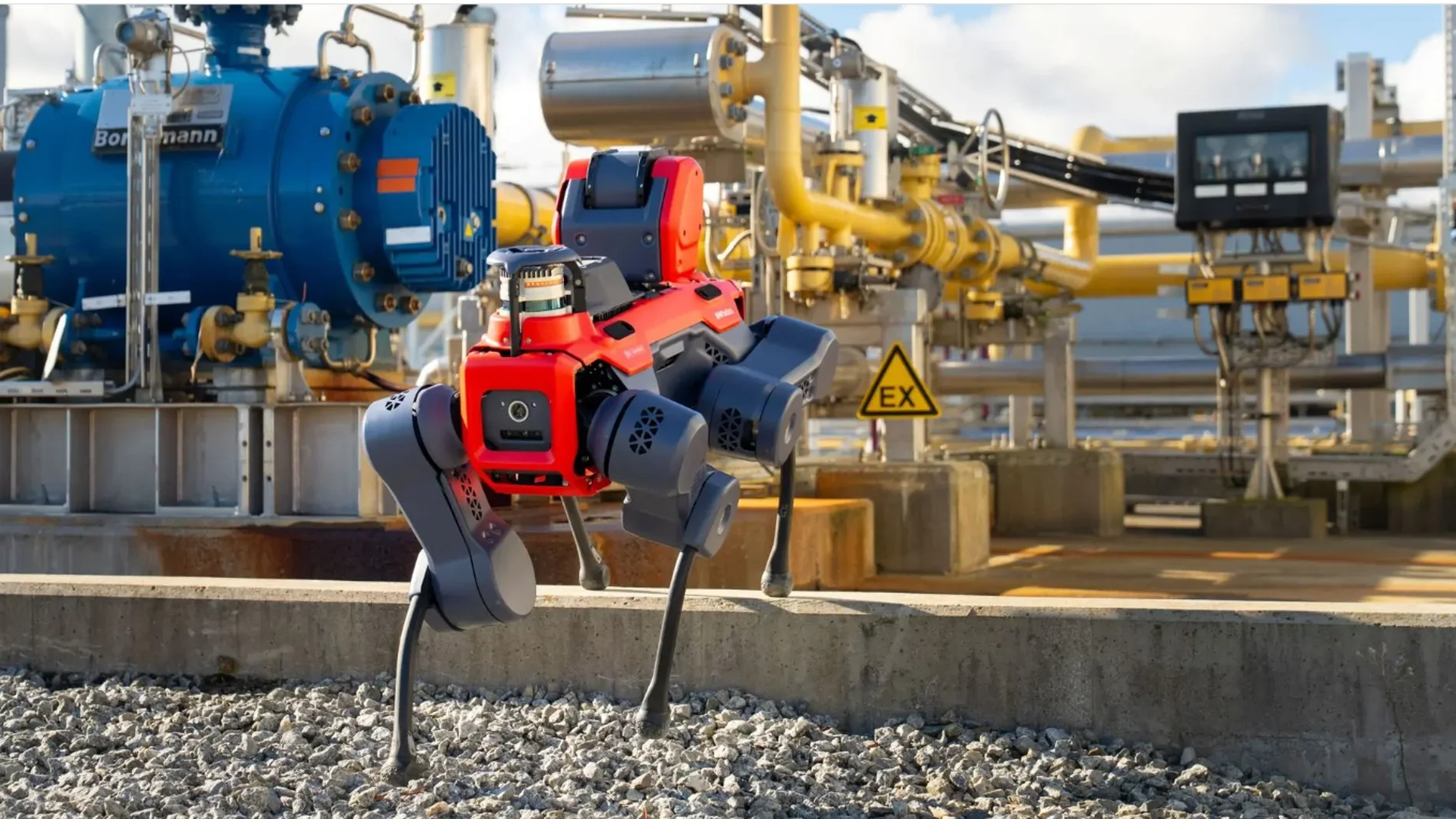
In a refinery, chemical plant, or gas facility, a robot may be prohibited from accessing the places it most needs to inspect. It is not a problem of autonomy, artificial intelligence or the ability to climb stairs. It is something much more basic: a tiny spark, a faulty electrical contact or a surface that is too hot can be enough to ignite a mixture of gases. Therefore, before sending a machine to monitor these facilities, a paradox must be resolved: how to get a piece of equipment full of motors, batteries and electronics to work in a place where any of those items could become an ignition source.
The Swiss company ANYbotics claims to have solved that problem with ANYmal X, a four-legged robot that has just begun commercial distribution. The company presents it as the first certified quadruped inspection robot to work in explosive atmospheres. Among its first clients are the energy company Equinor and the chemical company DSM-Firmenich. The project has accumulated four years of specific development and more than ten patents, according to its creators, after several companies in the sector have tested the machine in hundreds of land and sea missions since 2023.
The difficulty is protecting a machine that must retain the agility of a mechanical animal. Conventional industrial robots can use heavy housings and relatively bulky protection systems. But A quadruped needs to move its legs, balance, overcome unevenness and carry sensors without losing mobility. You also need a battery with enough power to move around and a computer to process the information. All of this must work without generating a spark or reaching a dangerous temperature.
ANYbotics has tackled the challenge component by component. The artificial intelligence computer and inspection equipment are housed in sealed compartments filled with nitrogen, an inert gas that helps isolate them from the outside atmosphere. The twelve motorized joints and the battery have flame-resistant enclosures, while non-metallic housings insulate certain components. Its conductive legs help dissipate static electricity and control systems monitor temperature to activate protections when necessary. Charging and data transmission also incorporate security barriers.
It is not about making the robot indestructible, but about prevent possible failures from becoming the source of an explosion. That is the logic of certification for explosive atmospheres: evaluate the foreseeable ignition sources and demonstrate that the equipment has adequate protection measures for the authorized conditions of use.
ANYmal X has ATEX certification, used in Europe, and IECEx, an international evaluation system for equipment intended for explosive atmospheres. According to the manufacturer’s specifications, it can operate up to Zone 1, a classification that includes places where an explosive gas atmosphere may occasionally appear during normal operation. The authorization is also limited to certain characteristics of the gas and environmental conditions. It is not equivalent to a permit to enter any dangerous facility, regardless of its risks.
ANYmal A zoom camera allows you to observe components from a distance; another thermal camera measures temperatures between −10 and 400 degrees Celsius, while a microphone records sounds that can reveal vibrations or anomalies. A laser system scans the environment in 360 degrees to help locate the machine and orient it during its movements. It can also incorporate a sensor to measure concentrations of flammable or toxic gases.
The combination of all of them matters more than each sensor separately. An abnormal increase in temperature can warn of a mechanical problem; an acoustic change may signal wear; A concentration of gas may indicate a leak that requires attention. The robot does not automatically replace the diagnosis of a specialistbut allows inspections to be repeated with a constant procedure and results compared over time.
The real advancement of ANYmal X is not that it walks on four legs. It is about ensuring that a mobile machine can inspect certain environments where an electrical failure or excess temperature could have serious consequences. In those places, artificial intelligence can help interpret what the robot sees, hears and measures. But The decisive innovation begins earlier: in making sure that, while searching for a breakdown, it does not cause another.