
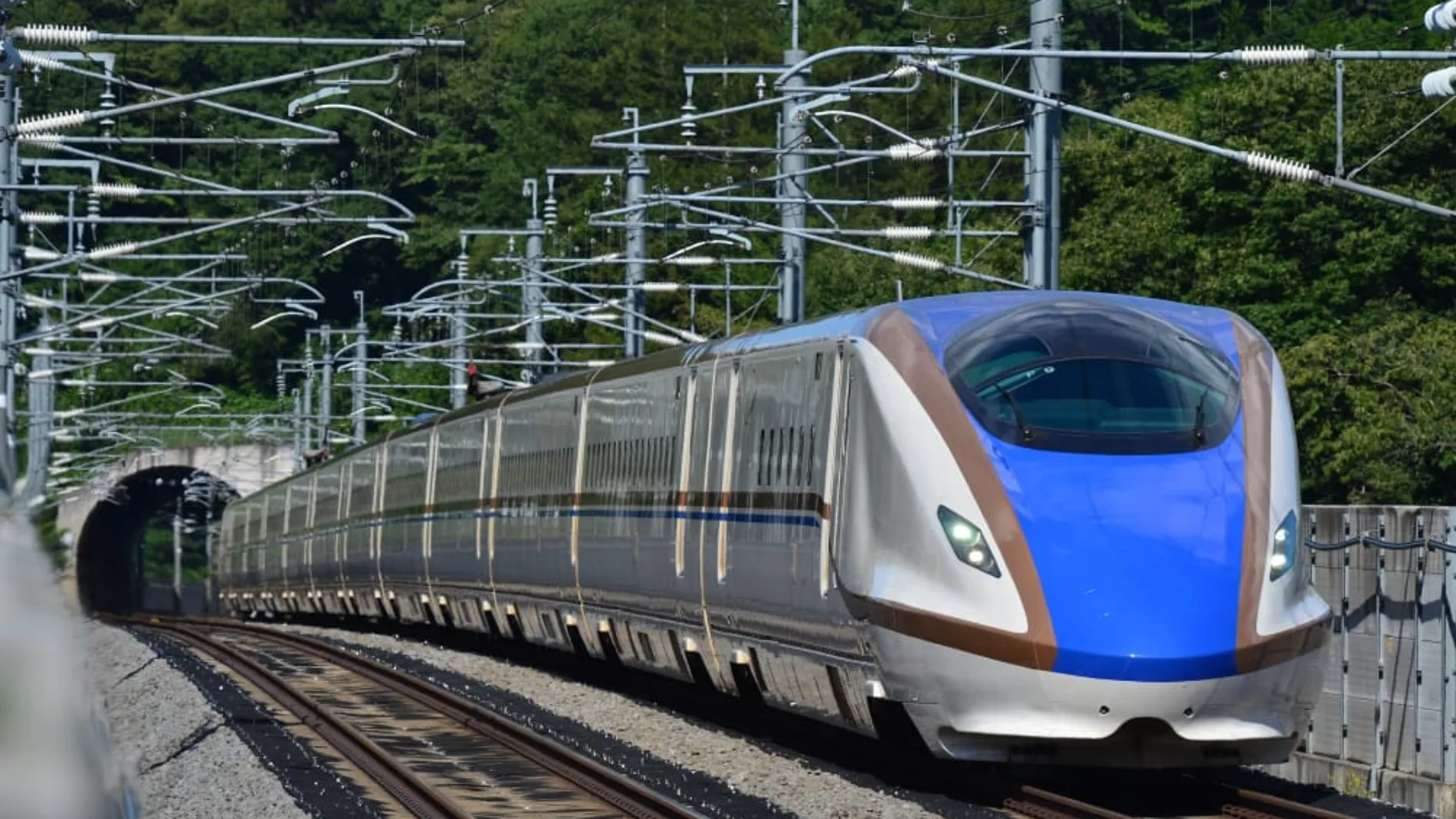
In the exploitation of Japanese high speed, the Shinkansen does not negotiate with residual error. Since 1964 it has moved more than 10 billion travelers without a single passenger death due to collision or derailment. Dedicated roads without a single level crossing. Continuous automatic control that imposes speed and brakes without waiting for human decision. Seismic detectors that capture the primary wave and cut off the current before the strong shock arrives. When the earth shakes the convoy stops alone. The average delay per train is around a minute even with typhoons and earthquakes involved. There are no emergency phone calls or interpretation under pressure.
This doctrine collides head-on with the Urda catastrophe. The preliminary report of the AITAT (Railway Accident Investigation Commission) in its Spanish version describes a chain of breakdowns, instructions and actions that led to the impact. The LZB system (in-cab stepless speed control system) collapsed. The trains moved to the outside side signaling blockade. The Atocha Regulation and Control Center authorized normal operation of the AVE when the regulation required visible circulation limited to 40 km/h. The Renfe AVE was traveling between 160 and 200 km/h when it hit the Iryo, which was trying to resume moving. Twenty-four hours later the international version deletes that chain and reduces the problem to failures of the LZB, postponing the analysis of organizational and procedural factors.
In the Japanese high-performance line, that human barrier is never activated; the design of the infrastructure makes it unnecessary. Meanwhile, Spain is already the country with the most deaths in high-speed train accidents in the EU.
Brussels has invested billions in the European Rail Traffic Management System (Ertma) with the political goal of interoperability. Trains from different countries, different weights, speeds and braking systems share the same tracks, and a passenger convoy traveling at 300 km/h can travel along the same corridor as a heavy freight train, or cross conventional lines. The network becomes a heterogeneous ecosystem that multiplies the risk of exploitation. Each degradation of the automatic system forces us to go back to procedures from a century ago: security telephone calls, on-sight driving and human interpretation under pressure in the cabin.
The Shinkansen was designed to avoid collisions. The premise is passive safety – the resistance of the train to impact – so it loses relevance if the collision becomes physically impossible. It was conceived as a closed and independent system. Without level crossings, it eliminates at its root the main cause of accidents on the world’s railways. No conventional or freight trains step on its rails. By unifying the weight, speed and braking curve of the rolling stock, circulation becomes predictable. The automatic control is not limited to warning the driver, it brakes as soon as the safety distance with the preceding vehicle is reduced in the slightest.
On the other hand, line and fault seismographs detect the primary wave. It is the principle of the UrEDAS (early seismic detection and alarm system) that JR Central launched in 1992 in Tokaido to estimate magnitude and epicenter in seconds and cut off the supply before the destructive wave. The 2004 version lowered the reaction from three to two seconds. In Niigata, on October 23, 2004, the Toki 325 derailed at 210 km/h between Urasa and Nagaoka because the epicenter was too close. There were 154 people on board. No one was injured. That reinforced the anti-exit guardrails and early detection.
European railway liberalization has fragmented the sector and by law separates infrastructure managers from operators. It stimulates commercial competition, but introduces bureaucratic boundaries and technical responsibility gaps in operational crises.
The Japanese system operates as a total system. All tangible components – trains, overhead lines, signals, telecommunications and civil structures – and intangible components, such as operation, maintenance and training, are managed vertically by a single entity.
The brain is the General Control Center, a bunker that monitors every parameter of the network in real time. From there, decisions are made with data of absolute precision and unified instructions are issued both in daily routine and in extreme emergency situations.
The physical shielding is total, with a fenced corridor monitored with presence sensors. If an object falls on the road or someone passes the perimeter, traffic is immediately interrupted by automatic interlock. Meteorological sensors tirelessly measure rain, wind, snow and river flooding. If something exceeds safety limits, the center slows down or suspends service before the weather puts travelers at risk.
This centralization provides the system with extraordinary commercial flexibility. With very high frequencies, the number of trains is adjusted daily to real demand, and the use of material and facilities reaches an efficiency that maximizes operating income and ensures long-term economic viability.
Reliability is based on preventive maintenance that eradicates failures before they appear. Commercial trains monitor bogies and traction systems in real time, and fixed infrastructure is inspected with multi-purpose inspection trains traveling at the same speed.
For its part, JR East has announced SOAR, a convoy of seven cars without a single seat that will replace the East-i, with more than two decades reviewing tracks, catenaries and signaling. It incorporates subframe monitoring technology tested in the experimental ALFA-X and forty-eight cameras: thirty-two on the sides and three on the roof in the car and eight on the front at each end. A new PQ estimation system measures dynamic forces between wheel and rail and analyzes rail deformation; In the future it will add AI to automatically detect cracks.
It will be the first capable of traveling at 320 km/h, like the fastest services. It will enter service in fiscal year 2029. Its name combines the idea of rising with the O of zero, that is, the ultimate goal of zero incidents.
While in Europe night maintenance is combined with goods, here an absolute blockade prevails. Between midnight and six o’clock commercial circulation stops and the window is reserved exclusively for operators, guaranteeing their safety and the quality of their interventions. Before authorizing the first train of the morning, exploration vehicles travel each section at moderate speed and visually and mechanically certify that the infrastructure is clear and in perfect condition.
In the industrial culture of the Land of the Rising Sun, punctuality is the definitive indicator of the operational health and active safety of the system. A delay alters the cadence and the safety distance between blocks and increases the load on the controllers and the probability of error. This reliability transformed the socioeconomic structure of the country with unprecedented territorial integration. By connecting the two large metropolises in just over two hours with peak metro frequencies and a train every three or four minutes, it almost completely displaced the air bridge, redefined corporate mobility and eliminated logistics and overnight costs.
Despite the very high automation, operators consider personnel the last and most important security barrier. The structure and rules are designed so that the entire organization reacts instantly to any unforeseen event. Independent internal inspectors carry out daily audits so that rigor does not decline. The training combines theory from experts with intensive practices in state-of-the-art simulators. On the field of play, veterans guide young players to transmit technical knowledge. Fitness is managed with service histories and thorough medical examinations of each driver’s physical and mental condition.
The most recognizable symbol is the point and call protocol (Shinto Kanko). By pointing with the finger and verbalizing its status out loud, the operator consciously associates visual perception with the physical action, statistically reducing errors due to confusion in the cabin by up to 85%.
The Japan Rail (JR) network covers practically the entire country and trains reach a maximum speed of 320 km/h. It offers different categories on board, from standard class and reserved/non-reserved seats to the Green Car (first class) and the exclusive Gran Class on some lines in the north of the country.