
There are nights that end up becoming eternity on a canvas. Friedrich turned them into contemplation; Whistler, in music of light and shadows. Vincent van Gogh, on the other hand, painted a sky that seemed to churn like an ocean of fire. More than a century later, astronomy could have found the real night that hides behind its most famous work: The starry night.
But what happens when the sky that inspired a masterpiece can be reconstructed more than a century later? A team of South Korean scientists maintains that The starry nightby Vincent van Gogh, fits with an astronomical configuration visible before dawn around July 22, 1889when the painter lived in Saint-Rémy, in the south of France. The coincidence does not definitively establish the day on which the painting was made, but it provides new evidence to reconstruct how one of the most recognizable images in the history of art could be born.
The study, published in Scientific Reportsfrom Nature magazine, has been jointly developed by SLLAB, a South Korean company dedicated to space science, and the School of Space Research at Kyung Hee University. His proposal is based on a seemingly simple question: did Van Gogh represent an imaginary sky or did he transform a real observation into painting?
The astronomical interpretations of the work date back to the studies of Albert Boime, of the University of California in Los Angeles, in 1984, and Charles Whitney, of Harvard, in 1986. However, both reached contradictory conclusions and neither managed to displace the religious and symbolic interpretations that have traditionally accompanied the painting. According to the authors of the study, During the following four decades, the observational geometry of the painting sky had not been addressed with an analysis of this nature.
The first to sign the study is Elijah Jeong-hyun Kim, executive director of SLLAB and a doctoral student at Kyung Hee University. His interest arose from a discrepancy with previous interpretations. “To an observational astronomer, the star cluster of The starry night It is the Hyades, in Taurus. But, the moment I read the previous studies that explained it as Aries, I felt like the painting was calling me.” After building numerous telescopes and spending years observing the sky, the team considered it unlikely that Aries was the reference that had inspired the painter.. The study began with two field trips to France in 2019 and expands on the evidence gathered by Kim in a popular book published in 2025, adding quantitative data.
The date traditionally associated with the painting is supported by a letter that Van Gogh wrote to his brother Theo around June 18, 1889. However, the waning gibbous moon of that period does not fit with the thin crescent depicted on the canvas.. Around July 22, on the contrary, the Hyades, a star cluster in the constellation of Taurus, appeared in the east next to Venus, while the Moon presented a shape much more similar to that painted.
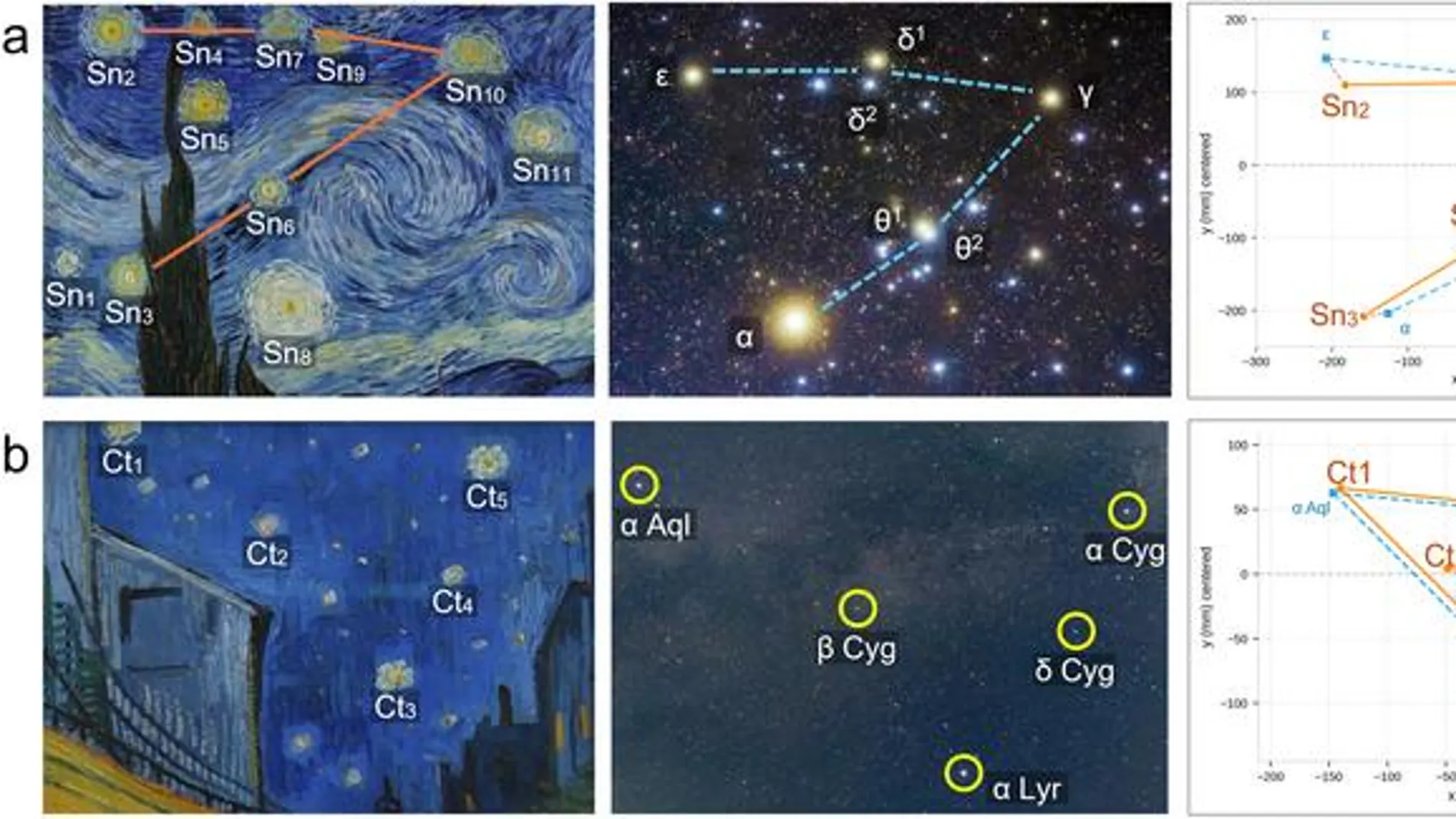
To verify this, Kim’s team reconstructed the artist’s visual field. In Arles, they contrasted, through photographs taken on the spot, the perspective of Starry night over the Rhône (1888). In Saint-Rémy they located the place from which Van Gogh drew the landscape that appears under the sky of The starry night and they reconstructed the view before him.
They then applied a geometric analysis of shapes known as Procrustes analysis, which allows figures to be compared taking into account their position, orientation and scale. The result confirmed the correspondence between the five central stars of the painting and the Hyades. The adjustment was even more precise in the pen drawing Van Gogh made after the painting. For the authors, This coincidence supports the hypothesis that the sky was based on a real observation and not exclusively on the artist’s imagination.
The proposed dating also forces us to review the chronology of the painter’s health. Until now, it had been assumed that July 22 coincided with one of his crisis episodes. The team contrasted the original French and Dutch letters with contemporary weather records and references to cicada songs to propose that the episode began in late July. This reconstruction supports the possibility that Van Gogh contemplated the sky before his crisis, although it does not in itself prove when he transferred the scene to canvas.
“I hope that this work promotes a new multidisciplinary look at the sequence and working methods of Saint-Rémy’s paintings, as well as Van Gogh’s movements during that summer – concludes Kim -. Our conversation with Van Gogh’s other heavens continues. “We plan to tell those stories one by one.”