
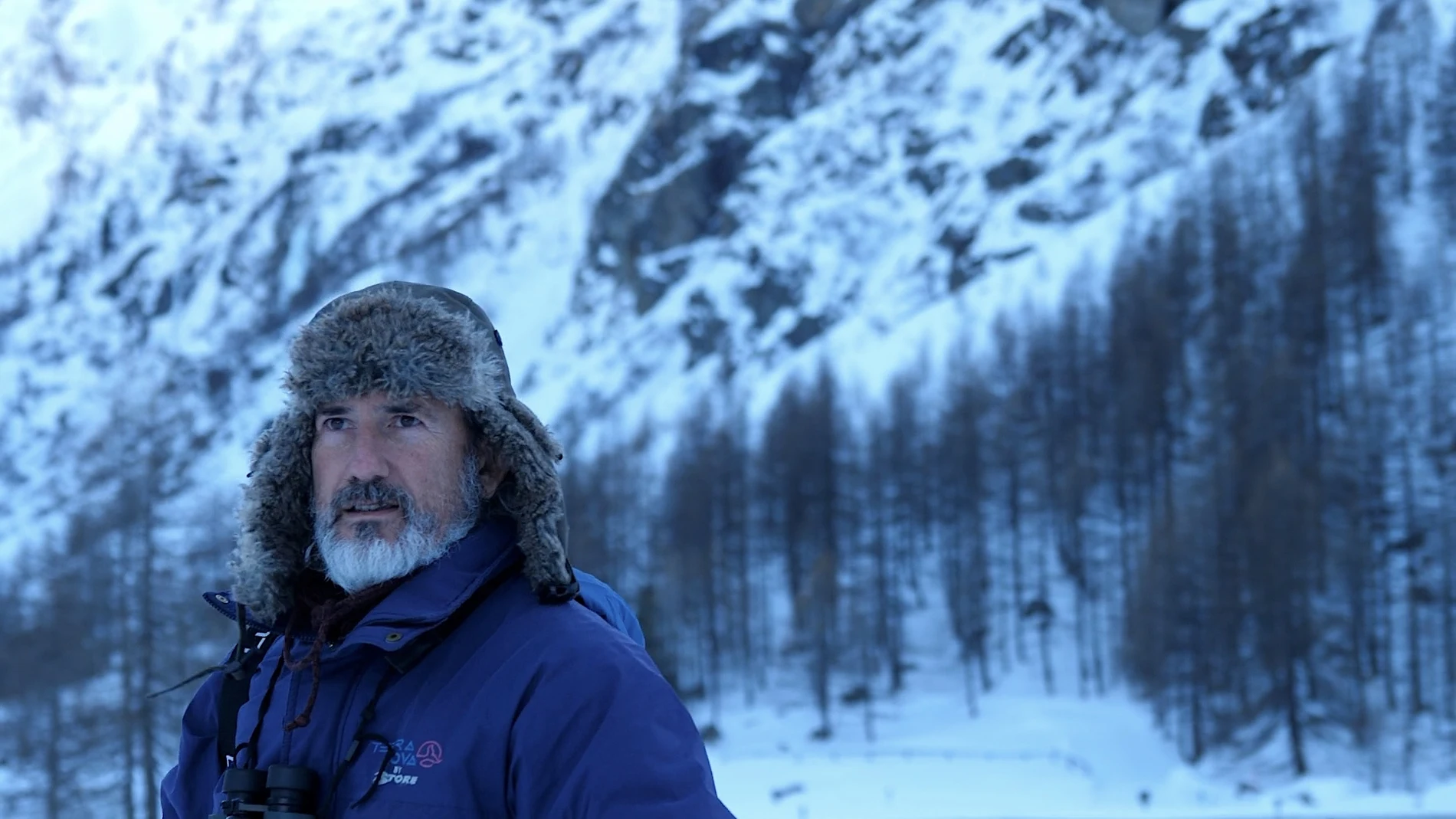
Andoni Canela has been photographing and recording nature for more than 30 years. Now he presents his latest work, “Sleeping with Wolves,” a summary of a five-year trip throughout the Iberian Peninsula in which he talks about one of the most persecuted and, at the same time, most admired animals in the world: the wolf. He does it with his daughter Amaia, whom the viewer sees grow while her way of understanding nature evolves. A film about knowledge, patience and respect, and about the possibility of a shared future between humans and wildlife, which will be screened this Saturday, October 24 at mk2 Cine Paz and on Sunday, October 25 at Cineteca, within the Another Way Film Festival.
It is not the first time he has filmed with his children. Why that choice?
I have given the latest works this approach, which allows us to do two things: talk about animals not so much as a specialist, but in a more educational and informative way, but without losing rigor and criteria. The film is transparent and natural. On this trip, when it begins, Amaia is very small and the conversations are simpler. In the case of Unai, when we made *Panteras*, about big cats, his attitude was very different. Amaia is quieter and lets out phrases like that, like more from time to time. The important thing is that this learning serves to know and also to establish an emotional bond. When you know something and you like it, you learn; In addition, there is the adventure component: since it is fun, you get more involved.
But the piece is for all audiences.
It is not aimed at children at all. Throughout the five years of filming, Amaia grows and the conversations we have about wolves are useful for any adult. Most do not know the biology of the wolf, its behavior or its distribution. However, it already happened to us with *Panteras* or with the trip with Unai: we get calls from teachers who want to organize trips with primary or secondary students. And the incredible thing is that, although it is not aimed at children and lasts about 100 minutes, there are small children, 8 or 10 years old, who remain with their eyes open, when they could be bored. There is something that is not my merit: it is nature, which is presented there in capital letters, without the need for a voice-over to tell you about it. I believe that we must continue valuing and paying infinite tributes to well-preserved nature and to species and animals.
One of the most striking things about the film is that there is not much conversation. Is it a desired effect?
I think we explained enough about the wolf. The film is mainly about the species, although it also captures its past in recent decades, when it has been exterminated in many places. We mention that there are attacks by wolves and that, from time to time, they kill livestock, because it is true: they are carnivorous animals, but it is a small part of the story. Wolves are super predators, but it must be explained that they live in family groups, in packs; how they feed, what their biological cycle is, how the puppies are born, how they spend the winter and what their prey are… And with that, that’s it; You don’t have to explain too much. Then you have to show animals in freedom, going about their daily lives without being conditioned by the presence of the camera, which they do not see in 90% of cases. That, for me, is the fundamental thing: that the viewer can get into those landscapes where the wolf lives, which are precisely very diverse, from desert areas to high mountains, from the sea to areas of cereal steppe and forests…
He talks about attacks, but in the film he is seen, above all, hunting wild species…
The wolf is opportunistic and, if there are livestock that are not protected, they take advantage of it. However, wolves also feed on roe deer, deer and chamois, and they eat voles… Among all this diverse diet there is also livestock, but it is a small part. In the film I come out explaining it to Amaia: you have to say what happens in certain places and under certain circumstances, but without further ado. There is a black legend about the wolf in stories and movies, but it is just another animal. I have no prejudice about whether the wolf is good or bad.
He has been watching wolves for 35 years. In this time, how has it evolved as a species?
In these years, the wolf has gone from being confined in the Cantabrian mountain range and in a very small geographic space to advancing south, crossing the Castilian plateau, through Tierra de Campos, Valladolid, Palencia and Ávila, where it has been breeding, as well as through Guadalajara, Segovia and Salamanca. He has arrived in Madrid; In the mountains there are already several herds. All this has happened in these three decades. There is clear growth in terms of distribution. In Galicia it has also spread and has increased in Asturias and Cantabria. That has happened until now, but it is no longer evolving like that. There have been a few years of protection, approximately four years, from 2021 to 2025, which have more or less served to consolidate this situation. But now there are communities like Asturias and Cantabria where the legislation has changed and control is carried out by killing wolves to prevent damage. Although, well, it’s like killing for the sake of killing, because there is no plan that clearly identifies which wolves kill livestock to eliminate them; This is a general group.
What do you think of this legislative change?
Now, in Cantabria, Asturias and La Rioja, they are going to begin to establish a quota of wolves that can be killed. For example, in Asturias, before the species was protected in the 2010s, an average of between 12 and 14 wolves were killed. However, this year I think it was 50-something or 60; that is, about five times more. That can be quite damaging. If, from now on, communities decide to kill hundreds of wolves, it will obviously affect the population, because going from not killing them to killing hundreds will cause their number to drop and their geographical distribution to be restricted.
Talk about attacks on livestock. Is it possible to coexist between livestock and wolves?
What happens here happens throughout Europe and in all countries where there are wolves: in Asia, the United States and Canada. There is no magic formula. When livestock farming is extensive and takes place in the mountains, it must be protected as much as possible. In extensive farms, these wolves must be driven away and, in cases where there is damage, livestock farmers must be compensated in a fair and agile manner: they should be paid well and on time. We must also think that the attacks fall within normality, without further ado. They affect a very specific area, livestock, and they can coexist, as has been done in many areas where there are wolves and livestock. There are conflicts, but we must not think, as they say now, that livestock farming is disappearing because of the wolf. It isn’t true. There are many problems in livestock farming: prices, the difficulty of making a farm profitable… The problem is not the wolf, because the problems are the same as those that exist in the rest of the territory where there are no wolves. The only conflict it generates is related to livestock. Tourists are not affected and people who live in the towns will not be attacked, even if the wolves pass near them.
In the documentary, in fact, you spend many hours in some areas until you see a specimen.
Yes, the wolf is very smart, it moves a lot at night and, if there is human presence, it disappears. In areas where there are few wolves or they are highly persecuted, you can make a couple of trips, spend two or three weeks and not see any. For example, in the Community of Madrid we made three trips. In the one included in the film, spring is beautiful, very flowery and pretty, but we didn’t get to see any wolves. Sometimes you make more than twenty outings and, of those twenty, maybe we see wolves in half or less.
Has our relationship with the wolf changed?
In the time of Félix Rodríguez de la Fuente, more than 30 years ago, there were very few wolves and fewer conflicts. But, as the population has increased, conflicts have also increased. And, although there are not so many cases of ranchers affected by wolf attacks (there are, but they are few and compensation is paid for the damage), the rejection of wolves in the rural world is very, very great. It is more due to other reasons: the wolf has entered the political debate, “wolf yes, wolf no.” From the rural world it is thought that it is an imposition that comes from outside, from the cities or from a political party. There are also exaggerations on both sides.
Which is it?
On the one hand, there are those who say that there is a plague of wolves, but there can never be a plague of wolves, because they regulate themselves. It is scientifically proven. If you have a few packs and the wolf population grows a lot, what they do is expand, but there will not be a pack of 20, 30 or 40 wolves, because among them they would kill each other or leave. There is no plague of wolves; What there is is a geographical expansion. Among the hoaxes that are spread from that part is also that they are dangerous for human beings. However, in 50 years there have been no deaths caused by wolves in all of Europe. From the most environmentalist point of view, it is said that the wolf is in danger of extinction and that it is being wiped out, but in recent decades its population has been growing. It is true that it is now stabilized and that the deaths will affect it, which can be very harmful, but the number of wolves has grown in the last 30 years. It is not true that it is in danger of extinction, that there are very few left or that it is disappearing.
What fascinates you most about the wolf?
Their ability to adapt and resist, and that they are very, very intelligent animals. They know how to take advantage of all the resources and are capable of living, like human beings, in very cold places, in high mountains, in cereal steppe areas, by the sea, in forests and in places where it seems that it is impossible to live, such as sub-desert environments. They are quite similar to humans: they live as a family and have the ability to adapt, to live like the Inuit in the Arctic, at 30 degrees below zero, eating what they can, and also to be in tropical areas.