
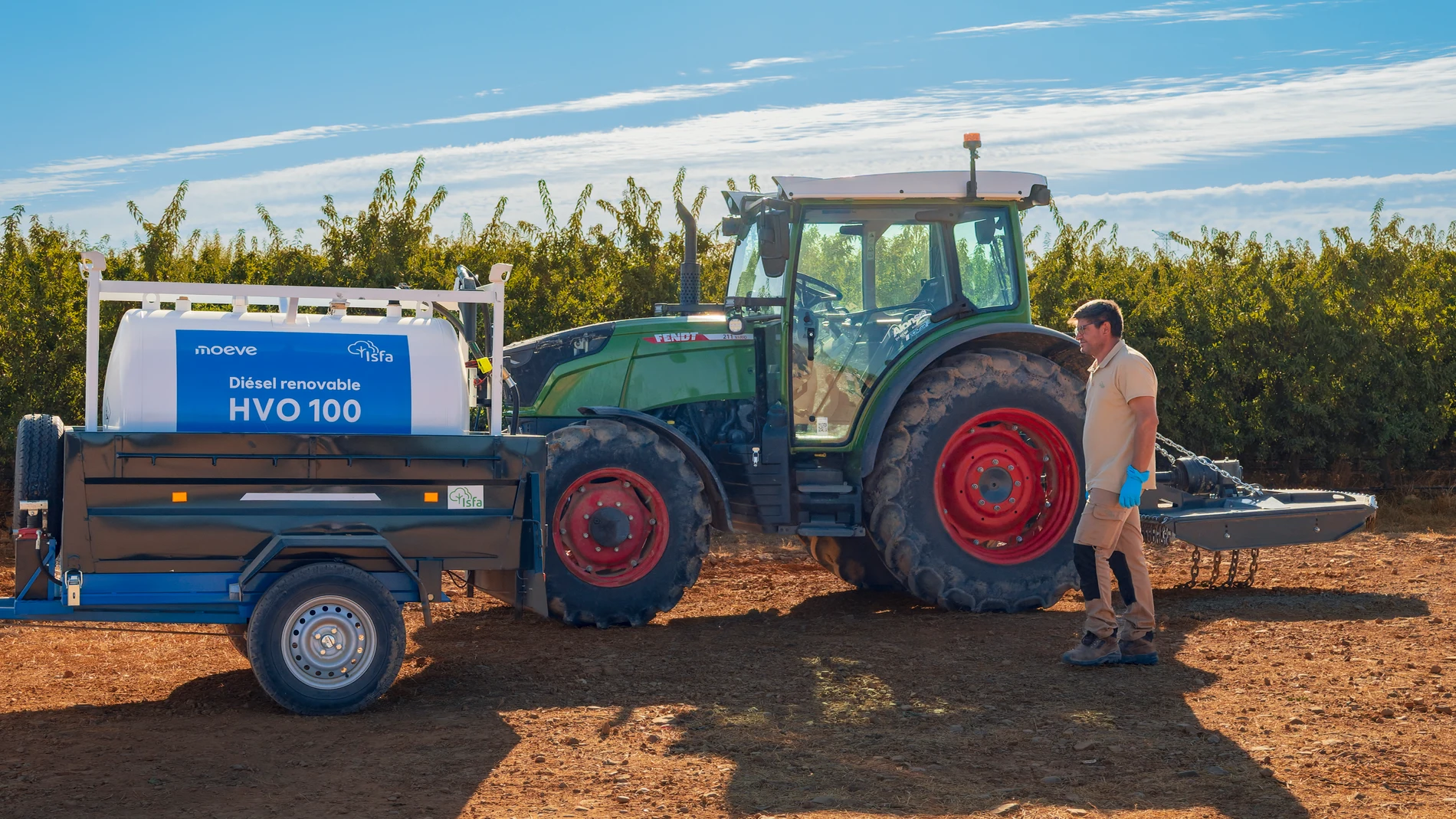
The afternoon sun silhouettes eight tractors and four combines lined up between the rows of a green sea of 600 hectares of almond trees. We are located on a plot managed by the ISFA agricultural company located in Logrosán, Cáceres. At first glance, it seems like a regular campaign: the characteristic roar of the diesel engines breaks the silence of the Extremadura countryside while the combines advance. The real transformation of this rural landscape takes place inside the fuel tanks. Because, since June, this fleet has not consumed fossil fuel, but 100% renewable diesel (HVO) supplied by energy company Moeve in a pioneering six-month pilot project.
The setting for this experience is one of the largest almond farms in Europe, where intensive mechanization and precision technology set the pace of daily work. During this field trial, which will last until December, Moeve supplies 15,000 liters of second generation biofuel (2G) to propel the 12 agricultural vehicles on the farm.
The objective is to replace traditional diesel with this green fuel, which according to predictions, will avoid the emission of approximately 43 tons of CO₂ into the atmosphere. This reduction directly attacks the most complex emission source of the operation, since heavy machinery represents 28% of ISFA’s total carbon emissions.
This innovation does not require replacing existing machinery. He HVO (Hydrotreated Vegetable Oil) that fuels them is a biofuel produced from renewable raw materials and organic waste, such as used cooking oils. Subjected to a hydrogenation process, this waste becomes a fuel that is chemically homologous to conventional diesel, capable of reducing CO₂ emissions by up to 90% throughout its life cycle.
Its main technical advantage is its capacity for immediate integration: it is fully compatible with current diesel engines and existing refueling infrastructures, circumventing the limitations of autonomy, power and recharging availability faced by electrification in heavy agricultural machinery.
Miguel Angel Lopezfounder of ISFA, describes how this innovation is experienced from the tractor cabin: «For the team, day-to-day life practically does not change, and that is good news. HVO is used in the same machinery and in the same way as standard diesel, without the need to intervene in the engines or change the way of working.
Regarding the performance and mechanical response of the vehicles in demanding cultivation and harvesting tasks, López confirms the absence of setbacks: «No, so far we have not seen differences in daily work. Both tractors and combines operate normallywhich is precisely what we wanted to verify with this test.
Likewise, the founder of ISFA highlights the strategic impact of acting on the current fleet: «Agricultural machinery represents 28% of ISFA’s carbon emissionsso reducing them is a fundamental part of our commitment to sustainability. Being able to do so with a solution available today, without waiting to renew the fleet, allows us to move forward from now on.”
For its part, Cristina BallesterCommercial Director of Moeve’s Clean Energies area, highlights the need to protect the activity of the primary sector while moving towards decarbonization: «Reducing emissions associated with agricultural activity is a priority to advance the energy transition and requires immediate solutions that protect its competitiveness. “2G biofuels allow us to advance in this objective with an alternative already available and compatible with current engines.”
The test in Logrosán does not remain a local anecdote, but is connected to a large-scale industrial deployment. Moeve is advancing together with Apical in the construction of a new 2G biofuels plant in Huelva, with an investment of 1.2 billion euros. The facility will be operational in 2027 with the capacity to produce 500,000 tons of HVO per year and sustainable aviation fuel (SAF), heading towards the goal of reaching 2.5 million tons of 2G biofuels in 2030.
As the sun sets over the 600 hectares of almond trees in Cáceres, the tractors conclude their day, leaving clean air behind them. Experience shows that making the agricultural park greener does not require waiting for future technologies, but rather applying renewable solutions compatible with the work of the land today.