
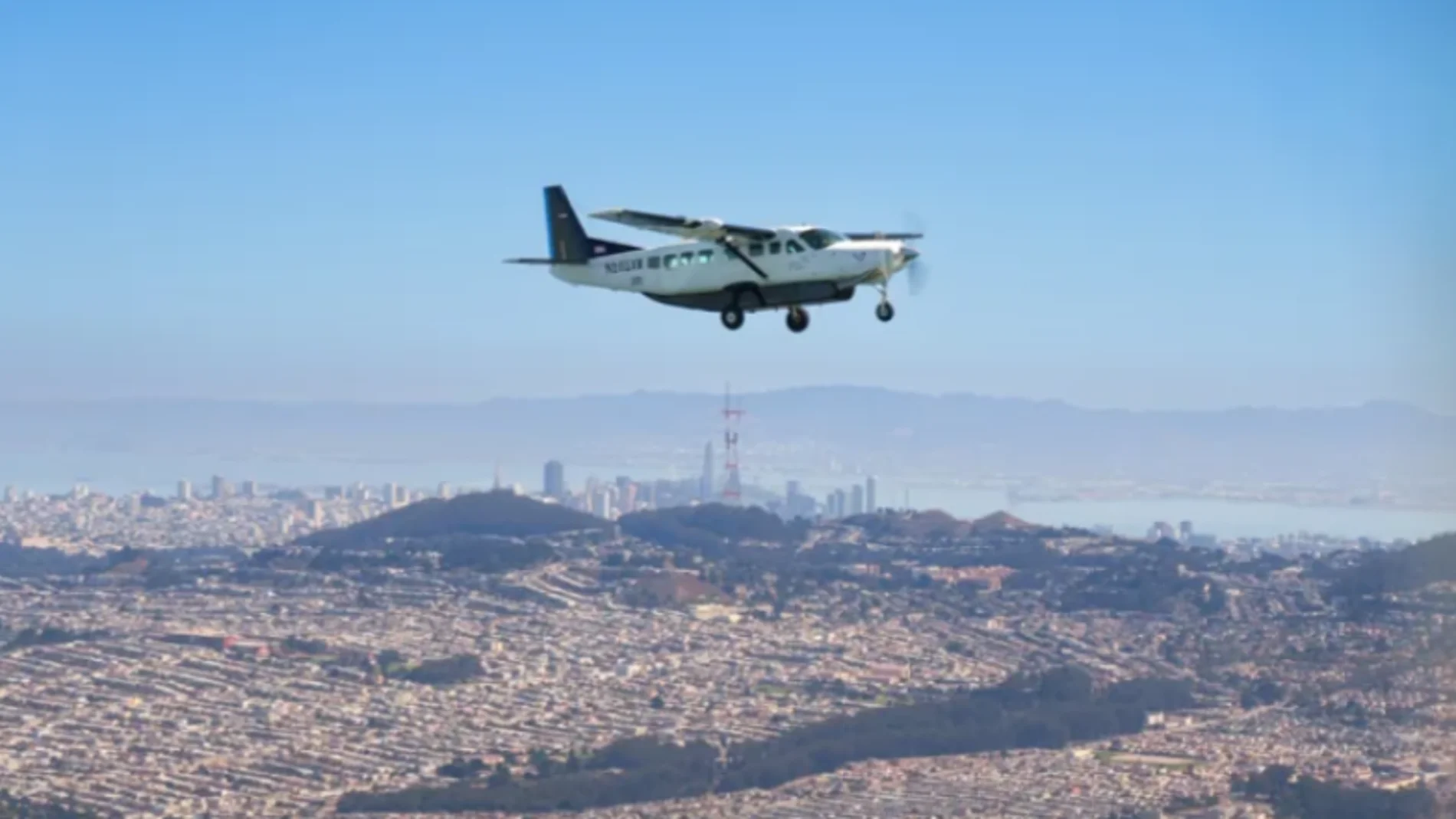
On December 17, 1903, on a beach in North Carolina, a plane traveled just 36 meters before touching down again. It happened at Kitty Hawk, the plane was the Flyer I and those responsible were the Wright brothers. The flight, although brief, was enough to change history. Now, 123 years later, Another plane has also arrived in North Carolina after traveling 5,148 kilometers from California. The difference is that this time no one was in charge.
The protagonist is a Cessna Caravan J208 modified by Joby Aviation, a conventional single-engine aircraft converted into a test bed for autonomous flight systems. The plane departed Concord, California, on September 7 and arrived in the Outer Banks of North Carolina on September 18.completing what Joby describes as the United States’ first autonomous coast-to-coast flight.
The important word here is “autonomous.” The plane had a safety pilot, but During the more than 5.00 kilometers of the journey, he did not take any action on the controls. The system took care of taxiing on the runway, takeoff, navigation, cruise flight and landing. Meanwhile, operators in California and South Carolina monitored the mission from the ground, at times up to 3,700 kilometers away.
It was not about following a route drawn like a line on a map either. The plane had to operate in situations that can hardly be rehearsed beforehand. In Phoenix Deer Valley, Arizona, one of the busiest general aviation airports in the country, had to integrate into a congested air environment. During the trip he also encountered storms and adverse weather conditions and modified his route to avoid them. And it did so, according to Joby, without having specific prior information about some of the destination airports.
That is precisely the difference between an airplane that simply executes a programmed sequence and one capable of making decisions during flight. The Cessna’s autonomy has to interpret the information from sensors and navigation systemsknowing the position of the plane, maintaining the trajectory, managing the flight and responding to changes that were not necessarily foreseen. In this case, furthermore, it had to do so crossing different types of airspace and airports.
For Joby, the test has a purpose that goes far beyond demonstrating that a machine can fly alone. The company is developing electric vertical takeoff and landing aircraft, but Its autonomy technology could have different applications, from the transportation of goods to the transfer of medical supplies, disaster response or military logistics.
“This journey across the United States offers a vision of a new era of aviation,” said JoeBen Bevirt, founder and CEO of Joby Aviation in the statement. Autonomy has an important role to play in the future of flight, allowing us to connect remote communities, deliver essential supplies“, respond faster to disasters, support military operations and keep pilots out of harm’s way.”
The aircraft used for the demonstration is especially significant. Instead of building a pilotless aircraft from scratch, Joby incorporated its autonomous system into an already certified Cessna Caravan. It is a strategy that allows testing the technology on a known platform and bringing it closer to uses such as cargo transportation. The company assures that Its system has already accumulated more than 400 flights and 800 hours of automated flight in controlled and uncontrolled airspace.
But there remains an important difference between this demonstration and a future in which planes can fly completely alone. The safety pilot was still there. His presence was part of the testing conditions and allowed him to intervene if something went wrong, although on this voyage he did not need to take control. Nor does it mean that an autonomous aircraft can join commercial air traffic tomorrow without restrictions.: Certification, safety standards and integration with other aircraft remain fundamental obstacles.
That is why the place chosen to end the trip is almost symbolic. After crossing the United States, J208 made a low flight near the first flight monument at Kitty Hawk and then landed at Dare County Regional Airport. There, in 1903, the Wright brothers demonstrated that a heavier-than-air machine could fly with a human on board. Now, a short distance away, another machine has demonstrated something different: that it can travel a continent without needing that human being to touch the controls. In just over a century, We have gone from flying 36 meters fearing for the life of the pilot, to traveling more than 5,000 km, about 140,000 times the distance, without the need for humans on board.