
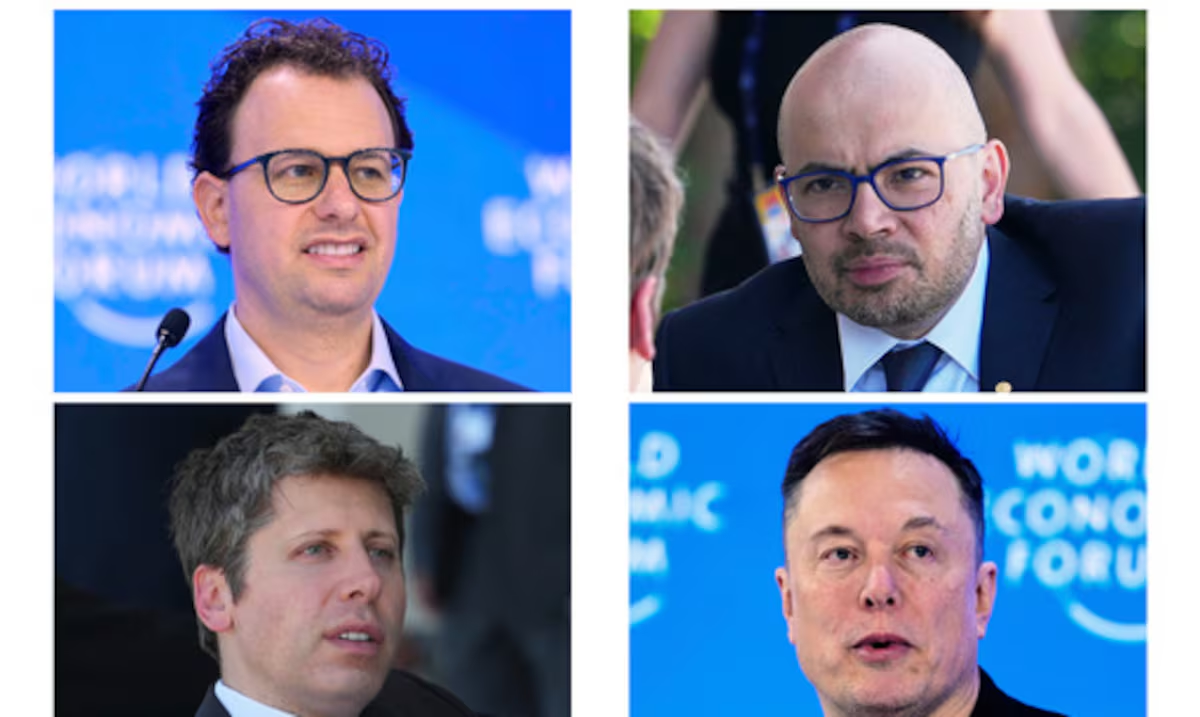
A new lawsuit claims that Anthropic, OpenAI, SpaceXAI and Google reached an illegal agreement to slow down the pace of their respective development in the field of artificial intelligence (AI).
The lawsuit, filed Friday in the U.S. District Court for the Northern District of California, alleges that major artificial intelligence companies violated competition laws by agreeing to coordinate their efforts to slow developmentand that this would reduce the value that consumers obtain from their paid subscriptions to artificial intelligence services.
According to the lawsuit, the coordination largely took place on September 12, when Anthropic CEO, Dario Amodeipublished an article in which it urged the entire sector to cooperate to stop the advances and reinforce security measures. That same day, OpenAI CEO Sam Altman; the CEO of SpaceXAI, Elon Musk; and Google DeepMind co-founder and president Demis Hassabis publicly responded to Amodei’s proposals and agreed with them.
However, the lawsuit also alleges that coordination began taking shape months earlier. He points to a July 2026 statement signed by senior officials at several major AI labs, which acknowledged the “intense competitive pressure not to unilaterally slow down” development. This statement urged the Government to support a global initiative to stop the automated development of AI.
The plaintiffs argue that an agreement between major rivals in AI to make progress “slower than competition would otherwise allow” clearly has an anti-competitive effect on consumers.
A group of attorneys representing four identified plaintiffs, payment subscribers of ChatGPTClaude, Grok or Gemini, filed the lawsuit on behalf of a proposed nationwide class action lawsuit that would include other paying subscribers to such services.
The plaintiffs do not object to companies deciding, on an individual basis, to slow down their own progress in the interests of security. Instead, they allege in the lawsuit that antitrust laws prohibit them from taking the “shortcut” of agreeing to “substitute collective restraint for individual responsibility.” A competitive market allows for responsibility and genuine progress, the lawsuit argues.
“AI will quickly escape human control and could kill us all if we allow AI security and protocols… to be controlled by private, selfish agreements between the world’s most powerful ‘for-profit’ technology companies.”said Nick Rowley, the lead attorney for the plaintiffs.
Representatives for Anthropic, OpenAI, Google and SpaceXAI have not responded to a request for comment sent Saturday.
In his initial essay proposing the slowdown, Amodei acknowledged the potential for antitrust issues and wrote that it would be helpful for the U.S. government to mediate “or at least facilitate” these talks between the labs. The Government will not have to intervene, he wrote, but it will have to “grant a limited exemption for certain types of security conversations.”
In response, Altman noted in the social networks that OpenAI He welcomed the idea of a “federal framework that establishes consistent security requirements,” but added: “We don’t think we have to wait for an antitrust waiver or legislation to start working on building that trust.”
Although recent debates about the pace of development have been driven by growing concerns that AI will escape human control, several AI leaders have long talked about developing a common set of standards or, alternatively, coordinating to ensure that security efforts remain a priority.
1/17 | Impressive: China exhibits its advances in artificial intelligence and robotics in Shanghai. A realistic-looking robot head watches a visitor during the World AI Conference. – Ng Han Guan
The plaintiffs maintain that they do not oppose artificial intelligence companies asking Congress, the White House or any other agency that develops regulation on artificial intelligence, nor do they oppose such companies requesting an exemption from antitrust legislation.
However, achieving that kind of collaboration with the federal government could prove to be an arduous task.
The American president donald trump rejected calls to regulate social media. He has claimed that any attempt to limit technology is part of a “conspiracy.” He questioned why industry leaders would ask for regulation that, according to him, “if applied firmly, will lead them to oblivion and bankruptcy.” Trump said on social media Saturday that he is forming an AI task force and will appoint an “AI czar,” but gave few details.
The Trump Administration has expressed its desire for American laboratories specialized in artificial intelligence to surpass and prevail over Chinese competition. While several Democratic leaders and candidates have called for far-reaching action on AI regulation, Republicans have largely mirrored Trump’s stance.
Sen. Josh Hawley, R-Mo., told a recent Senate hearing that “there is no scenario” in which he would agree to grant “the most powerful companies in the history of the world” an exemption from antitrust laws so they can collaborate, arguing that they could collude and stifle competition.