
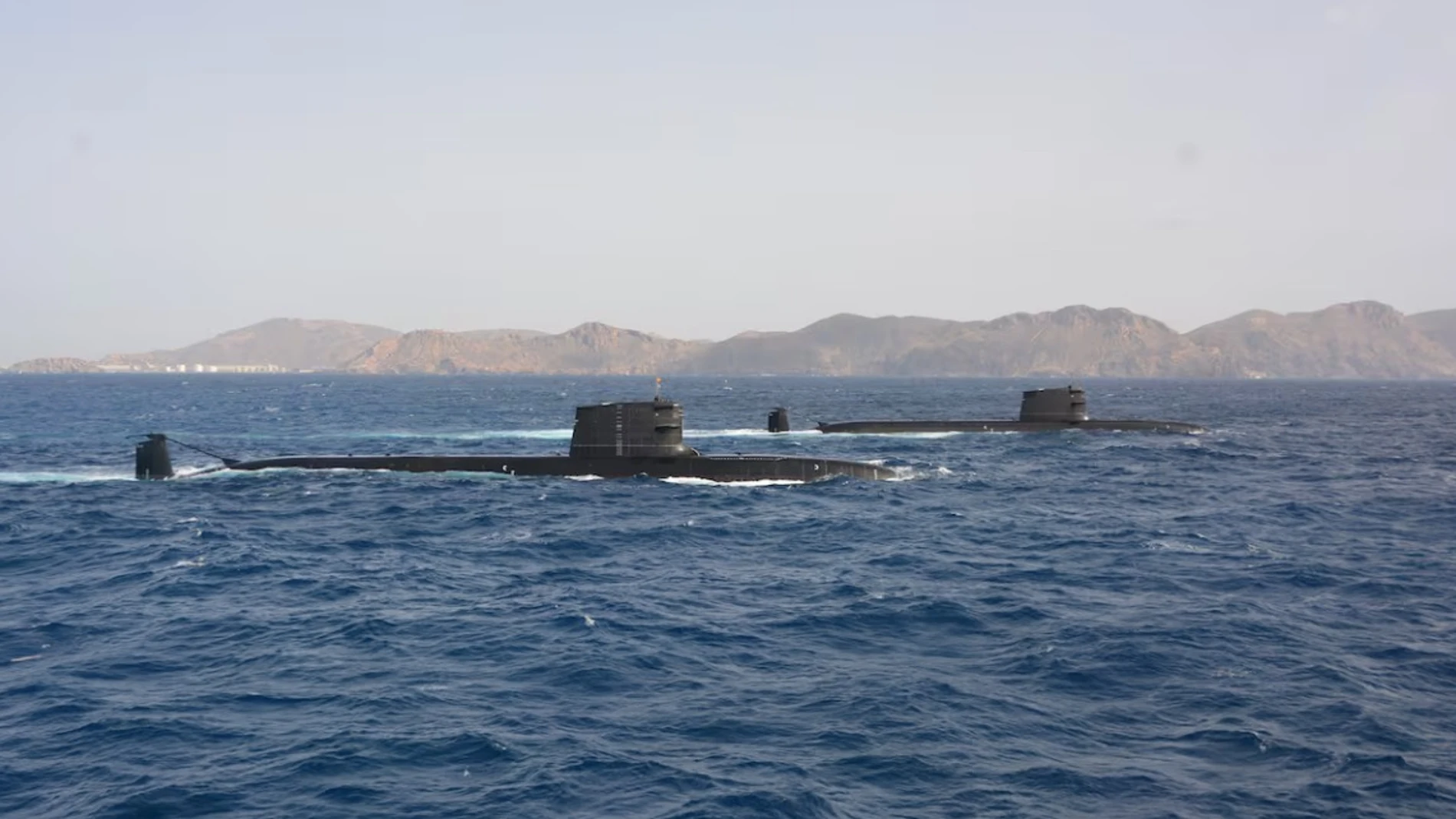
Spain, as a peninsular country, must have a Navy up to the task, since it is the maritime (and air) environment that has the most impact within the armed forces. Currently, and according to the Global Fire Power website, Spain holds the sixteenth position in naval capabilities.
The truth is that it is a good position in a ranking that is extensive and that includes the best navies on the planet. A ranking that has risen over the years thanks to the Government’s investment in its Navy. It has recently been proven that this invested capital has been well spent when two of the latest generation submarines that will soon equip its naval forces have been observed at sea.
The joint departure of the two submarines has marked a new milestone for the submarine weapon within the Navy. As Defense magazine has mentioned, the fact that S-81 and S-82 have shared this journey simultaneously reflects “on the ground the advance of a strategic capability designed to reinforce the security of Spain’s defense.”
During the route carried out, both ships have had different tasks. The S-81 has made the trip as a means of training for its crew, while the S-82 has carried it out for real tests on the high seas. The latter is a key process, since it is used to verify the behavior of the platform and systems before there is an official incorporation into the Navy.
Regarding the Narciso Monturiol, it is not the first time it has gone out to sea. The submarine began its tests at the end of last June and, the following month, it achieved one of its milestones with its static immersion in the waters near the La Algameca Naval Base, in Cartagena (Murcia). On the other hand, the Isaac Peral is an old acquaintance that completed its first deployment in Operation Sea Guardian within the framework of a NATO mission in November 2025. It already has no less than forty-six days of navigation, 840 hours of immersion and a total of 5,050 nautical miles traveled. Figures that clearly and clearly show the capacity of the new submarines manufactured by the Navantia firm.
In addition to being able to carry out basic missions for this type of ship, the S-80 series is much more. Among their characteristics, Navantia submersibles provide advanced surveillance, reconnaissance, intelligence and pioneering naval warfare and, of course, a wide range of possibilities regarding discretion, autonomy and special operations. In short, these submarines constitute an element of great value for military deterrence. It has nothing to do with the fact that they have a conventional propulsion structure, since their performance has been applauded both nationally and internationally. For the submarine commander, Lieutenant Commander Fernando Clavijo Rey-Stolle, the Isaac Peral provides “improved intelligence gathering capabilities compared to the previous series, along with technologically advanced equipment that allows us to cooperate with other units at greater distances and with greater precision in information.”
Extensive capabilities
Apart from Navantia’s good efforts, the incorporation of these two S-80 series submarines into the Spanish Navy will have immediate consequences. Its extensive capabilities will help improve military deterrence against the country’s competitive and potential enemies. That Spain has naval forces to match is essential, especially if we look to the south, where Rabat has aspirations of all kinds regarding Spanish sovereignty. Therefore, the arrival of the S-81 Isaac Peral and the S-82 Narciso Monturiol are, therefore, a great addition to increase the power that Spain can deploy in the Strait of Gibraltar. The message that is sent with this joint journey is clear for the Alawite kingdom.
Right now, and after the biggest migration crisis that Spain has suffered in its recent history, the eyes of the armed forces and analysts are on the North African country. Spain’s direct competitor on the southern front of Europe is fighting with the hope of obtaining economic concessions or aspiring to control territories that have never been part of its State.
Experts and analysts point out that Morocco, for now, could not sustain a naval conflict in Atlantic and Mediterranean waters. Its naval forces are much inferior (ranked thirty-eighth according to the website cited above). The distance between Spain and Morocco must continue to widen to prevent the authorities in Rabat from having the intention of using force to achieve what they have not achieved until now. The S-81 and S-82 arrive to widen that gap.