
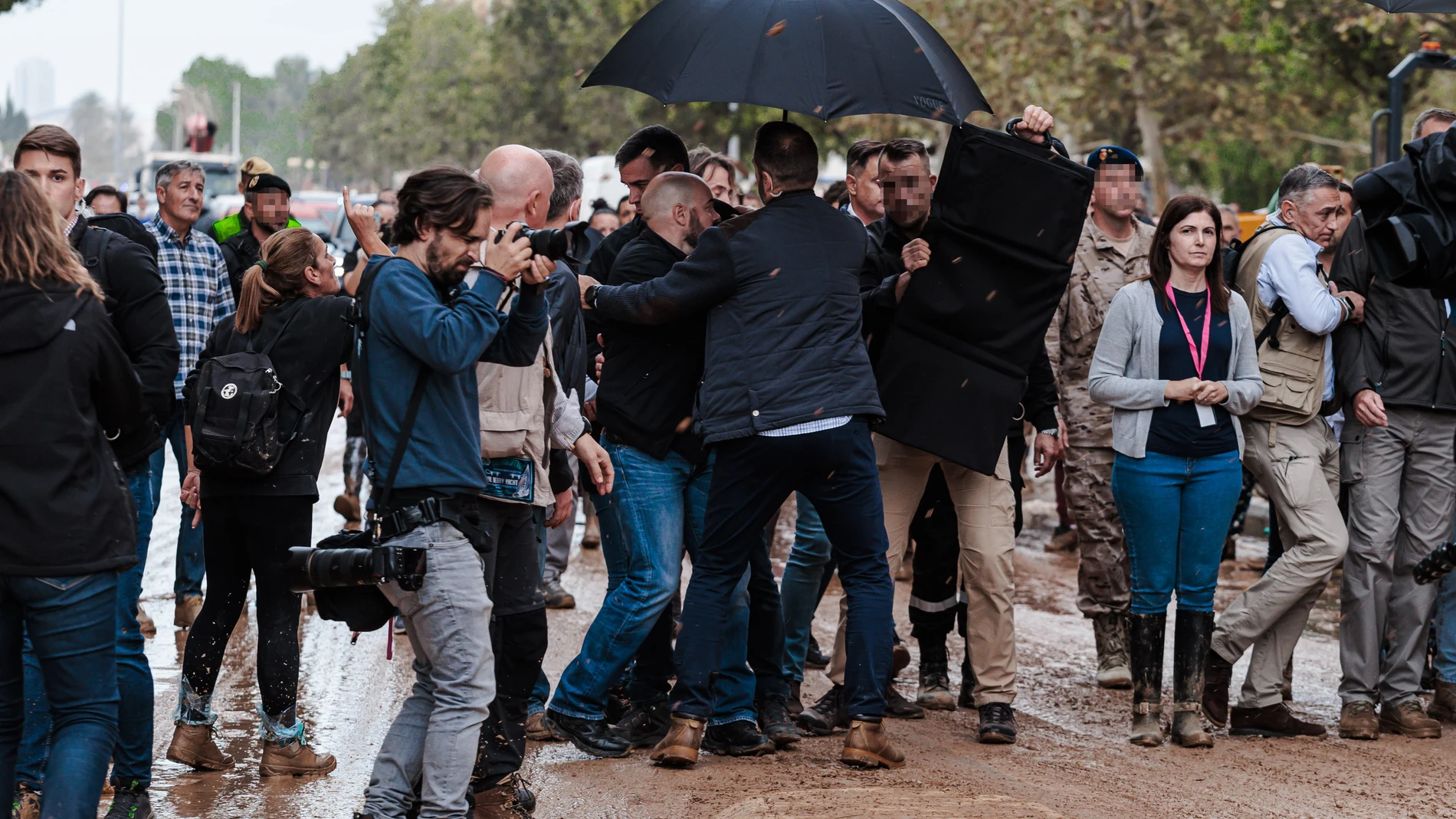
Pedro Sánchez knows that there are photographs that last an eternity and that only history can judge. Paiporta’s is one of them. That day it rained mud on the streets. Also about him and about the Kings. In short, mud rained on the State itself. Felipe VI, Letizia, Pedro Sánchez and the former Valencian president Carlos Mazón arrived together.
But they didn’t go together. The security detail evacuated the President of the Government while the Kings and Mazón remained enduring the shower of violence.
Then came the explanations. They always arrive. Yes, security. Yes, the risk. Yes, the protocols. Surely they were all true. But photographs have an unpleasant habit: they do not allow footnotes.
And that photograph was kept in the national historical archive. Almost two years later, Pedro Sánchez may once again find himself in front of one of those images that a president cannot control. And this time it may be in Ceuta. Felipe VI and Queen Letizia prepare their trip to the autonomous city. There is no set date yet. It is also not publicly decided whether Sánchez will travel with them. But in Moncloa they know that the issue is on the president’s table.
Ceuta has been needing something more than ministers for weeks. A few have passed by there. Also secretaries of State, police, military, officials and politicians of all administrations. The Government has created a single command to try to regain control of a crisis that for too long seemed to have several commands and too many versions. The Kings will go soon. That is: the State.
Sánchez knows it perfectly. In fact, it was he himself who announced in Congress that Felipe VI would travel to Ceuta and Melilla to convey the State’s commitment to both cities. And that’s where the problem appears for him.
Because if the trip is intended to symbolize the physical presence of the State after one of its greatest crises, it will be impossible for the presence – or absence – of the President of the Government to go unnoticed. If Sánchez goes, he will have to expose himself. If you don’t go, you’ll have to explain it.
Politics sometimes has extraordinary dilemmas. The memory of Paiporta also turns the possible trip into something different. Ceuta is not Paiporta. Neither the circumstances are comparable nor should a natural catastrophe that left hundreds dead be confused with a migration, border security and territorial integrity crisis. But there is a common element: both places became for weeks the physical representation of a State failure.
In those moments, citizens not only expect the State to function. They also want to see it. Felipe VI learned a long time ago a peculiarity of being King. There are places where one goes precisely because one would prefer not to have to go. Sánchez also knows it.
A president enjoys inaugurating trains, announcing investments or receiving medals. It is much less pleasant to walk through the scenario of a crisis whose management he has been defending alone for weeks.
But that’s what power is also for. In Moncloa they know the risk perfectly. Ceuta has accumulated anger, fatigue and a feeling of abandonment. The opposition has turned crisis management into one of its main arguments against Sánchez.
And any presidential visit would be surrounded by cameras capable of turning a gesture, a scream or twenty uncomfortable seconds into the viral image of another day for the happy national historical archive.
Paiporta taught precisely that. Sánchez was there and ended up leaving before the Kings. That outbreak marked a before and after in the relationship between Moncloa and Zarzuela. Sánchez can still decide if he will be in Ceuta.
Felipe VI has the capacity for representation and influence, but not for political direction. Their action in the face of the Ceuta crisis requires collaboration and acquiescence from the Government. The visit would have a strong symbolic, security and foreign impact, especially in Morocco, so it must be coordinated between Zarzuela and Moncloa. How it ends is a different thing.