
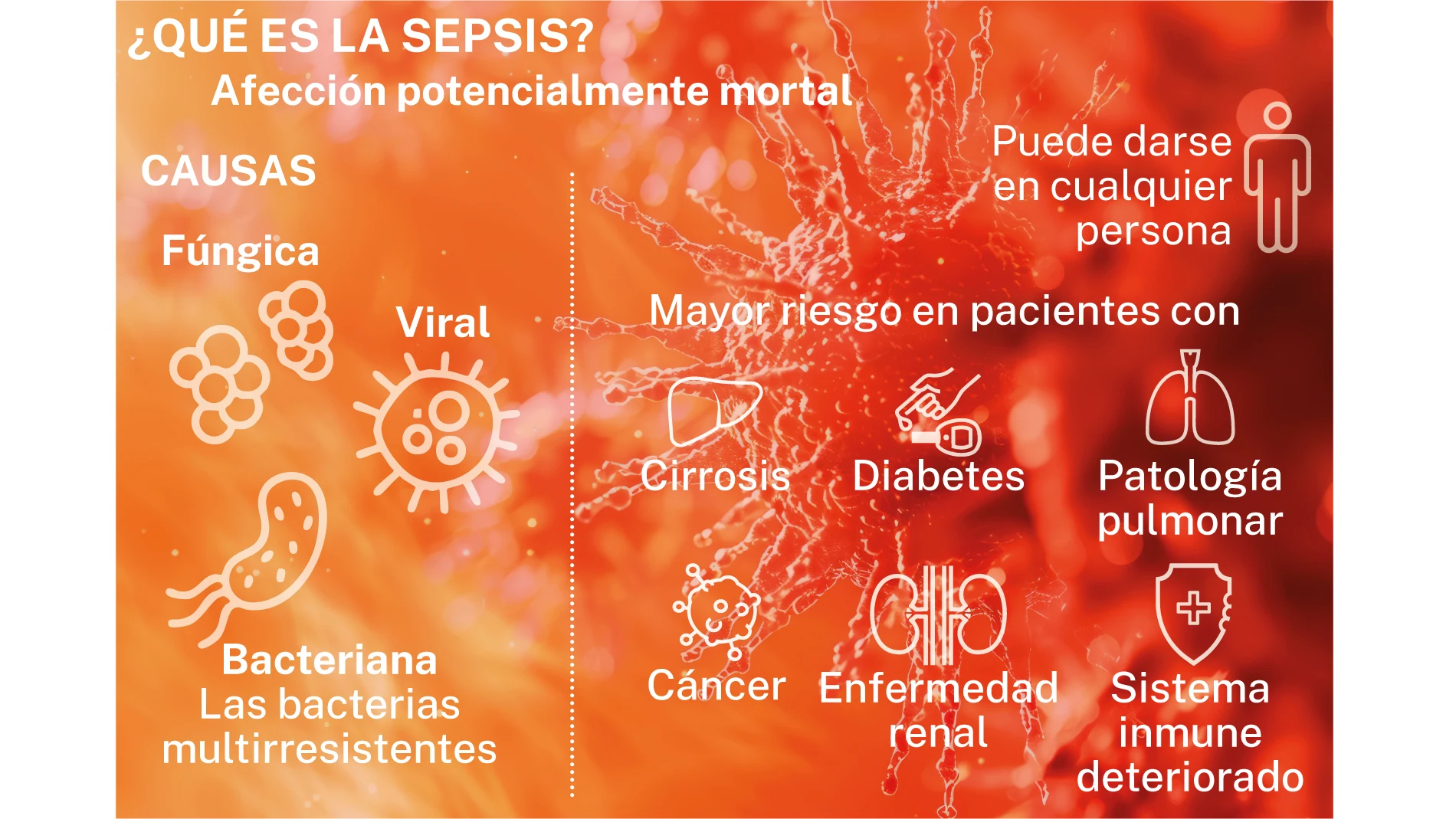
Sepsis is not a new, unknown, or rare disease, but it is one of the great silent emergencies of modern medicine. It appears without warning, it is confused with banal infections and, when it shows its true face, it has already set in motion an inflammatory process capable of destroying organs in a matter of hours. Every year, thousands of people in Spain develop severe sepsis or septic shock. Many survive, others do not, and a growing number suffer physical and psychological consequences that last for years.
This Sunday, on the occasion of World Sepsis Day, Specialists remember that the key remains the same: time. Every hour without diagnosis or treatment increases the risk of death. But today, for the first time, science is beginning to offer tools that could change that critical margin.
The first major transformation comes from the microbiology laboratories. “The developments that allow sepsis to be detected to prevent multi-organ failure from occurring are fundamentally those based on new diagnostic tests that allow results to be given more quickly,” he explains. Luis Buzón, spokesperson for the Spanish Society of Infectious Diseases and Clinical Microbiology (Seimc).
It’s not just about blood cultures anymore. Hospitals work with ultrafast PCR in cerebrospinal fluid, tissue biopsies, urine or respiratory samples. The technology allows the microorganism to be identified in hours, not days.
But that speed has one condition: that there be a microbiologist available 24 hours a day. “It is critical that there be a microbiologist in the hospital to work on the samples at the time they receive them,” insists Buzón.
AI, more effective than a doctor choosing antibiotics
Sepsis is a race against the clock. And microbiology, which for decades was a slow and manual process, has become a key piece of precision medicine. Spain is also being a pioneer in the use of artificial intelligence to choose the most appropriate antibiotic based on the patient’s profile and the microorganism.
“We already have examples in Spain that AI is more effective than a doctor choosing antibiotics in specific profiles”explains the specialist. It is not about replacing the clinician, but rather giving them tools to decide faster and with more information.
But even with the best diagnosis, sepsis still has an unpredictable component. “The development of multiple organ failure does not depend only on the early diagnosis and treatment,” recalls Buzón. The evolution depends on the interaction between the microorganism and the patient’s genetics.. Two people with the same infection can have radically different outcomes.
Research is moving towards models that allow predicting this individual response. A recent scientific article published in Frontiers in Medicine suggests that, in a few years, it will be possible to anticipate which patients are most at risk of developing severe sepsis or septic shock. Today it is just a hypothesis, but AI and biomarkers They are accelerating that path.
Meanwhile, the septic shock treatment (the most serious complication of an infection, causing a drastic drop in blood pressure and failure of vital organs to function) continues to evolve.
International guidelines review the indications for fluid therapy, vasopressors and resuscitation from time to time. But the essential scheme remains: “In the treatment of septic shock there are three steps that never change. The first is to locate the focus of the infection and resolve it as soon as possible, either through drainage, surgery or acting directly on the affected area. The second is rapid resuscitation with intravenous fluids, essential to reverse the sudden drop in blood pressure and restore organ perfusion. And the third is to immediately start effective empirical antibiotic treatment, without waiting for the result of the culture. We start with broad-spectrum antibiotics and, When the laboratory identifies the microorganism, the treatment is adjusted. Speed saves livesbut the biology of the patient is still decisive,” explains Buzón.
On the other hand, sepsis is no longer understood only as an acute emergency. The new international guidelines focus on the physical and psychological consequences What survivors suffer: cognitive impairment, chronic fatigue, post-traumatic stress disorder, anxiety, depression and functional difficulties.
To understand the speed with which sepsis acts, just listen to Alicia Hernanz, delegate of the Spanish Association against Meningitis and Sepsis (AEMS) in Castilla y León. His daughter Lucía was 13 months old when a seemingly mild infection turned into fulminant sepsis. It was Carnival and the girl had spent the day well. At night he started moaning in the crib. Nothing alarming. A few hours later he had a fever of 40. At the health center they recommended alternating ibuprofen and paracetamol. “The first symptoms usually seem like a banal disease. It’s not that they don’t know how to see it, it’s just that it doesn’t show its face in the early stages,” explains Alicia.
“Like a rag doll”
But at 9:00 in the morning, the girl was unrecognizable. “I was hanging like a rag doll. I had purple lips, reticular skin, all white, with marked veins. I didn’t respond.” The pediatrician asked them to go to the health center immediately. There was no medicalized ICU in the area. If they called the helicopter, it wouldn’t arrive in time. The only option was to drive 60 kilometers to the Segovia Hospital.
In the car, petechiae began to appear on the girl’s face. “I saw how they were drawn one by one. He vomited ‘with a shotgun’, he didn’t even admit water, he barely opened his eyes. I thought I was dying in the car“. In Segovia, the doctors acted immediately. They could not channel a line because the blood was already clotting. They put it on her head. “They told me that she had septic shock, that she was very serious and that they did not know if she would survive.” Only if they managed to stabilize her could they transfer her to the Ramón y Cajal. They managed it within minutes.
Lucía spent 18 days in the pediatric ICU, thirteen of them in an induced coma. He suffered a thrombus in his heart, added infections and risked losing limbs. After the ICU, he returned to Segovia to continue with direct heparin to the heart. At home, his parents had to continue injecting him every day.
Recovery was slow. Lucía did not crawl or walk. For almost a year, the family lived among neurologists, cardiologists and early care. “You’re so scared that you keep wondering what you’ve done wrong,” Alicia admits. Finally, the girl had no consequences. Only a small mark on the back due to necrosis of the petechiae.
A few months after living the hardest experience of her life, Alicia started working at the Irene Megías Foundation against Meningitis, which was the only association of those affected that existed at that time. 10 years ago, he co-founded the AEMS, of which today she is a delegate in her community. Struggle so that no family arrives at the emergency room without knowing what sepsis is, encouraging doctors to make patients and their families aware of the existence of the Association, where they can help and accompany them.
Infectious, the specialty that does not arrive
Spain is the only Western country that does not yet recognize the specialty of Infectious Diseases. “It is an anomaly, it has no logical explanation,” explains Buzón. “The absence of this specialty represents a loss of quality in the health system and especially when there is a reason why it should not be delayed even one more day, which is that Patients with complex infectious diseases treated by infectious disease specialists have lower mortality. This is widely demonstrated in scientific and clinical evidence. “Simply for this reason it is not acceptable that a Spaniard has a greater or lesser risk of mortality for a pathology depending on how lucky he is that his reference hospital has or does not have an infectious specialist.”
Its absence “represents a loss of quality of care,” especially when it has been widely demonstrated that patients with complex infections treated by specialists “have lower mortality,” Buzón details. “We don’t know what Health is waiting for, honestly. Every day that passes without the specialty is a comparative insult for the patients treated in our country.”