
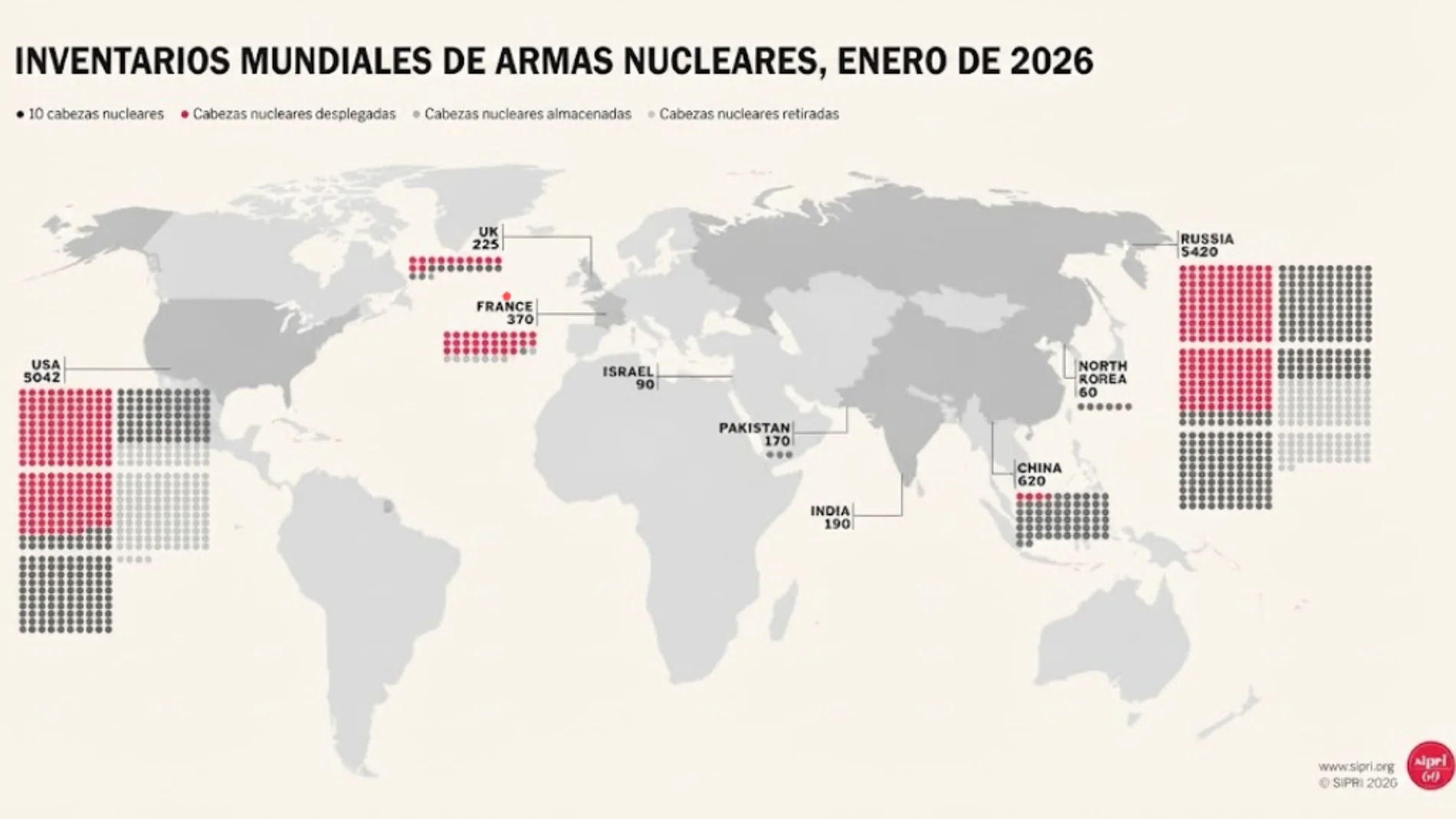
For decades, the number of nuclear weapons in the world followed a slow but steady downward slope. The Cold War ended and, although the United States and Russia (responsible for 86% of the nuclear total) kept arsenals capable of destroying the planet several times over, they were dismantling a good part of the weapons that had been out of service. Now that trend is beginning to change. Not because there are more nuclear weapons in total, but because there are more that can be used.
The new report from the Stockholm International Peace Research Institute (SIPRI) places the number of nuclear warheads in the world at around 12,187 in January 2026, compared to the 12,241 estimated a year earlier. The total figure, therefore, continues to decrease. But within it there is a much more disturbing fact: the warheads that are part of military arsenals and that could be used have gone from 9,614 to 9,745. YesThere are about 130 more in just one year. Those deployed on missiles or alongside operational forces have also increased, from 3,912 to 4,012.
The explanation lies largely in the increasingly slow pace at which the United States and Russia dismantle their retired weapons. Both countries still accumulate more than a thousand retired warheads waiting to be destroyed. For years, that dismantling more than offset new weapons made by other powers. SIPRI now warns that this relationship could be reversed: The rate of destruction is decreasing and could soon be surpassed by the entry of new warheads into military arsenals.
China occupies a central place in this change. Its arsenal has gone from about 600 warheads in January 2025 to approximately 620 a year later. It is the third nuclear arsenal on the planet, still far behind the United States and Russia. But no other country is increasing its arsenal at the rate of China.
Growth is not limited to making more warheads. Beijing is also transforming the architecture of its nuclear force. For decades it kept nuclear warheads separate from its missiles in peacetime, a policy that reduced the risk of accidental or unauthorized launches. SIPRI estimates that this practice could be beginning to change. By early 2026, up to 34 Chinese warheads could have been deployed with operational forces, although the vast majority remain in storage.
At the same time, China is building and filling new silo fields with missiles. The United States has estimated that during 2025 Beijing loaded more than a hundred missiles into three large silo complexes. That does not mean that these missiles are armed with nuclear warheads: there is no public evidence to confirm this. But it does reveal the dimension of an expansion that can change the strategic balance of the coming decades.
SIPRI points out that China could have at least as many ICBMs as the United States or Russia by the end of the decade. And even if it reached 1,000 warheads in 2030, it would still have approximately a quarter of those that Washington and Moscow possess today. The issue, therefore, is not that China is still catching up with the two great nuclear powers, but that it is rapidly closing the gap.
The Chinese movement is part of a broader phenomenon. The nine nuclear weapon states (United States, Russia, United Kingdom, France, China, India, Pakistan, North Korea and Israel) continued to modernize or expand their arsenals during 2025. India increased its slightly, to about 190 warheads, and North Korea would have reached about 60, while Pakistan, Israel, France and the United Kingdom roughly maintained their previous numbers. France also announced in March 2026 that it will increase the number of warheads in its arsenal.
The result is a paradox. The world has fewer nuclear weapons today than it did a year ago, but it has more weapons ready or potentially available for nuclear war. The difference may seem small compared to the thousands of warheads accumulated during the Cold War, but it signals a change in direction.
And there is another element that makes the scenario even more uncertain. The New START treaty, which for years provided limits and transparency mechanisms for the strategic arsenals of the United States and Russia, expired in February 2026 without a replacement agreement. At the same time, SIPRI warns that nuclear states are being less and less transparent about their capabilities.
The era of major nuclear reductions is not exactly over, but it does appear to be reaching a tipping point. Retired weapons still disappear faster than they are manufactured. The question is how long that difference can be maintained. Because if China continues to increase its arsenal, other powers modernize theirs, and the United States and Russia stop dismantling weapons at the previous rate, the global nuclear counter could begin, again, to move in the opposite direction.