
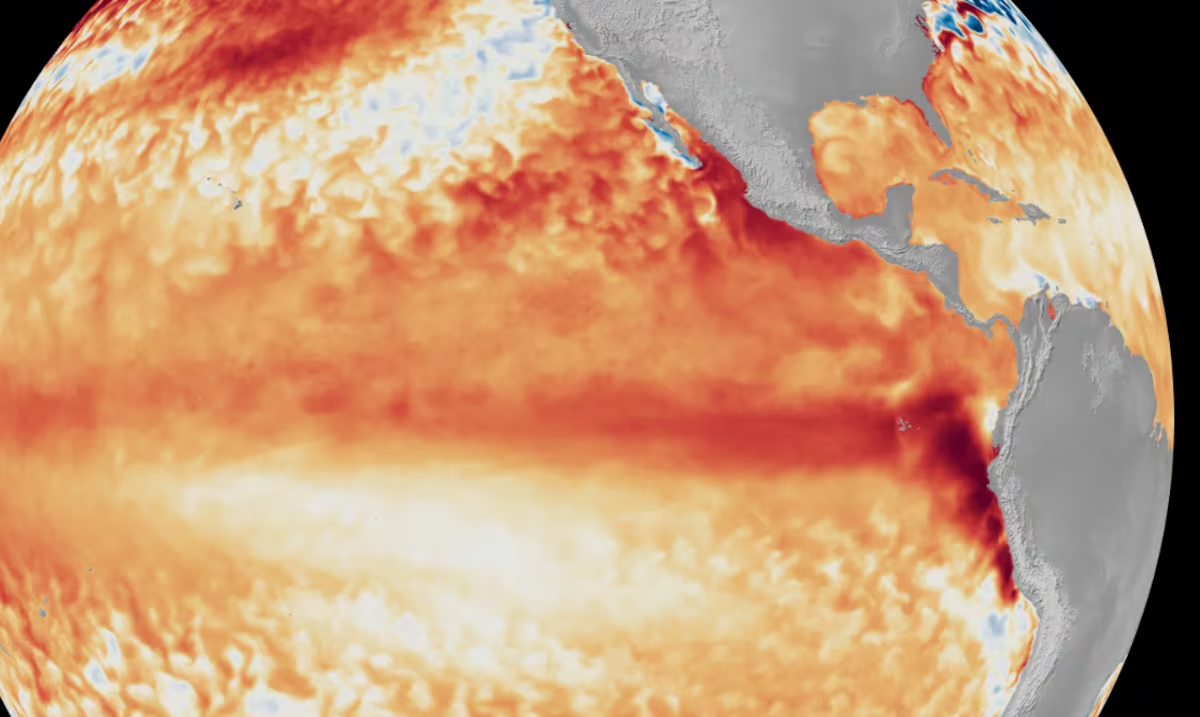
This Thursday, the oceans mark 100 consecutive days of unprecedented heat, the main driver of which is climate change, with “disastrous consequences” for the world. marine ecosystems and “important impacts” for the economy or the weather, among other areas, according to experts.
Several scientists who monitor daily sea surface temperature (SST) at a global level have analyzed today in a virtual meeting the latest findings on ocean warming, a situation aggravated this year by the effects of The Child.
They emphasize, among others, that the burning of fossil fuels is warming the planet and the oceans absorb most of that heat, at a rate that in the last two decades is more than double that of the previous 40 years.
In the last decade alone, about 104 zettajoules (a unit of heat equivalent to one trillion joules of energy, equivalent to 1.7 billion atomic bombs) have been added to the ocean.
They also reveal that the ocean has absorbed 93% of the excess heat trapped in the Landbut that safety cushion is weakening, as temperatures rise rapidly and the oceans absorb less and less CO2.
Data show that climate change has caused marine heat waves to be ten times more intense and last three times longer than before, and half of those recorded since 2000 would not have occurred without global warming, according to this.
Tom Pickerell, Global Director of the Ocean Program and Head of the Secretariat of the High Level Panel for a Sustainable Ocean Economy, World Resources Institutebelieves that prolonged ocean warming “is not just an environmental issue; it is, to a large extent, an economic shock.”
In his speech, he considers that “one hundred days of prolonged and record heat means prolonged stress on the natural infrastructure that supports food, employment, commerce, tourism and also energy systems.”
For his part, scientist Zachary Labe, from the American organization Climate Central, emphasizes that “the factor driving this record warming is climate change; that is, the long-term warming trend.”
That warm-up “It is not limited to a single part of the ocean, but has a global character”he adds.
Regarding the impact of El Niño, he points out that “it is not only El Niño that is causing these extremely warm conditions, but the Mediterranean has been a particularly warm spot in recent months.”
The conditions of heat wave marine “continue through Western Europe and extend towards the Mediterranean” and high temperatures are also recorded in other parts such as the Gulf of Mexico.
Important consequences
“Major impacts” of ocean warming include effects on marine ecosystemsfor example, through corals; the displacement of the geographical distribution of the components of the food chain of these ecosystems; the impact on the economy, on fishing and tourism and on the physical and meteorological climate system.
1/7 | What is El Niño? The meteorological phenomenon that could be “very strong” this year. The El Niño weather phenomenon formed in the tropical Pacific, expected to be “very strong” and bring a “prolonged” period of above-average temperatures. – NOAA
“Some of the connections that really worry us with these increasingly warmer oceans are those related to tropical cyclones and hurricanes”says Labe.
Another “key impact” concerns increased coral bleaching, “an especially important concern during this El Niño year, which is making sea surface temperatures even warmer.”
Claire Bergen, researcher at the ICARUS Climate Research Center, Maynooth University, Ireland, warns that “even a 1 degree increase in sea temperature can have significant effects on marine life.”
“Extremely high sea surface temperatures and marine heat waves have disastrous consequences for marine ecosystems, causing mass mortality episodes of habitat-forming species such as corals, sponges and macroalgae.”
“A rapid transition away from fossil fuels is essential to preserve critical ecosystems, fisheries, food production and tourism,” he says.
In the region of Latin America and the Caribbeanexperts warn that coastal erosion is becoming an economic problem for Chile’s tourism industry, a country that could lose up to $60 million a year by the end of the century due to the erosion of its beaches.
In addition, El Niño Costero generated a 73% year-on-year drop in the Peruvian fishing sector in May 2026, reaching its worst results in six years and motivating a 42% drop in manufacturing linked to fishing activities.