
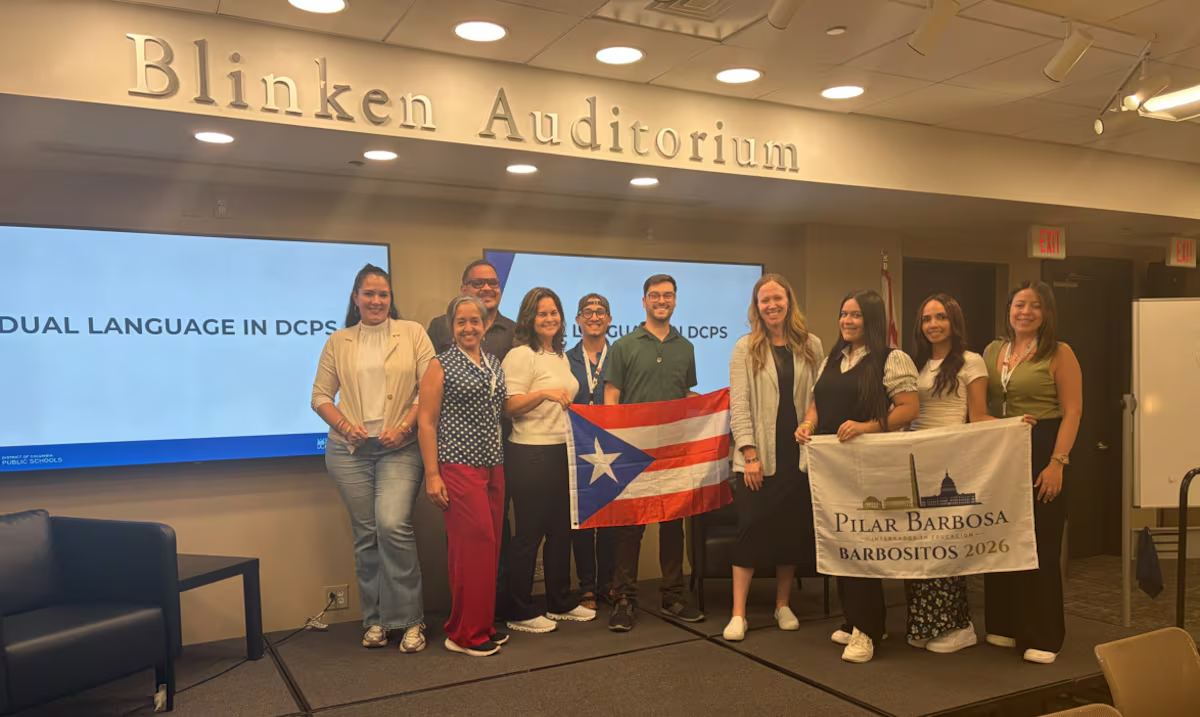
The integration of artificial intelligence (AI) tools in classrooms and bilingual education were some of the topics in which the ten educators from the public education system who recently participated in the Pilar Barbosa Boarding School in Washington DC delved deeper.
Held from August 10 to 21 at The Washington Center, the internship benefited eight teachers and two administrative teachers from the Regional Educational Offices (ORE) of San Juan, Arecibo, Bayamón, Mayagüez and Ponce, selected after a competitive candidate evaluation process.
In the federal capital, Puerto Rican educators received specialized training in educational leadership, integration of technology in the classroom, innovative pedagogical strategies, bilingual education, and federal public policy related to education.
They also visited the headquarters of the federal Department of Education, the Puerto Rico Federal Affairs Administration (PRFAA) and the Office of the Resident Commissioner, reported Carlos Yancy, teaching facilitator of English and Bilingual Schools at the ORE of Arecibo and faculty director of the boarding school participants.
“It was an enriching experience that exceeded my expectations. It was an opportunity to open my eyes to an educational world beyond the classroom,” said Joanmarie Rosado, an English teacher at the José Santos Alegría High School in Dorado, who has already begun to implement part of what she learned in Washington DC.
“At the boarding school they gave us a workshop on how to create books, presentations and infographics with artificial intelligence,” said Rosado. “I really like integrating technology, since we are faced with the challenge of educating a generation that is technological, but does not know how to take educational advantage of technology.”
He said that this semester he began using AI tools to, for example, make games based on topics tested on the College Board test. He also created infographics to show, in a more visual way, the elements of a story.
Yancy added that, in the workshops, teachers were taught how to write prompts (prompts) for AI and how to use this tool to make evaluation instruments, write stories and create recreational activities, such as games. memory cards of the parts of the cell.
“I thought: ‘If I use artificial intelligence to do the lesson and the student uses it to answer it, will they acquire the knowledge?’” Rosado recalled. “At the boarding school they opened our eyes to the fact that the future has already arrived and we have to look for other alternatives. If the student is going to create a presentation, they can make an infographic with artificial intelligence, but they must orally demonstrate that they master the subject.”
Regarding the teaching of English, Yancy reported that personnel from the National Association for Bilingual Education (NABE) and public schools in the federal capital and the town of Alexandria, Virginia, guided Puerto Rican teachers on the implementation of bilingual education programs. “Our goal is to develop a student who is a balanced bilingual, who is fluent in English and Spanish,” he said.
The internship is organized every year by the Joint Commission of the Pilar Barbosa Internship Program in Education, attached to the Office of Legislative Services, to promote the professional development of teachers in Puerto Rico through immersive experiences in the federal capital.
The closing of the initiative will be this coming Monday, September 14, at 9:00 am, at the Capitol, where participating educators will present to members of the Joint Commission what they learned during the internship and how they will use it to impact their schools, Yancy reported.
Educators participating in the Pilar Barbosa 2026 Boarding School:
- Dan Franco Colon
- Abimelec Morales Rivera
- Joanmarie Rosado Soto
- Almairy Morales Esteves
- Belimar Ramos Rosario
- Vanessa Lugo Figueroa
- Amarelis Caro Caro
- Damaris Varela Velez
- Fabiola Molina Santiago
- Israel Rivera Guzman