
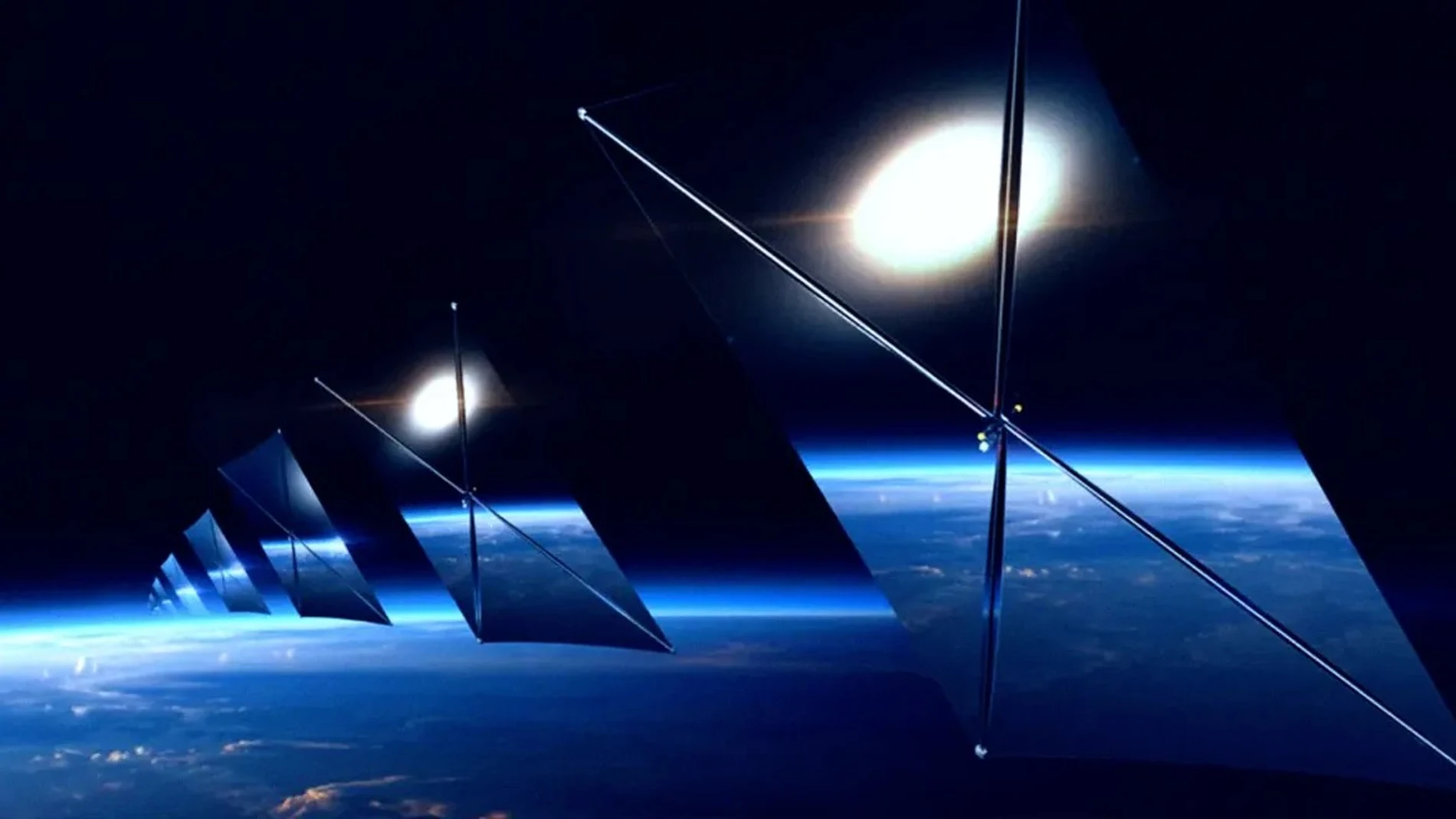
The idea of illuminate certain areas of the Earth at night using large mirrors installed on satellites is getting closer to moving from plans to a real test. The United States Federal Communications Commissionthe FCC, has recently authorized Reflect Orbital to experiment with a satellite designed to reflect part of the Sun’s light back to the Earth’s surface.
The company maintains that this technology could be used to maintain the production of photovoltaic plants after dark or provide lighting in emergency situations. However, the project has also caused a strong opposition between astronomers and other specialists that warn of the consequences of introducing artificial objects capable of reaching very high brightness into the sky. Several experts consulted by The Verge point out that Accidentally observing one of these satellites through certain telescopes could cause permanent retinal damage..
The risk does not refer to seeing them directly with the naked eye, but to doing so using instruments capable of concentrating a large amount of light. According to specialists, a 12 inch telescopeabout 305 mm aperture, which is a relatively common size among astronomy fans, could be enough for the intensity received to be dangerous.
Reflect Orbital has named its first prototype Earendil-1 and intends to use it to verify both the operation of the system and the security measures designed to reduce these risks. Christopher Buscombecompany spokesperson, assures that they are holding conversations with ‘scientists, astronomers, environmental researchers and other interested parties’ before starting the tests.
Warnings about the possible effects of orbital mirrors are also not new. Russia experimented during the 90s with the program Znamyawhich sought to reflect sunlight towards Earth through structures deployed in space. A study published in 2000 by the Royal Astronomical Society of Canada He already pointed out then that observing one of those systems under certain conditions could expose the eye to dangerous levels of light.
Despite these objections, the FCC has decided to authorize the American experiment. Critics informed the organization of the possible risk to eyesight, but The regulator has considered that it was a reduced factor compared to the ‘benefits of allowing American companies to test innovative technologies in space’.
However, this is a considerable risk to human health which makes it ‘extraordinary’ the approval of the FCC, as stated to the media Robert Masseydeputy chief executive of the Royal Astronomical Society.
Another objection from astronomers is that there is currently no system that warns them of when and through what area of the sky Eärendil-1 will pass. This increases the chance that an observer accidentally encounters it while using a telescope..
The potential problems do not only concern the visual health of potential observers. The Air Line Pilots Association has expressed doubts about the impact these flashes could have in air safetywhile several specialists in chronobiology consider that a massive use of these systems could alter the natural night environment.
Among the possible consequences are interferences with human sleep and with the circadian rhythms of animals and migratory species. Presidents of several international chronobiology associations have warned that a large-scale deployment would mean ‘a significant alteration of the natural nighttime lighting environment on a planetary scale’.
Reflect Orbital ensures that it will control the amount of light sent to the surface and that will adjust brightness to levels that ‘humans and animals already tolerate’. Specialists question, however, to what extent this control can be guaranteed due to to factors such as atmospheric dispersion, clouds and changing conditions in each area.
The debate thus joins growing concern over the rapid increase in the number of satellites in low Earth orbit. For astronomers, the possibility of adding objects specifically designed to be very bright introduces an additional problem in an increasingly crowded sky.