
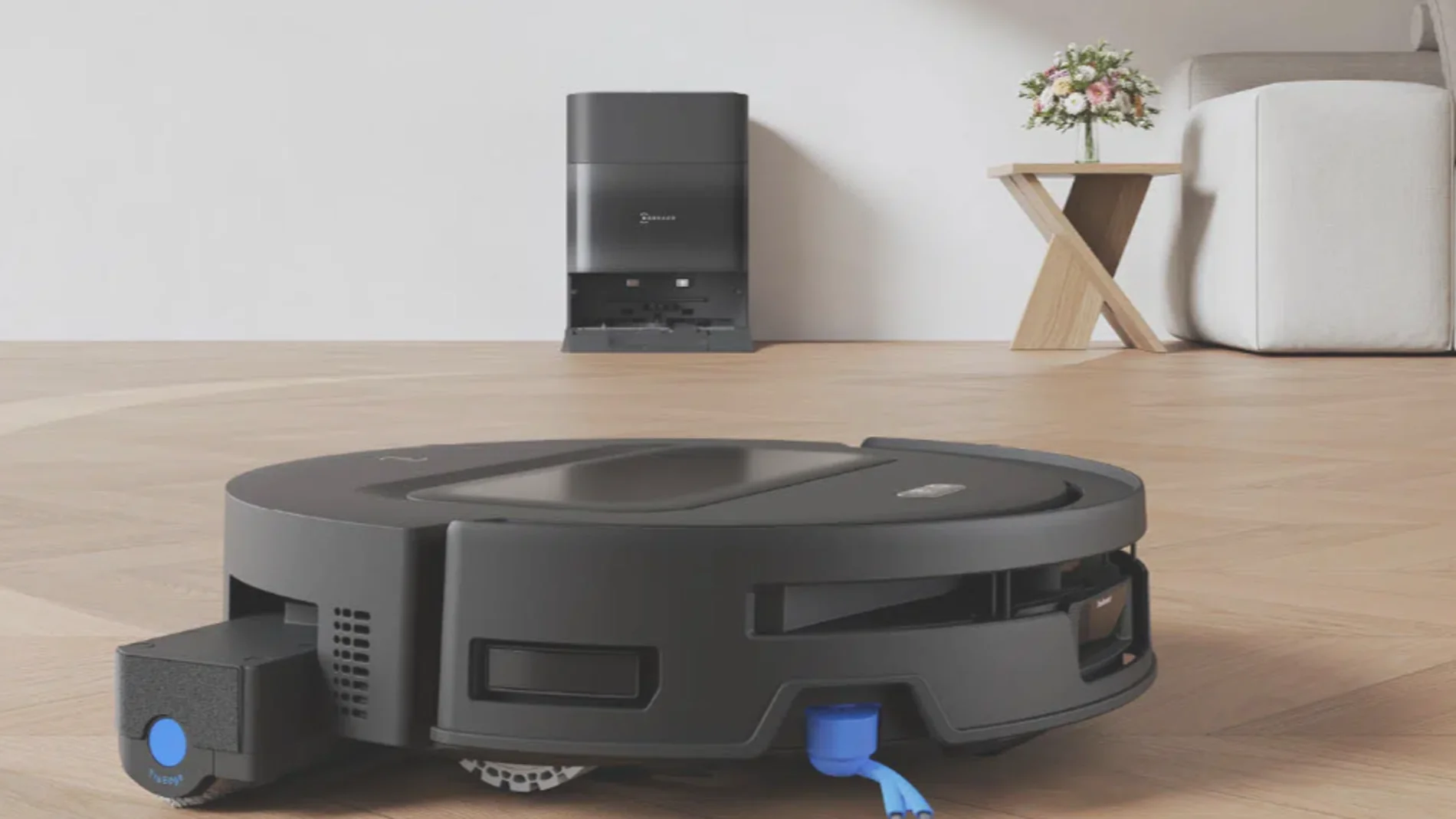
A traditional vacuum cleaner has an advantage that we hardly appreciate: it does not need to know where it is. We push it, it finds a stain and we remove it. A robot vacuum cleaner, on the other hand, faces a problem much more similar to that encountered by robots that explore other worlds: You must orient yourself, recognize obstacles, decide where to move forward, and modify your behavior based on what you find.
At IFA 2026, Ecovacs has presented up to nine new DEEBOT robot vacuum cleaners and has shown a strategy that goes well beyond increasing suction power. The company, named number 1 in the sector by Forbes, wants its machines to be able to better perceive the environment, interpret what is happening in it and adapt their behavior. Cleaning thus begins to look less like a repetitive task and more like a robotics problem.
One of the clearest examples is the new DEEBOT T90S PRO OMNI. Its 40,000 Pa suction pressure and BLAST technology are designed to collect everything from fine particles to larger debris, while ZeroTangle 4.0 attempts to solve one of the most prosaic problems of any vacuum cleaner: hair that ends up wrapped around the brush.
But perhaps more interesting is what happens with noise. Ecovacs has modified the main brush, fan and air ducts to reduce noise by up to 3 dBA during dust collection and up to 5 dBA during vacuuming. The difficulty here is purely physical: moving air with enough speed to carry dirt creates turbulence and noise. Getting a machine to suck strongly while producing less sound forces you to work simultaneously on the airflow, geometry and mechanics of the system.
The T90S also adds AGENT YIKO 2.0, an artificial intelligence system that adapts cleaning strategies to the characteristics of the home, the habits and preferences of the user. In homes with animals, sensors allow pets to be identified and specific cleaning zones to be established to move around them without interfering with their routines. The conceptual leap becomes even more evident in the DEEBOT X12S OmniCyclone. Here Ecovacs combines a 53 AW suction motor with a specific system for carpets, whose brushes are 130% thicker and which, according to the company, can achieve 95.45% mite elimination.
But a carpet poses a different problem than a hard floor: it is not enough to vacuum more. The robot must know what surface is in front of it and modify its behavior. When it detects a carpet, the scrub roller can be raised up to 15 millimeters and a cover creates a barrier to prevent the wet roller from coming into contact with the fibers. It’s a small sample of something that will become increasingly important in home robotics: the ability to change strategy based on context.
The X12S also includes FocusJet, which acts on dry and difficult stains before the roller passes over them, and AIVI 3D 4.0, which allows you to adapt navigation in real time and maintain a safe distance from pets and obstacles. AGENT YIKO 3.0 takes autonomous management one step further: the machine can learn from the characteristics of the home and the user’s habits to optimize your routines. And while the robot learns to clean, it also learns to get less dirty.
Both models incorporate OZMO ROLLER 3.0, based on a 27-centimeter roller that is continuously washed with pressurized water. The idea is simple but important: if the element that collects the dirt is kept clean during the process, the possibility of that same dirt being distributed again on the floor decreases. Added to this is TruEdge 3.0, designed to take cleaning to edges and corners, and PowerBoost, which manages the charge to maintain operation during prolonged sessions. In the X12S, PowerBoost Charging Plus allows you to recover, according to Ecovacs, 13% battery in three minutes.
The real evolution, however, may be in the OMNI stations. For years, the main drawback of robot vacuum cleaners has been that they automated cleaning but not necessarily everything that happened afterwards: emptying the tank, cleaning the mops, removing waste or keeping the system in working order. The X12S OmniCyclone station attempts to close that loop. Its PureCyclone 2.0 system allows automatic emptying of dust without using bagswhile washing, programmed heating of the dirty water tank and automatic drying of different components seek to reduce waste, humidity and odors. According to Ecovacs, the system can save up to 25 bags of dust in five years.
The company has taken this philosophy even to spaces where a large machine would have difficulty operating. The DEEBOT MINI 2 measures only 28.6 centimeters in diameter and concentrates a suction power of 10,000 Pa in that small volume.ZeroTangle 4.0 and OZMO TURBO 2.0, with two high-pressure rotating mops that rise when detecting carpets. Its station is also designed to disappear into domestic architecture: it occupies just 0.13 square meters and integrates emptying, washing, hot air drying and self-cleaning. In homes with pets, it also adds specific strategies for their activity areas and video functions that allow them to be monitored when the user is away.
But perhaps the most significant thing about this new generation is not any specific number. Neither the 40,000 Pa of the T90S, nor the 53 AW of the X12S, nor the millimeters that a roller can lift. The address seems to be different. A first generation of domestic robots learned to move around the house. Then he learned how to clean it. Now begins to learn to interpret it: distinguish a carpet from a hard floor, recognize a pet, locate a stain, decide when to change strategy and keep your own systems ready to get back to work. The vacuum cleaner thus ceases to be a machine that executes orders and progressively becomes a machine that makes small decisions. And perhaps that is the true future of domestic robotics: not robots that do more and more things, but robots that need us to tell them less and less.