
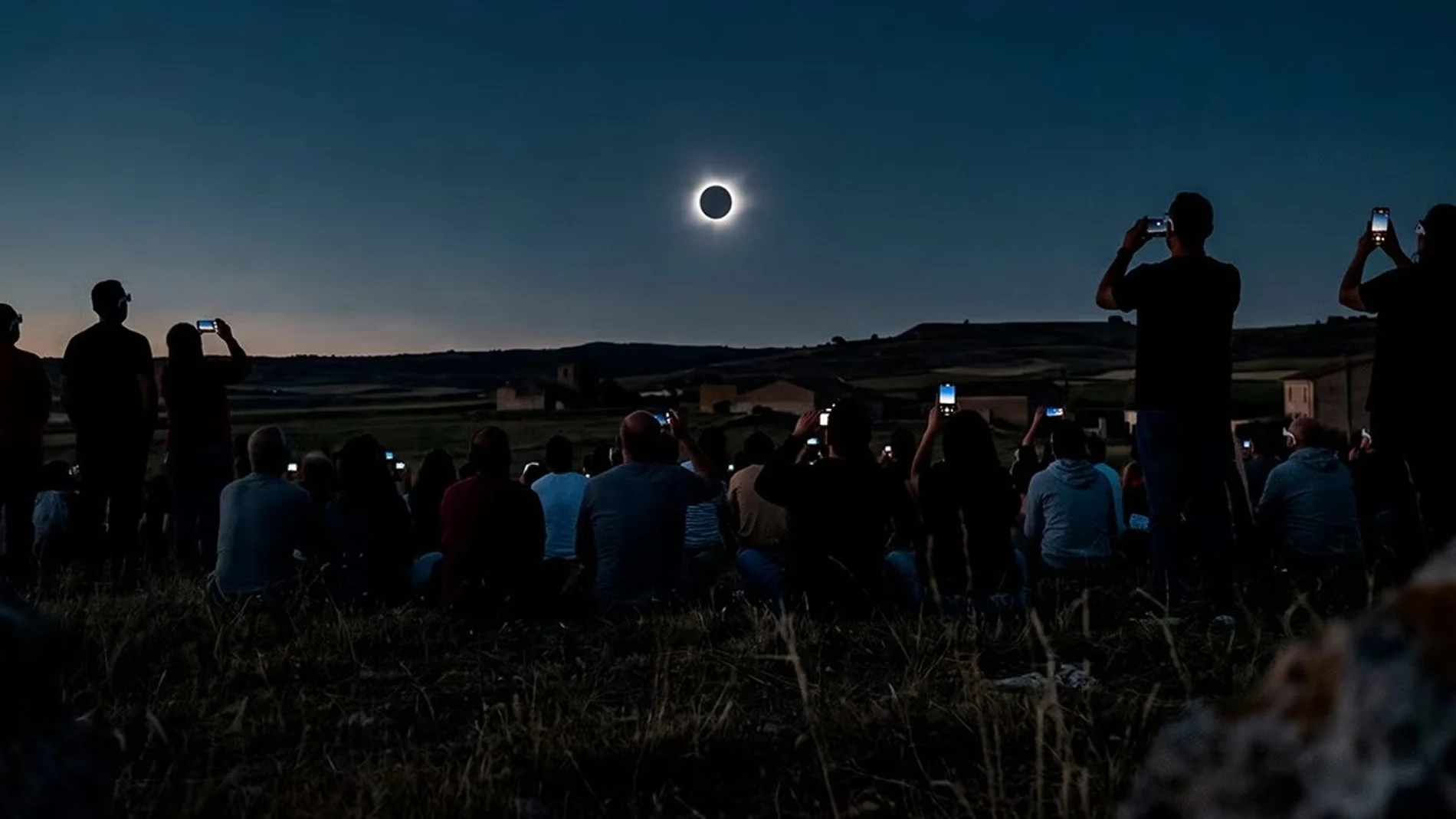
Spain still has very recent solar eclipse of August 2026, but the astronomical calendar already has the next big event marked. We will have to wait less than a year to witness an even more exceptional phenomenon and that is the total solar eclipse of August 2, 2027considered the longest of the 21st century.
On this occasion, the shadow of the Moon will reach Spain again, although it will do so in a very different way. The strip from which the eclipse can be seen in its entirety will be limited to the southern tip of the Peninsula, while from much of the rest of the country it will be observed as a partial eclipse.
The great attraction will be in its duration. In the most favorable points on the planet, the totality phase will reach approximately 6 minutes and 23 secondsan extraordinarily long period during which the Moon will completely obscure the solar disk.
When will the next total solar eclipse be in Spain?
The date that must be marked on the calendar is Monday August 2, 2027. It will be the second total solar eclipse visible from Spain in just a year, after the astronomical event experienced in August 2026.
There is, however, an important difference between the two. The totality of the 2027 eclipse will pass through only a small area of Spanish territory.
The strip of totality will pass through the Strait of Gibraltar, part of Cádiz, the Costa del Sol, the coast of Granada, the west of Almeria, Ceuta and Melilla.
Outside that zone, the Sun will not disappear completely. Even so, the eclipse will be very deep from many places in Spain. In Mallorca it will be close to 99% occultation and in a good part of the Peninsula the Moon will cover approximately between 77% and 99% of the solar disk.
A different eclipse than the one experienced in 2026
Another peculiarity will be the time. While the eclipse of August 2026 was conditioned in Spain to occur near sunset, that of 2027 will arrive during the morning.
The forecasts place the phenomenon approximately between 10:45 and 10:53 hours, in Spanish peninsular time. The Sun will also be at a considerable height above the horizon, between about 37 and 41 degrees, which will make it easier to find places from which to contemplate it.
Spain will be at one of the extremes of the eclipse path. The shadow will later continue its journey through other regions of the planet, with North Africa among the privileged areas to contemplate a much longer totality.
More than six minutes with the Sun completely hidden
The most anticipated moment will come when the Moon is placed exactly between the Earth and the Sun. Within the band of totality, the solar disk will be completely covered and the sky will experience a sudden darkening.
In places where the totality reaches its maximum duration, this situation will last for a few 6 minutes and 23 seconds. It will be that duration that makes the phenomenon of August 2, 2027 the longest total solar eclipse of the 21st century.
During those minutes you can see some of the characteristic phenomena of total eclipses. Moments before totality, the known ones may appear Baily pearls, small points of light produced when the last rays of the sun cross irregularities in the lunar relief. Then the call can occur diamond ring, just before the Sun is completely covered.
How to observe the 2027 eclipse safely
The spectacular nature of the phenomenon does not eliminate the main risk associated with any solar eclipse. You should not look directly at the Sun without adequate protection during the partial phases.
To observe the phenomenon it will be necessary to use specific, properly approved eclipse glasses. Conventional sunglasses do not offer enough protection, no matter how dark they are. Filters intended for direct observation of the Sun must comply with the international standard ISO 12312-2:2015.
Nor should we be confident because the Sun is practically covered. Even when only a small part of its surface remains visible, the radiation remains dangerous to the eyes.
He August 2, 2027 This will thus offer Spain a second consecutive opportunity to contemplate a total eclipse of the Sun. This time, however, we will have to look to the south: there will be the narrow strip from which the Sun will completely disappear for a few minutes.