
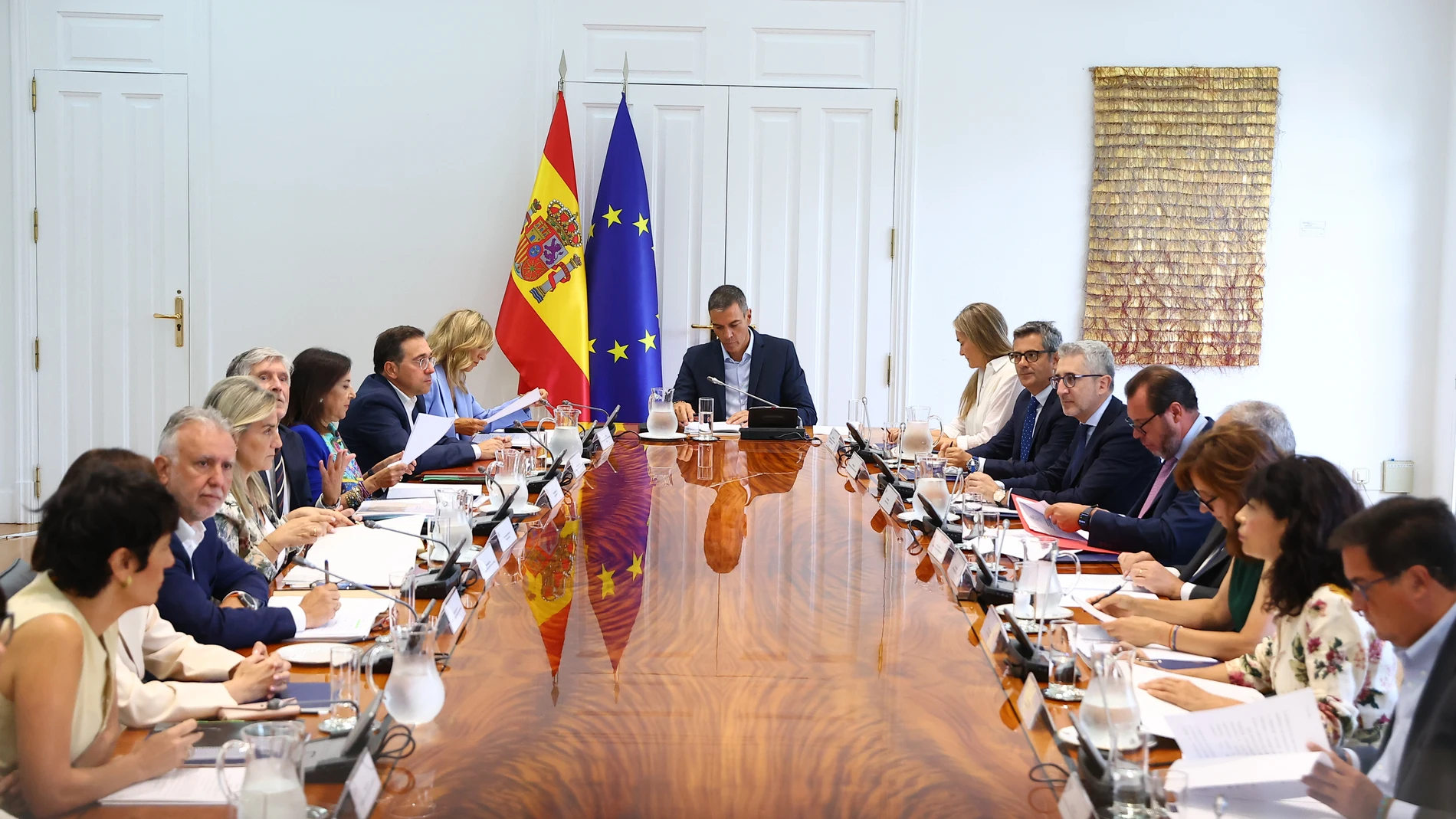
The Government yesterday raised the Ceuta crisis to the highest level of coordination almost a month after more than 72,000 people crossed the border from Morocco, but it still does not know how many migrants actually remain in the autonomous city. «We don’t know. Neither us nor the Government of Ceuta »Moncloa sources bluntly admit.
The Executive works with an estimate that places around 5,000 people who are still in Ceutacompared to higher calculations handled from the city itself. But no one can close the figure. There are migrants who remain dispersed, others who remain hidden and some who voluntarily return to Morocco without it being easy to maintain an exact photograph of a population that has not stopped moving in recent weeks. That is precisely one of the tasks that the new phase of the crisis will face.
Yesterday the Government approved for the first time the declaration of situation of interest to National Security and placed the Minister of Territorial Policy, Ángel Víctor Torres, as the functional authority to coordinate all resources.
The immediate objective will be to concentrate those who remain dispersed, identify them, affiliate them and begin to individually resolve their administrative situation. The single command was created 26 days after the border was blown up. And Moncloa has an explanation to justify why it did not do it before: Juan Jesús Vivas initially requested that the State assume commandbut he stopped demanding it when the Government asked him what it really meant to hand over control of the crisis.
Government sources reconstruct those first days of August ensuring that from Madrid the city was asked if it was really demanding that the central government take the reins. Once Moncloa explained the conditions – coordinate the work of all the State Security Forces and Bodies, streamline decision-making and the use of resources – these same sources assure that afterwards “the issue was not discussed again.”
Moncloa admits that Vivas literally never responded that he did not want sole control. It is the interpretation that the Government makes of what happened because the president of Ceuta, according to Moncloa’s account, stopped asking for it. Although Vivas’s request clearly reappeared last week and Sánchez ended up accepting it. The Executive rejects, in any case, that those 26 days have posed a coordination problem. What’s more: asked if Ceuta would now find itself in a similar situation even if the single command had been activated on August 2just two days after the avalanche, respond affirmatively.
“We do not believe that there has been a problem of lack of coordination with the Government of Ceuta”they maintain. The paradox is that the Government has precisely justified the declaration approved now with the need to “strengthen coordination” between administrations. Torres will have a specialized committee in which the autonomous city, the ministries involved, the CNI and the Department of Homeland Security.
The Government has also changed the language on returns. During the first days of the crisis, different members of the Government insisted that those who had entered irregularly would return to Morocco. Almost a month later, Moncloa introduces a nuance. “Our objective is that all the people who entered illegally can return,” the sources say, before immediately recognizing the limits of that claim: «There will be people who legally have the right to stay. And there will be unaccompanied minors, which are an issue that this country has to assume and address.
The difference is not trivial. The Executive aspires to return all those whose legal situation allows it to do so, but admits that a part will remain in Spain. The situation of minors is especially complex, whose repatriation cannot be carried out through an ordinary expulsion and requires each file to be processed individually taking into account the best interests of the child.
The crisis coincides with a profound reform of the immigration framework that the Government announced yesterday. The Interior promoted two draft bills with a new Asylum rule and a modification of the Organic Immigration Law to adapt Spanish legislation to the European Pact on Migration and Asylum. Moncloa insists that both projects predate the avalanche in Ceuta and rejects that they were improvised to respond to what happened on July 30.
These texts would have already passed through the General Commission of Secretaries of State and Undersecretaries before the crisis broke out. “They have nothing to do with it,” they insist on any causal relationship with Ceuta. The problem will now come in Congress. The two reforms have the status of law and the Executive will have to gather a parliamentary majority that is currently not guaranteed. Moncloa admits that the texts will still have to be negotiated with the groups and that some formations that usually support the Government maintain very different positions on immigration, asylum and returns.
Ceuta has become Sánchez’s main political problem. And Moncloa expects the crisis to last until December 31. The single command, led by the Minister of Territorial Policy, Ángel Víctor Torres, will centralize the coordination of the ministries and administrations involved, will reinforce urban and border security and will order the immigration response, from the identification and care of those who remain in Ceuta to the processing of returns.