
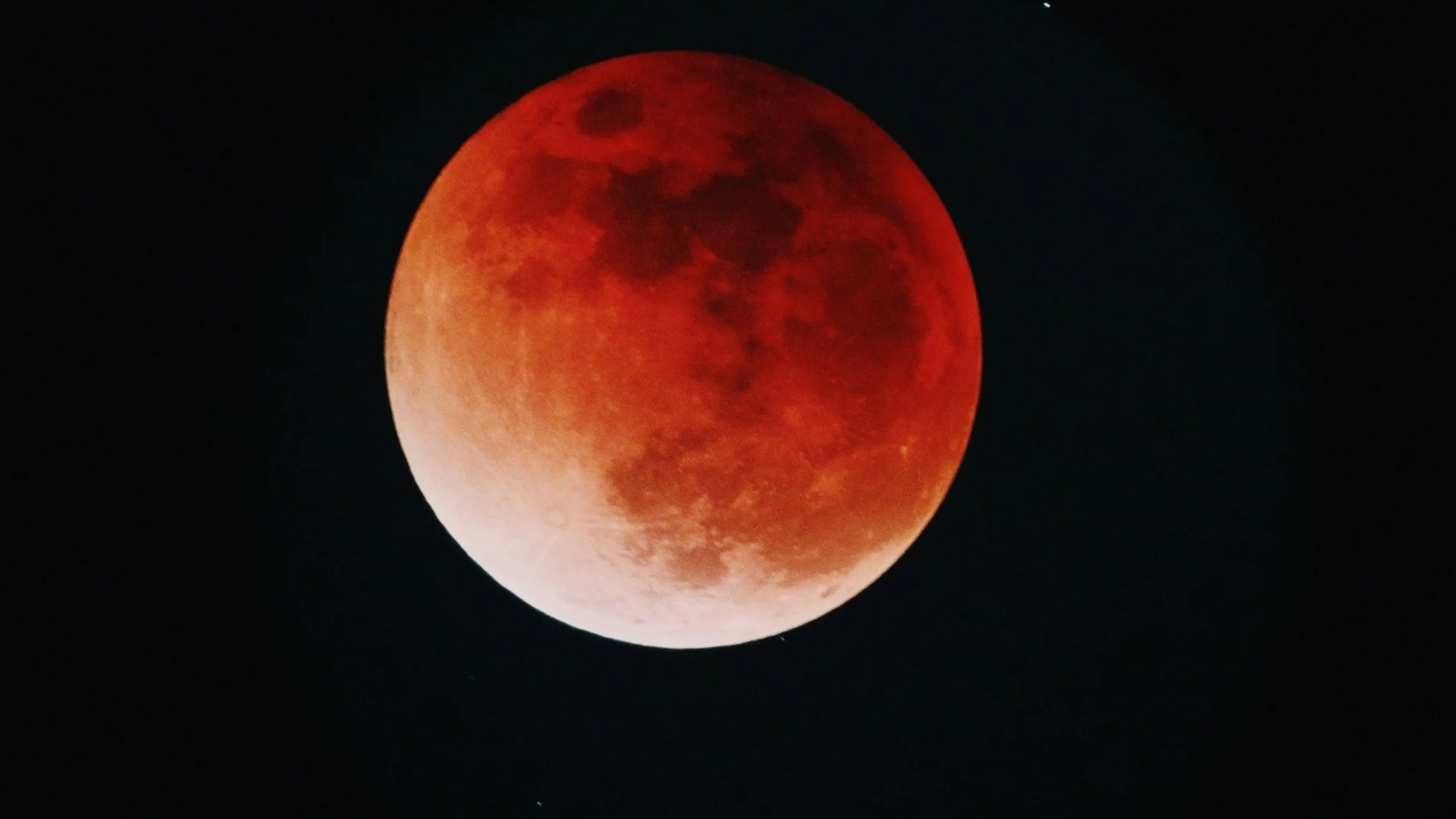
The summer of 2026 will be one of the most remembered by astronomy lovers. Beyond the past total solar eclipse that It could be observed in much of Spain on August 12next Friday, August 28, we will experience a partial lunar eclipse which can be enjoyed without visual protection.
From the 3:23 a.m.Spaniards will be able to enjoy this astronomical event, which occurs when The Earth is positioned directly between the Sun and the Moonprojecting its shadow on the satellite. Being a partial eclipse, you will see how darkness begins to spread across the Moon until it covers it by 93%.
However, this process will be much slower than what could be observed during the solar eclipse. It will not be until 4:34 a.m. that its partial phase begins and until 6:12 hours when it reaches its peak. A phase that will end at 7:52 a.m., although the phenomenon will continue to be visible until 9:01 a.m..
What the partial lunar eclipse will look like in the different regions of Spain
As announced by the Ministry of Science, Innovation and Universities, this astronomical event can be observed from all over Spain, although not in the same way. This is because The duration of the eclipse will be shorter in the central zonethe east of the peninsula, the Balearic Islands and Melilla, since the Moon will set before its partial phase ends.
While, in the rest of the peninsulaas well as in the Canary Islands and Ceuta, you can enjoy all phases of the eclipse. However, it will be necessary to take into account the climatic conditions of each area, since If there are low clouds, they may cover the satelliteas already happened in some cases during the last solar eclipse.
It will not be necessary to use approved glasses to see this astronomical phenomenon
Another important point is its observation, therefore, unlike what happened with the solar eclipse, to see this astronomical event It will not be necessary to have approved glasses with ISO 13212-2 certification or with any other type of protection. This is because the radiation arriving from the Moon is not capable of damaging the retina although it is observed directly, as reported by the National Geographic Institute.
Therefore, in this case it is possible to use tools such as binoculars or telescopes to be able to enjoy a closer image of the phenomenon without the need for approved filters or the rest of the precautions announced for the previous solar eclipse. Thanks to this, you can see how the Moon is reduced to a small bright, reddish stripe.
What are the best areas to see the partial lunar eclipse in August 2026?
It should be taken into account that the maximum point will be reached starting at 6:12 a.m.so the most recommended thing to be able to enjoy this event to the fullest is stand in a clear area with views to the west or southwest. It is important that nothing obstructs the view, such as mountains or buildings, which could compromise the view of the eclipse.
If this lunar eclipse cannot be observed, NASA reports that the next one that can be seen from the European continent will be February 20, 2027However, it will be a penumbral eclipseso only a slight reduction in the Moon’s brightness will be seen.
On the other hand, next year you will also be able to enjoy a new total solar eclipse, next August 2which can be seen in its entirety in the southwest of the peninsula and partially in the rest of the peninsula.