
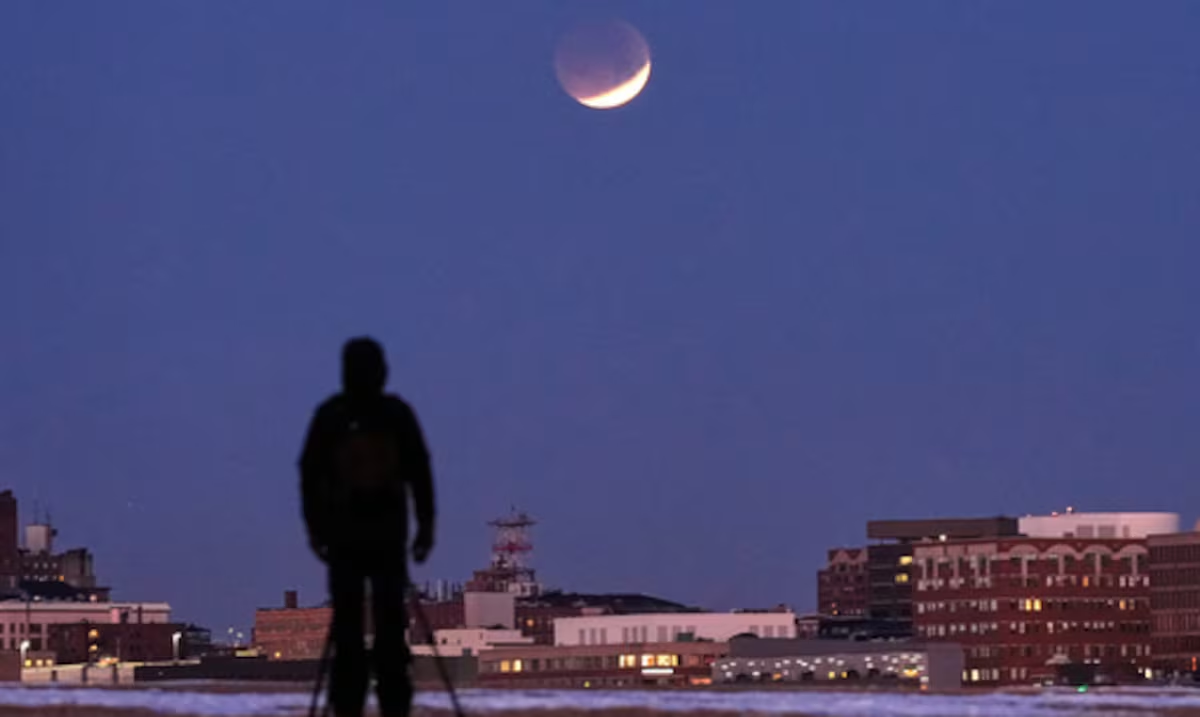
Now it’s up to the moon do your disappearing act.
After being left out of total solar eclipse of this month, the Americas They will have the best seats at the celestial spectacle when the shadow of the Land briefly wrap the moon. Almost all the lunar surface will be covered between Thursday night and Friday – an impressive 96% – making it a partial eclipse especially deep.
The moon is already in the spotlight. The POT sent to the astronauts of the mission Artemis II to a flyover mole historic in April, the prelude to an eventual landing on the surface and the construction of a base with people and robots over the next few years.
“It’s a great time to be part of the space programTRUE? “We are not stopping,” he said. astronaut of the POT Jack Hathaway told The Associated Press last week from the International Space Station.
It is the second act of the greatest show in the world. solar systemwhich arrives two weeks after a total solar eclipse toured Greenland, Iceland and Spain.
The eclipses They always travel in pairs when the sunthe moon and the Land They align so precisely that one obscures the other. This is because the moon It is 400 times smaller than the sunwhich is 400 times farther away, making them appear the same size: a cosmic coincidence and a gift from the universe.
1 / 22 | 📷 In images: this is how they captured the solar eclipse in different parts of the world. Between clouds and during a solar eclipse, the International Space Station crossed in front of the Sun in this image captured near Hodgdon, Maine. -Joel Kowsky
Developing at a slower pace, the next lunar eclipse will have a much larger audience than the solar show Europe. The eclipsed moon will be visible to billions of people in North America, South America, Europe, Africa and the Middle Eastas long as the skies are clear.
He lunar eclipse could also be visible to Hathaway and the other nine people living off-planet: seven astronauts in the International Space Station and three aboard the orbiting outpost of China.
He space offers a “unique perspective” to contemplate cosmic wonders such as eclipses and aurorassaid space station commander Jessica Meir.
In this case, the Land will come between moon and the suncasting a reddish-orange shadow over our nearest neighbor. Since it is a partial eclipsethe alignment will not be perfect and will not be a true blood moon. The partial phase of the eclipse will last more than three hours. However, the eclipse complete, since the full moon enters the faintest outer edge of the shadow of the Land until it comes out, it will last for 5 and a half hours.
He eclipse It will peak just after midnight EDT.
Almost 1 billion people in USA, Canada, Central America and South America They will have front row views for the entire eclipse. More than 3 billion people—44% of the world’s population—will be in a position to see at least some of it.
The eclipsed moon will be hiding in Europe, Africa and the Middle Eastshortening the show. It will be coming out in Hawaiigiving a late start to the eastern pacific along with the northwestern areas of USA and Canada.
This is the second lunar eclipse of the year and the fourth eclipse in total. A total lunar eclipse adorned the skies of the Americas, Australia and the east asia in March.
The next total lunar obscuration It won’t happen until the night of New Year 2028with Asia and Australia on the main stage. And it won’t be until 2029 When stargazers North America and South America can enjoy another total lunar eclipse.
This story was translated from English to Spanish with an artificial intelligence tool and was reviewed by an editor before publication.