
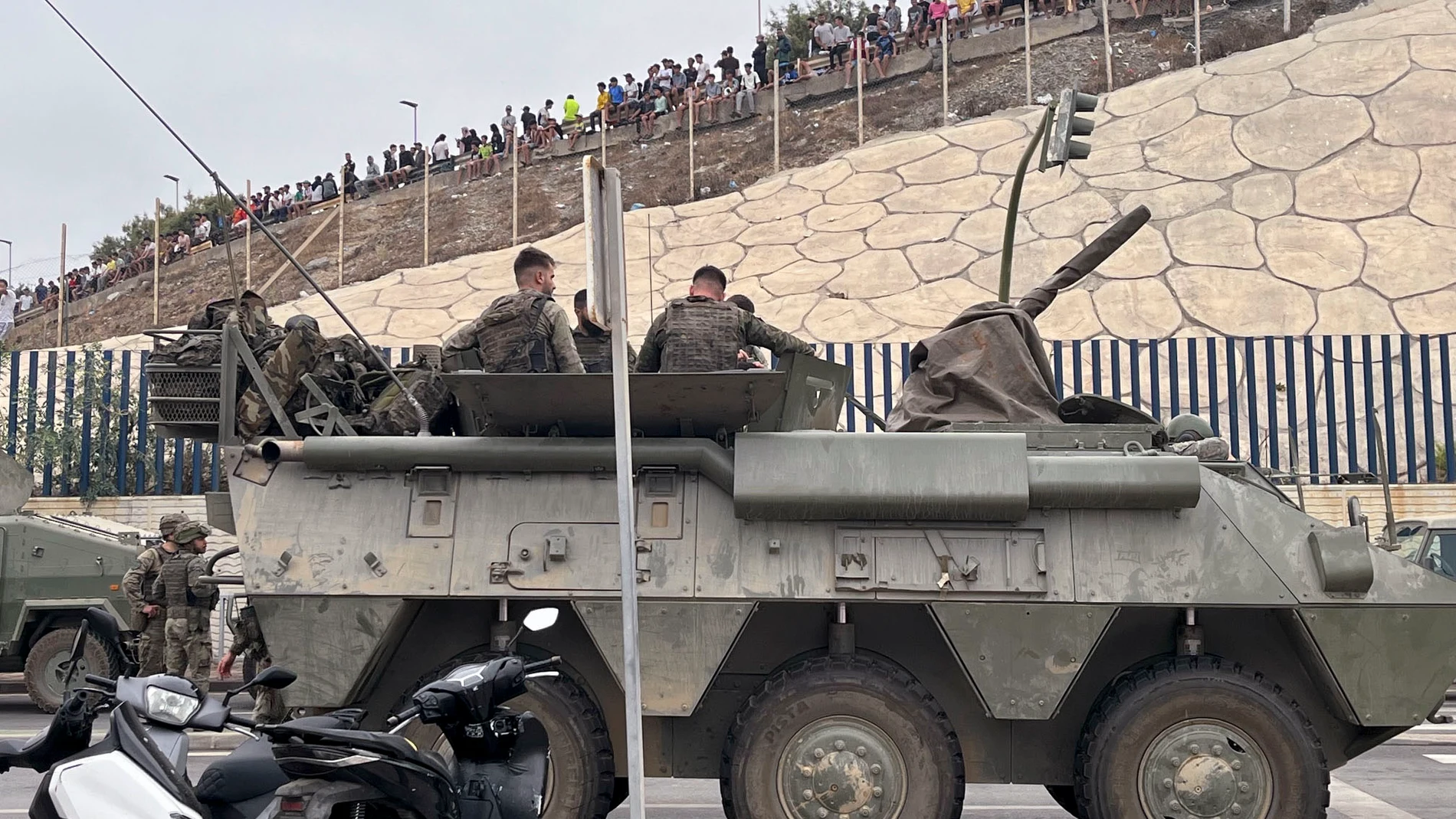
In these three weeks we have heard all kinds of theories and concepts about the crisis in Ceuta, a kind of totum revolutum that sometimes leaves us more confused. To shed a little light we turned to Samuel Morales, a Marine lieutenant colonel on leave and one of the greatest experts in the diffuse “gray zone” in which Morocco plays its strategy against Spain. Throughout his career he has held operational and General Staff responsibilities, as well as advisory functions in the Operations Command of the Defense Staff and the Department of National Security of Moncloa.
How do you interpret the latest migration crisis?
There is something that especially catches my attention. Ceuta has a population of about 80,000 people and around 70,000 migrants entered, but almost 50,000 had left within 48 hours. That, in my opinion, does not seem like a spontaneous movement. You cannot think that tens of thousands of people simultaneously make the decision to enter and, two days later, simultaneously make the decision to leave. Furthermore, there is a correlation. In 85% of the immigration incidents I have studied, there had been a crisis in the previous two months. And, in the rest, there was probably also one of those things that occur under the table.
Why now?
There are several hypotheses and I don’t know which one is true. There has been talk of the publication of the investigation into Pegasus and the Moroccan Intelligence system or the visit of the President of the Government to Algeria. I do not believe that one country can determine where the president of another travels, but agreements can generate tensions. The most important thing is that operations of this caliber do not occur without authorization from the king.
You raise another hypothesis related to the 2030 Soccer World Cup.
Again, it is not a certainty. Morocco is making a huge investment for the 2030 World Cup and wants to project itself as a country with a greater international dimension. The choice of Casablanca for the final has enormous symbolic importance. It’s the same thing Russia did with Sochi. And, suddenly, Pedro Sánchez returns from the final in New York and says that the final will be in Madrid. I think that statement could have been an element of friction. But what you have to ask yourself is what the strategic objective is.
With so much theory that we hear, it is all very confusing.
If you don’t understand the strategy, you can’t counter what they are doing to you. If you see each of their actions separately – the claims on Mount Tropic, putting the Canary Islands on the negotiating table, the economic asphyxiation in Ceuta and Melilla… – you will not understand what is happening. On the other hand, if you put everything on a map, it makes sense.
What is that strategy?
Very simple, that’s called gray zone strategy. It aims to achieve the objectives with actions below the conflict threshold. That is, it can only occur in periods of peace. It’s like the “salami slicing” technique, what you do is cut the salami little by little, little by little, very thin, and in the end you have eaten it. For example, I give you a platform in Spanish territorial waters and you say: “I am not going to go to war over a platform.” But you have lost. Basically, what it does is change the delimitation of territorial waters.
There is also talk of “hybrid war.” Is Morocco there?
It is the use of orthodox, military, and unorthodox methods, everything you can imagine, to achieve the objectives. It also occurs in peace, but very close to conflict. It could be “start touching noses.” Morocco is not yet in the hybrid war. For example, we still have no evidence that he is trying to employ the mafias or anything like that.
What is the ultimate goal?
It is important to make it clear that there is nothing that can be done here if you do not have an objective. And this is one of the mistakes many people make when they analyze what is happening. What is the objective of putting 80,000 people in Ceuta and Melilla and then, without further ado, 60,000 leave? Some have said that the king was angry. No, man. If there is no strategic objective this does not happen. Morocco’s very long-term goal is what they call Greater Morocco: parts of Senegal and Mauritania and, of course, Ceuta and Melilla.
Is that what you are pursuing now?
No, that is impossible now, it would be a suicidal strategy. What is clear is that he is going for Ceuta and Melilla and, in the future, possibly for the Canary Islands.
What are they looking for when they enter the Canary Islands?
Right now they are putting it on the table so that when we talk about Ceuta and Melilla there will be other elements to negotiate with. They are very skilled at that. In December 2025, official sources go and tell Spain that if we are in favor of their sovereignty in the Sahara, they will not have problems with ours in the Canary Islands. But when has that been in discussion? It’s like laughter. Narrative warfare is also part of the gray area we were talking about. The one who shapes the narrative is the one who shapes the agenda of the topics that are discussed.
And that’s where the famous Mount Tropic comes in, which many of us didn’t know about.
Clear. Morocco delimited its waters in 2021 and Mount Tropic appears there. Spain had already made its claim and international law of the sea establishes the rules for delimitation. Morocco considers that its continental shelf reaches that area and that the Canary Islands, due to its volcanic origin, does not reach it in the same way. Are we going to war over Mount Tropic? No. But there is something very important there: rare earths and tellurium. And tellurium is fundamental to the European photovoltaic energy strategy. China is also very interested in that area. Therefore, what is being configured is to have an advantageous position in the future European energy strategy. It doesn’t seem important if you look at it in isolation. But when you put all the dots together, a line starts to appear.
There is also gas.
Yes. There are gas exploitations in waters that are in dispute and Morocco has granted rights to an Israeli company. Spain may one day come to discuss these waters, but then another question arises: how do you expel a company that has been granted economic rights for years? That’s a gray area: playing with the rules to condition your ability to act in the future. And Morocco does something else very well: build narrative in Europe. His Foreign Minister made a tour of fourteen European countries, the so-called “Smile Tour”, to explain the Moroccan position on the Sahara. After “Qatargate”, Morocco managed to get different European countries to view its proposal favorably.
Is Spain understanding this strategy?
I don’t think so. The main problem is that there is no State policy on Morocco. Politicians work in the short term and that makes us vulnerable. Internal discrepancies and cross-statements generate friction that can be used in disinformation campaigns. The first thing Spain should do is completely Europeanize the problem. This is not a fight between Spain and Morocco. It is a problem of the EU against Morocco, because Ceuta and Melilla are a community border.
What else would work?
Do not militarize the conflict. Placing military vehicles on the border can generate images that Morocco would immediately use in a gray zone strategy. You cannot respond to massive migratory pressure by creating a photograph that allows you to present yourself as the aggressor. Finally, use our own tools. Morocco depends largely on our energy flow. Part of the energy it receives passes through Spain. That is a pressure tool, but it should be used through discreet diplomatic channels, not in a press conference. The key is for Europe to tell Morocco: “Not one more.” The European EU contributes billions to border management. As long as the problem is exclusively bilateral, Spain is at a disadvantage.
Do you believe that Pedro Sánchez’s change of position on the Sahara responded to Intelligence blackmail?
Don’t know. I can pose a hypothesis. Imagine that the Spanish intelligence services detect a situation of uncertainty regarding the succession in Morocco and consider that a crisis with the kingdom could generate serious consequences. In this scenario, a decision on the Sahara could respond to a preventive strategy. I have no evidence to say that this happened. But it is a hypothesis that, in my opinion, should be analyzed. It must also be taken into account that behind the Spanish position was France and also the United Kingdom. If there is a risk of destabilization in Morocco, Europe has a lot to lose.