
A data center usually has two enemies. The first is the electricity it needs to operate. The second is an inevitable consequence of that electricity: heat. The processors that train large artificial intelligence models consume enormous amounts of energy and a good part of it ends up converted into heat, which must be evacuated through cooling systems that also consume electricity and, in many cases, large quantities of water. Larger data centers can consume as much electricity as a city of 30,000 inhabitants and, according to the International Energy Agency (IEA) Up to 40% of this consumption is used to cool the facilities. With this in mind, an alternative that generates less consumption is not only desirable, but also necessary.
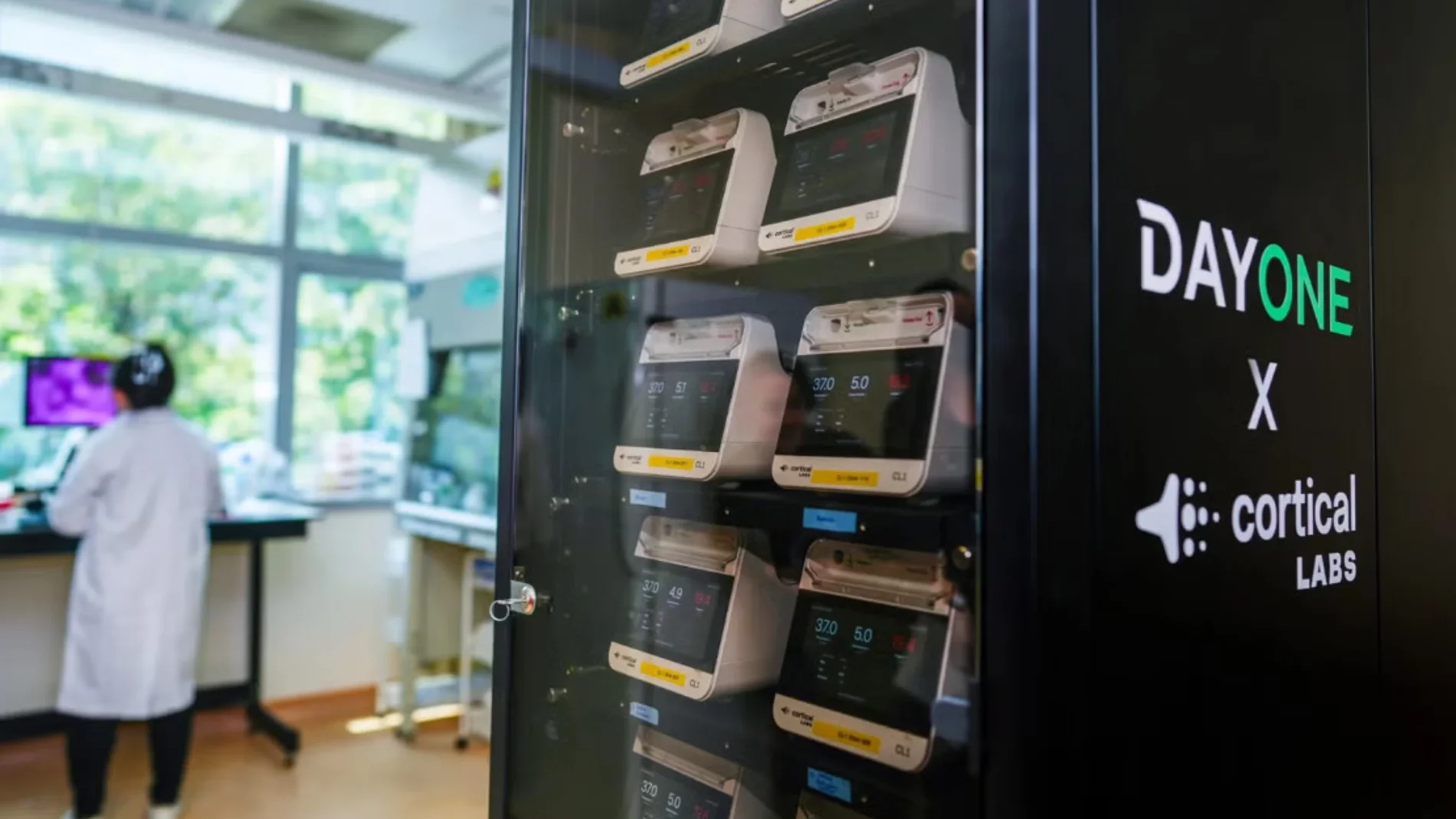
An experiment has just been launched in Singapore that proposes a radical alternative: using living human cells to process information. The prototype, developed by the National University of Singapore and the company Cortical Labs (known for fusing neurons with technology), brings together 20 CL1 biological computing units in a single rack. It is neither a simulation of neurons nor a conventional computer inspired by the brain. They are real human neurons, grown in the laboratory from stem cellsconnected to an array of electrodes on a silicon chip.
Each unit allows electrical stimuli to be sent to neurons and their response recorded. In this way, the computer can present information to the biological neural network and convert the electrical activity of the cells into data that the system can interpret. The result is a hybrid machine in which silicon provides the interface and electronics, while living cells perform some of the processing.
This is one of the fundamental differences with a conventional data center. A GPU requires a lot of power to perform its calculations, and in doing so, it generates heat. Neurons, on the other hand, are extraordinarily efficient from an energy point of view. According to Cortical Labs, each CL1 consumes about 30 watts, even taking into account the systems needed to keep the cells alive.
To get an idea of the difference, A high-performance GPU used for artificial intelligence can consume hundreds of watts alone. A server equipped with several of them can reach several kilowatts. The result is that a significant portion of a data center’s infrastructure is dedicated not to computing, but to providing power, cooling equipment, and keeping it within safe thermal limits.
Does that mean these data centers don’t need cooling? To a large extent, yes, but with an important nuance. Neurons do not need to be refrigerated to eliminate the heat generated during processing because their energy consumption is tiny. and they do not produce the enormous thermal load characteristic of AI processors. The head of Cortical Labs himself has pointed out that biological systems do not need cooling like conventional servers.
But cells do need very precise environmental conditions to survive. The CL1 incorporates a true life support system: it controls the temperature, mixes the necessary gases and maintains the appropriate conditions of the environment in which the neurons live. In addition, at the Singapore facility, the cells periodically receive a mixture of nutrients, sugars and other components necessary to keep them active.While a conventional data center needs to cool machines. A biological one like this needs to keep a tissue alive. And that also changes the nature of the infrastructure. The potential reward is enormous.
The Singapore prototype aims to explore a much less energy-intensive form of computing and, especially, applications where biological neural networks may have an advantage: situations where there is little data to train a system or where conditions are constantly changing. Among the proposed applications are humanoid robotics, cybersecurity, fraud detection and drug discovery. The reason is that a biological brain learns from a relatively small number of examples and can adapt to new situations. Current artificial intelligence systems, on the other hand, usually require enormous amounts of data and computing power to achieve similar behaviors.
The bet is not to replace silicon, but to add biology to the computer where it can provide something that silicon does worse. And perhaps that is the most interesting part of the Singapore experiment. For decades we have tried to get machines to imitate the brain using algorithms. Now we are trying another possibility: directly using one of the properties that made the brain extraordinary in the first place.
“By growing live human neurons from stem cells and combining them with rigorous engineering – concludes Rickie Patani, responsible for this advance, in a statement – we are not only creating a more efficient alternative to silicon, but we are also developing a platform that allows us to understand learning and adaptation at their biological origin. It gives us a real avenue to Accelerate drug discovery and neurological disease researchtransforming laboratory knowledge into concrete results much faster than before.”