
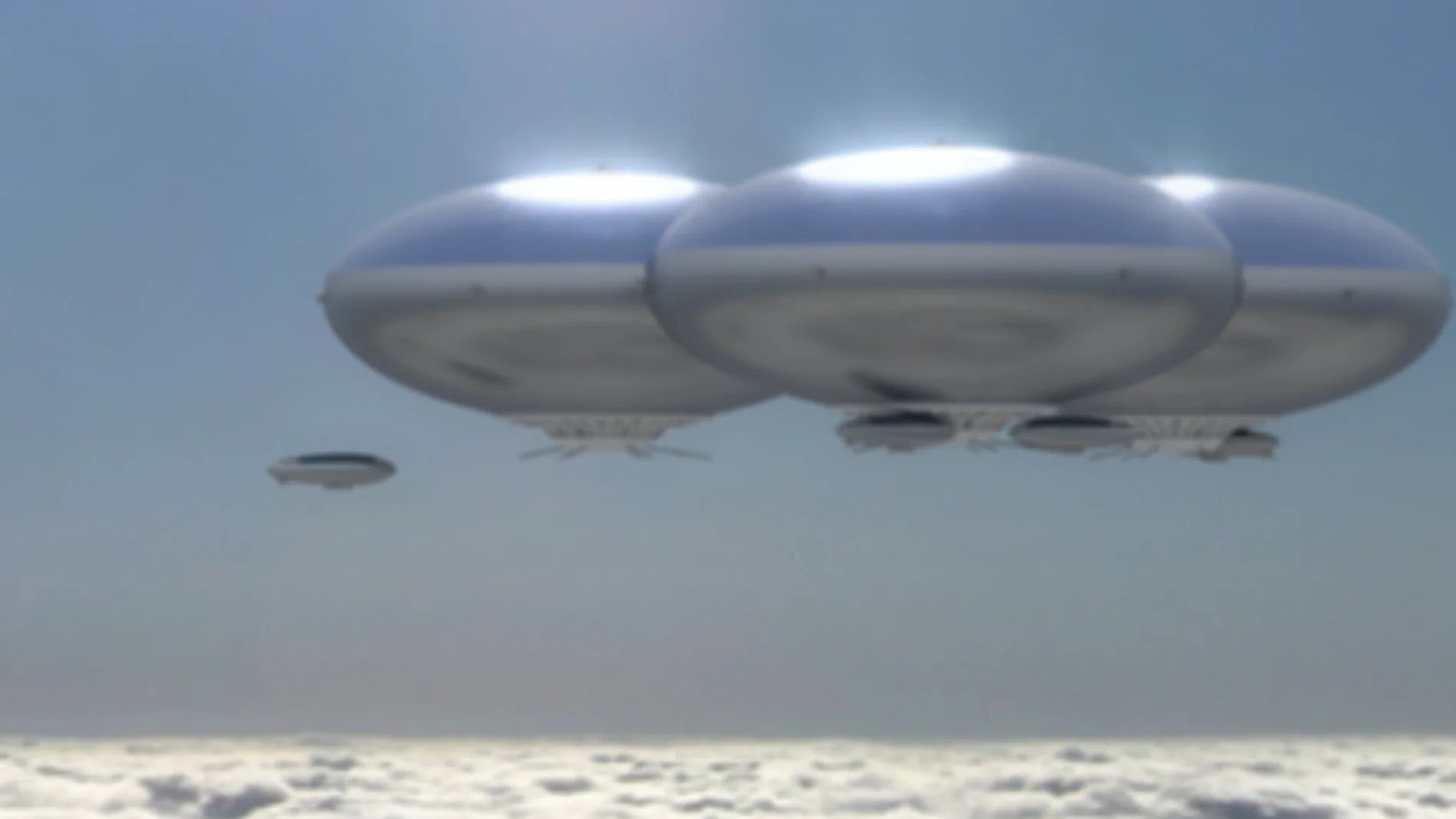
For decades, Mars has held a pride of place in our imaginations when we think about the first human colony outside of Earth. It has frozen water, a day that is barely 39 minutes longer than ours, annual seasons and a solid surface on which to build. Venus, on the other hand, seems like a nightmare: 467º C “in the shadows”, an atmospheric pressure 93 times higher than Earth’s pressure and clouds of sulfuric acid. If you had to choose where to land, Mars would win hands down. But perhaps the error is precisely in that word: landing or in this case setting foot on Mars.
And if we want to establish a permanent human presence on another planet, Venus could offer some unexpected advantages over Mars. The proposal does not consist of building cities on its surface, but rather placing them in the atmosphere, about 50 kilometers high. AND At that distance from the ground, Venus stops looking like hell and begins, surprisingly, to look quite similar to Earth.more than Mars in important aspects.
NASA has studied this possibility through the HAVOC concept (High Altitude Venus Operational Concept), an architecture based on aircraft capable of floating in the Venusian atmosphere. About 50 kilometers above the surface, the temperature is approximately between 30 and 70 º C and the atmospheric pressure is similar to what we find at sea level on Earth. These are extraordinarily benign conditions compared to those on the planet’s surface.
The first great advantage over the Martian candidate would be gravity. Venus has a surface gravity equivalent to approximately 90% of Earth’s. Mars, on the other hand, barely reaches 38%. We still don’t know what the consequences would be of living for decades with gravity as low as Mars, but we do know that microgravity causes loss of muscle and bone mass and other physiological changes. A Venusian colony located in the clouds would have, at least on paper, a condition much more similar to that of our planet.
The second advantage is atmospheric pressure. In our Martian neighbor it is less than 1% of that on Earth. The atmosphere is so thin that it does not allow liquid water to remain stable for long on the surface and offers limited protection from radiation. Any Martian colony would essentially have to be a pressurized bubble within a nearly empty bubble. On Venus, on the other hand, something extraordinary happens. At about 50 kilometers high, the external pressure approaches that of the Earth. This does not mean that astronauts can go out without protection: clouds of sulfuric acid and an unbreathable atmosphere still exist. But the difference between having an Earth-like external pressure and having to contain an atmosphere in the face of a near-vacuum can greatly simplify the design of a habitat.
The NASA HAVOC study indicated that The region located between 45 and 60 kilometers above the Venusian surface is “one of the most Earth-like environments in the solar system.” At about 50 kilometers high, the pressure and density conditions are approximately comparable to those found at sea level on Earth, although the temperature is considerably higher.
But the atmosphere of Venus is not only interesting for humans. In 2015, a study published in Icarus proposes the existence of a possible “aerial habitable zone” between about 51 and 62 kilometers high. The authors arrived at that range by combining two of the main limits for terrestrial life: temperature and acidity. The region also coincides with the large layers of Venusian clouds, where there are particles containing sulfuric acid and small amounts of water.
The study does not affirm that life exists there, but suggests that Extremophilic microorganisms could, at least in principle, survive in that environment. And another result is especially interesting: the authors, led by Lewis R. Dartnell, an astronomer at the University of Leicester, calculated that even extreme episodes of solar radiation, such as the one that could have occurred in the year 775, would probably not administer a dose sufficient to completely sterilize this hypothetical biosphere.
Radiation offers another potential advantage. The Martian world has a very thin atmosphere and lacks a global magnetic field to protect its surface, so future colonists would need additional shielding. On Venus, an aircraft located 50 kilometers away would be surrounded by a much denser atmosphere. HAVOC studies consider that radiation protection in that region would be broadly comparable to that of the Earth’s surface.
There is also solar energy. Venus is about 108 million kilometers from the Sun, while Mars is about 228 million. Therefore, Venus receives almost four times more solar flux than Mars and approximately 1.9 times what Earth receives. Venusian clouds reduce the radiation that reaches certain heights, so this difference cannot be directly translated into available electricity. Even so, Venus has a considerable energetic advantage. And a floating platform could incorporate solar panels on top.
Mars, however, has something that Venus cannot easily offer: accessible water.. There is water ice on Mars, and evidence abounds that the planet once had rivers, lakes, and other aquatic environments. Its current water is not always easy to extract, but it exists in quantities that make the planet a much more attractive candidate for obtaining this resource locally. Venus, on the other hand, is extremely dry and lost much of the water it had in its past. He red planet It also gains in land and mineral resources. There we can dig, build shelters, use regolith as building material, and directly access minerals in the crust. A floating Venusian colony would have to remain permanently suspended and rely on much more sophisticated infrastructure.
And Venus has one last problem that does not allow a simple solution: its clouds contain sulfuric acid. NASA considers the corrosion of materials, structures and solar panels one of the great challenges for any aircraft that remains in that atmosphere for a long time. Even the length of the day works in Mars’ favor. Venus takes about 243 Earth days to complete one rotation on its axis and its solar day lasts about 117 Earth days. Mars, on the other hand, has a day of 24 hours and 39 minutes, extraordinarily similar to ours.
That is why the comparison does not have a simple winner. Mars is still probably the most logical candidate if we want to build on another world. It has water, firm land and directly accessible resources. Venus, however, can be surprisingly attractive if we accept a much stranger idea: not living on the planet, but in it.
That doesn’t make Venus an easy destination. It is probably more difficult to reach a floating colony, maintain it for decades, and protect it from the corrosive chemistry of clouds than it is to establish a first Martian settlement. But it raises a possibility that for a long time was hidden behind appearances. Maybe Mars may be the best place to put your feet, but Venus might be the best place not to put them.