
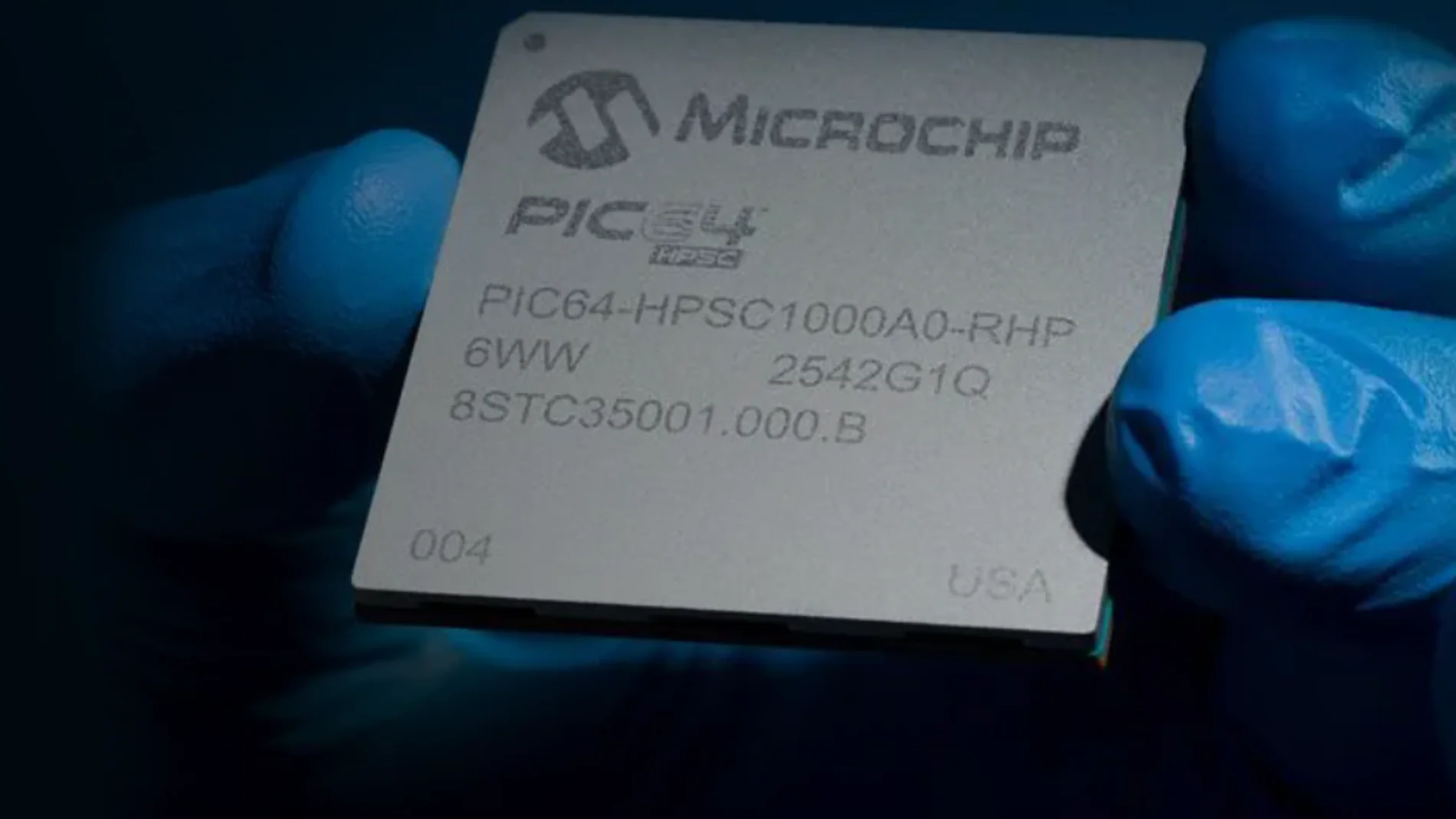
There’s something almost poetic about comparing two NASA computers separated by almost six decades. The first helped put humans on the Moon. The second is being designed so that upcoming spacecraft can make decisions for themselves hundreds of millions of kilometers from Earth. There is a difference between the two that summarizes a good part of the history of computing: The computer that guided Apollo 11 had less memory than a photograph taken with a current telephone. NASA’s new processor fits in the palm of a hand and, in early tests, has demonstrated performance far superior to current processors in spacecraft.
It is called High Performance Spaceflight Computing (HPSC) and is not intended to replace a desktop computer. Its mission is much more difficult: to function in space, withstand radiation, consume little energy and allow a ship to process enormous amounts of information without having to wait for instructions from Earth. When Neil Armstrong and Buzz Aldrin descended to the lunar surface in 1969, they had on board one of the first digital computers designed to operate on a spacecraft: the Apollo Guidance Computer (AGC). Its features today seem typical of a pocket calculator.
The AGC had 36,864 words of fixed memory and 2,048 words of modifiable memory. Its total memory was around 38,000 16-bit words. To put it in perspective, the computer had to manage navigation, orientation and control of a lunar mission with a memory that today would be tiny. A 16-bit processor is equivalent to 65,536 possible combinations, while a 64-bit processor is equal to 18,446,744,073,709,551,616 possible combinations. In short: about 281 billion times more distinct values than a 16-bit one.
But not everything is so simple: this apparent weakness hid an engineering feat. The AGC was designed specifically to do what the mission needed and do it with extraordinary reliability. I didn’t need to run a browser, play video, train an artificial intelligence, or download an update. He needed to take three human beings to the Moon and back. And he did it.
Sixty years later, the problem is different. NASA no longer designs ships with only a computer performing a few predetermined tasks. Future missions will have to process images, interpret signals, control robots, detect objects, manage sensors and, increasingly, use artificial intelligence and machine learning.
And there is a fundamental problem: Earth is very far away. An order sent to Mars can take several minutes to arrive and the response needs to travel the distance again. In certain positions, round-trip communication can approach 44 minutes. That means that a rover that detects an obstacle cannot stop. and wait for instructions from a ground operator as if you were connected to a remote computer.
You need a certain autonomy and to achieve it you need computing power. This is where the HPSC comes in. The HPSC is a system on a chip (SoC) developed by Microchip Technology in collaboration with NASA’s Jet Propulsion Laboratory.. Its architecture uses multiple 64-bit RISC-V cores, vector units and different systems for real-time processing, security and communications management. NASA assures that the system can provide more than 100 times the computing power of current space processors and that its architecture allows several chips to be connected to further increase the available capacity.
But there is something even more striking. In tests that began at the Jet Propulsion Laboratory in February 2026, the processor showed performance about 500 times that of radiation-hardened chips currently used in spacecraft. NASA advises that testing continues and that the processor has yet to complete its space qualification process.
The first message sent from one of these chips was, appropriately, “Hello Universe.” And here appears another comparison that allows us to understand to what extent NASA has changed. The Apollo computer had to push the Moon to the limit of what was possible to process with the technology of the 1960s. Today the agency not only wants much more powerful computers on board its ships. It also has true computing giants on Earth. At the beginning of 2026, NASA launched Athenaits most powerful supercomputer. Its maximum capacity exceeds 20 petaflops, that is, about 20,000 trillion floating point operations per second.
Athena can be used to simulate rocket launches, design aircraft, study scientific phenomena, and train large artificial intelligence models capable of analyzing huge amounts of data. And whatMaybe that’s one of the best ways to measure how much space exploration has changed since July 1969. Then we took a computer to the Moon. Now we are trying to get computers to be able to explore it for us.