
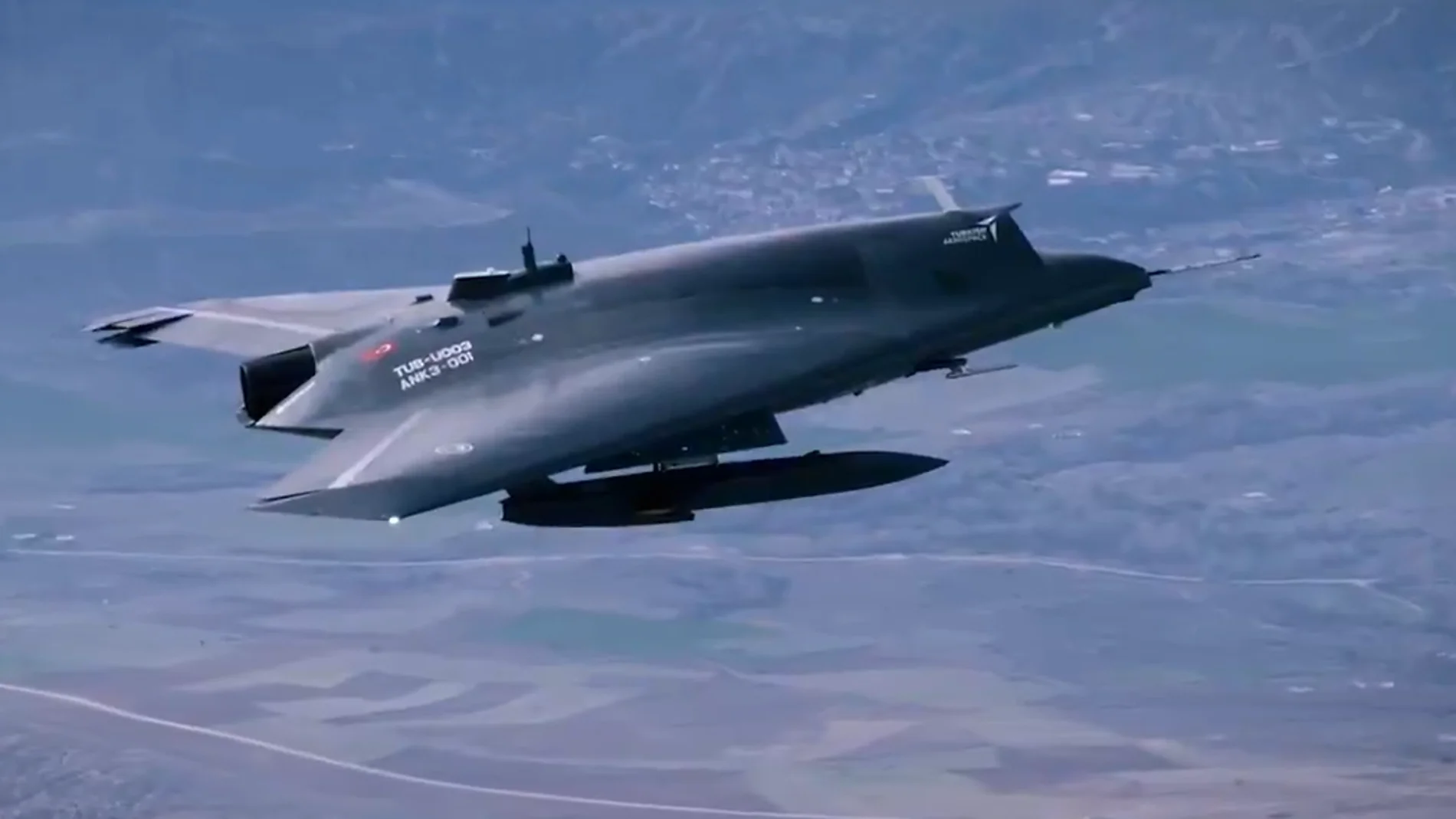
Imagine a plane entering a conflict zone without a pilot on board, designed to be difficult to detect by radar and capable of flying at almost 800 km/h. Now imagine that plane is not alone. In mid-flight it can transport another drone, release it and let it continue the mission autonomously. It’s not a scene from a science fiction movie. It is one of the capabilities that Türkiye is testing with the ANKA III, an unmanned combat aircraft developed by Turkish Aerospace Industries (TUSAŞ). The aircraft, with a flying wing configuration and low radar observability, It can reach 0.7 Mach, about 787 km/h at 30,000 feet, operate up to 40,000 feet, and stay in the air for up to ten hours.
But its speed is perhaps the least surprising. The interesting thing is under its wings. TUSAŞ has proven that the ANKA III can transport a Süper Şimşek, a smaller drone, to a certain area and release it during flight. In the test, the ANKA III arrived at the test area with the Süper Şimşek under the wing. After preliminary checks, the drone was released and, once safely separated, It continued to fly autonomously for 50 minutes before returning to the ground via its parachute system.
#ANKAIII pic.twitter.com/bY5UkMRdcP
— Turkish Aerospace (@TUSAS_EN) August 14, 2026
The difference with respect to a conventional drone is important. We typically think of an unmanned aerial vehicle as a machine that takes off, receives instructions, and performs a mission. Here, however, a different architecture appears: A drone can become the platform that transports and deploys another drone. And that second device can continue the mission on its own.
TUSAŞ has designed the Süper Şimşek to be launched from aircraft such as the ANKA III, the AKSUNGUR or the ANKA. Its maximum advertised speed is 0.85 Mach, it can reach 35,000 feet and has an autonomy of up to 80 minutes and an operational range of up to 900 kilometers in the configuration currently published by the manufacturer.
Why carry one drone inside another? Because it allows you to do something that is more difficult for a single aircraft: distribute a mission among several machines. The Süper Şimşek can carry up to 50 kilograms of payload and is designed for different functions, including missions against air and ground targets and tasks related to electronic warfare. It also incorporates autonomous flight and swarm operation technologies. And that opens up different possibilities.
An aircraft could approach an area and release a second vehicle for reconnaissance. Another could be used for electronic interference. another could act as a decoy to force an air defense to reveal its sensors. It does not mean that all these possibilities are part of a single ANKA III operational mission. But it does explain why the combination of both aircraft is interesting: the main platform can become a deployment vehicle for other autonomous systems.
But the ANKA III hasn’t been designed simply to be fast. Its most striking visual feature is its flying wing configuration, a geometry that helps reduce radar detection. TUSAŞ precisely highlights its stealthy design, together with its turbofan engine, its speed and its capacity to transport up to 1,200 kilograms of payload.
The device It measures 7.9 meters in length, has a wingspan of 12.5 meters and a maximum takeoff weight of about 6,500 kilograms.. That is, although we call it a “drone”, we are talking about a considerable aircraft. And it is not a purely experimental project. The ANKA III made its first flight on December 28, 2023 and since then TUSAŞ has been progressively expanding its capabilities, including weapons tests, autonomous flights and coordinated operations with other systems.
And, finally, there is the swarm section, perhaps this is the most interesting part of this drone. Military aviation is slowly moving from thinking about individual aircraft to thinking about connected aircraft systems. ANKA III itself incorporates cooperation technologies between manned and unmanned aircraft and swarm capabilities combined with artificial intelligence.
TUSAŞ has also demonstrated formation flights of two ANKA IIIs controlled from a single ground station, as part of the first tests of these capabilities. And so the logic changes: instead of building a single machine that has to do everything, we can imagine a platform that transports different vehicles and distributes them according to the needs of the mission. Is an idea similar, saving distances, to that of an aircraft carrier. Only here the aircraft carrier also flies at almost 800 km/h. Furtively.