
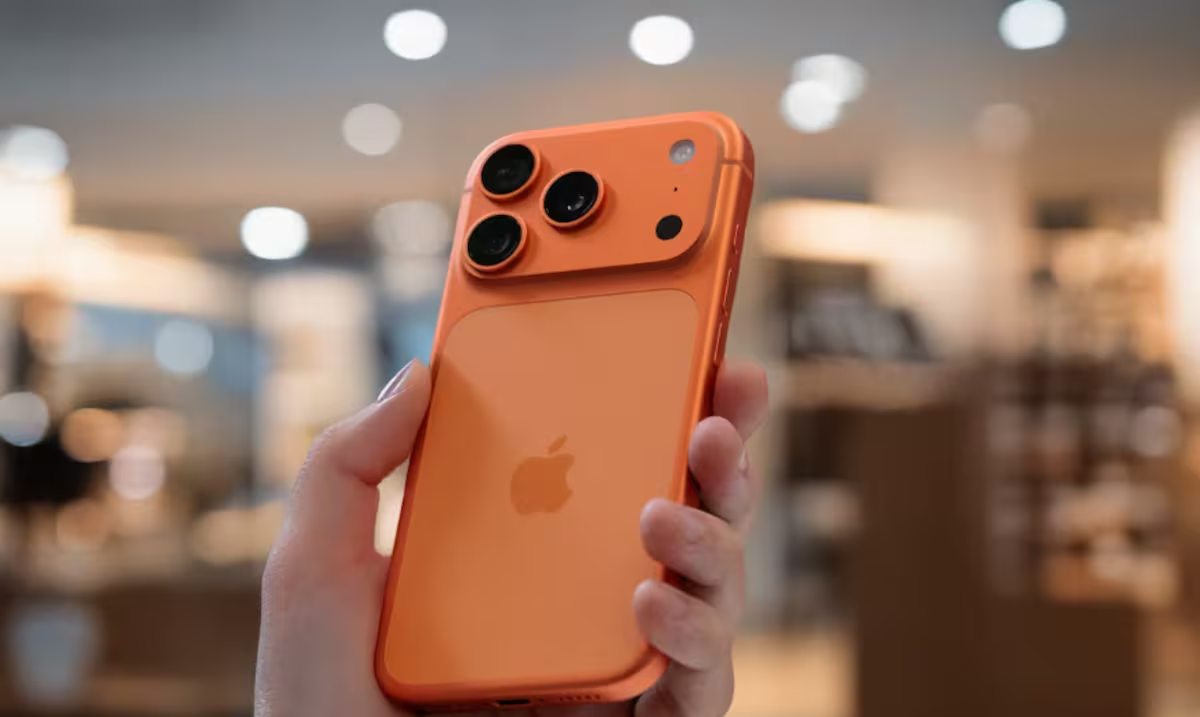
The global smartphone market is heading towards a “perfect storm” in 2026, and Apple’s next launch will be no exception. According to the latest report from the specialized consulting firm TrendForcethe cost of manufacturing (BOM) of the future iPhone 18 Pro will suffer an unprecedented increase in 38% year-on-year. This jump, driven mainly by the shortage of critical components generated by the popularity of AI, promises to redefine industry prices and put manufacturers’ profit margins in check.
The culprit: AI’s voracity for RAM
Historically, the most expensive components of an iPhone were the OLED display and the processor. However, the TrendForce report reveals a systemic paradigm shift: RAM memory has gone from representing just 10% of the cost total a year ago to an estimate of 34% by the end of 2026planning to surpass the 40% in the first half of 2027.
This phenomenon is due to fierce competition for supplies. The explosion of the artificial intelligence (AI) It has caused a huge deviation in the production chain. Chipmakers are prioritizing high-bandwidth memory (HBM) for AI servers, leaving smartphones with a limited supply of LPDDR5X chips. Added to this is that giants like Nvidia They now compete directly with Apple for the same mobile-class memory for their Grace and Vera server processors, which has driven prices up.
A breakdown of an iPhone Air from 2025; RAM and storage chips are among the components that have increased the most in price since last year iFixit
Three of the leading DRAM and HBM memory manufacturers, Samsung, SK Hynix and Micron, They have already sold all their productive capacity by 2027which will be aimed at meeting the demand for artificial intelligence (AI) and long-term agreements with its clients. In fact, only 30% of its production goes to personal devices.
Apple’s AI: a 12 GB requirement
Another element is added to the increased cost of components: Apple cannot simply cut its investment in memory (as other competitors have done) to lower costs.
The operating system iOS 27 and advanced features Siri AIwhich include more expressive voices and high-precision dictation, require devices to operate with at least 12GB RAM to run the language models locally.
Even the standard iPhone 18 model would have to make the jump from the current 8GB to 12GB to avoid being left without Siri AI. While components such as the upcoming A20 Pro chip (made in 2nm) and OLED displays maintain relatively stable costs, the price of the memory set (DRAM and NAND storage) could reach 400 dollars per unit for high capacity models.
Impact on the pocket and the industry
For the consumer, the news is not encouraging. Analysts predict that the retail price of iPhone 18 Pro Max could increase between 200 and 300 dollars compared to the previous generation. Apple faces a dilemma: absorb part of the cost while sacrificing its margins to maintain sales volume, or pass the total increase on to the user, which could cool demand.
The prices of the iPhone 17, iPhone 17 Pro and Pro Max, and the iPhone Air at launch; It is likely that by the generation of 2026 the company will be forced to raise prices due to rising costs
But the problem goes beyond Cupertino. If Apple, with its enormous bargaining power, faces these pressures, the ecosystem Android will suffer an even greater blow. Brands competing in the low- and mid-range segments have much thinner margins and will be forced to implement more aggressive price increases or, in the worst case, discontinue low-end product lines that are no longer profitable.
Global smartphone shipments are estimated to fall by 13.9% in 2026reaching its lowest level since 2013. In this scenario, only players with integrated supply chains, such as Apple, Samsung or Motorola (via Lenovo, the largest PC manufacturer in the world), seem to have the necessary resilience to navigate the crisis, while brands focused on the economic segment could have enormous difficulties in supplying their market at a competitive price.