
The Chinese Minister of State Security, Chen Yixinasked this Sunday to build a “safety barrier” around the artificial intelligence (AI), at a time of growing concern in Beijing and Washington about the political, social and technological risks of this tool.
Chen said that AI has become a major field of global technological competition and a new avenue of “great power rivalry”according to a text published by the Cyberspace Administration of China, the main Internet regulatory body in the country, on its official account on the WeChat social network.
The head of the organization asked to promote the “healthy and orderly” development of AI, but also to strengthen supervision over data, algorithms, computing infrastructure and applications for civil and military use.
The article lists risks linked to the dissemination of false content, computer attacks, data leaks, manipulation of public opinion, disinformation, military use of autonomous systems and legal problems derived from liability for content generated by AI.
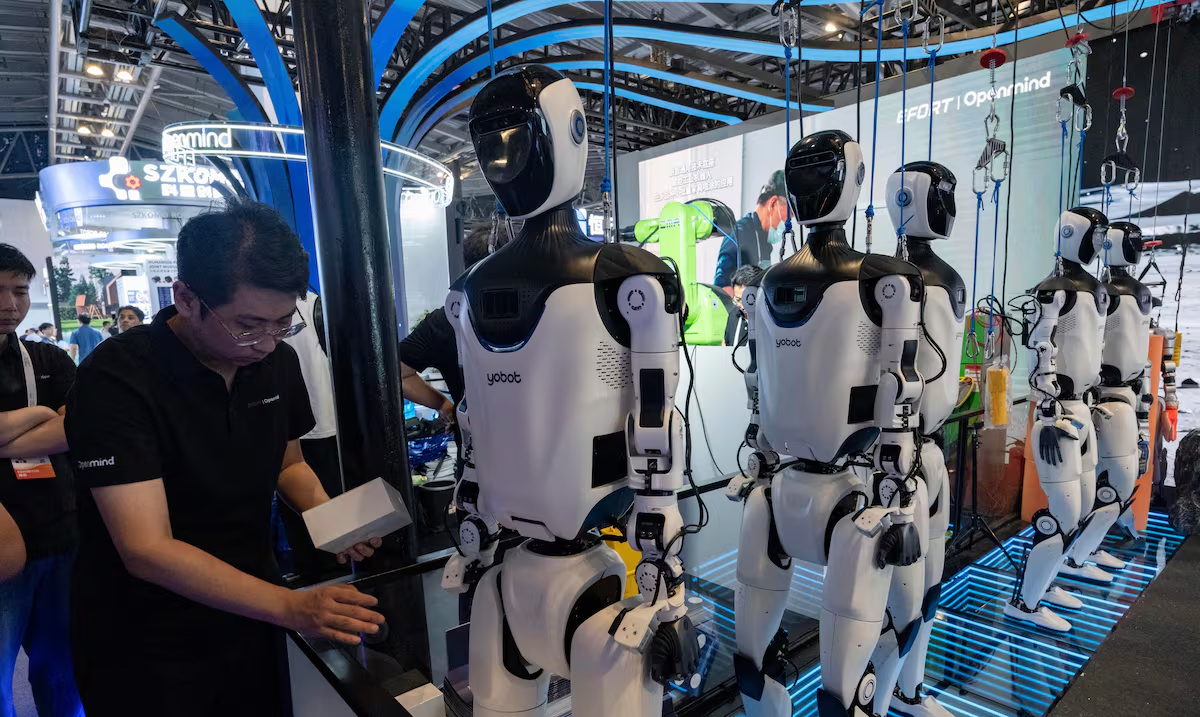
1/12 | Robots that dance, cook and fight: this is how China exhibits its advanced technology. Robots of different shapes and functions were displayed during the 2026 World Robotics Conference in Beijing, China. -Andy Wong
Chen stated that, in June 2026, AI products in China already exceeded 500 million users, an example of the speed with which these tools have spread in the country.
“Certain nations leverage their accumulated advantages in fundamental AI theory, model architecture, and core computing capacity, all under the guise of ‘maintaining national security,’ to limit other countries’ ability to acquire cutting-edge technical equipment and improve their technological innovation capabilities,” the official said, in a veiled reference to the United States.
In the military sphere, Chen asserted that AI “is moving from being a supporting role on the battlefield to becoming a protagonist,” specifically citing the conflict between Washington and Tehran.
China accelerates the development of its models
The warning comes at a time of intense activity in the Chinese sector, with companies such as DeepSeek, Moonshot, Alibaba, Tencent or Zhipu competing through open models, low prices and rapid commercial implementation, despite US restrictions on advanced chips.
Recently, DeepSeek and Moonshot have outlined possible IPOs and models such as Kimi K3, Qwen3.8-Max or GLM-5.2 have approached the most advanced systems of American firms such as OpenAI or Anthropic.
US authorities and officials such as Treasury Secretary Scott Bessent have accused Chinese companies of using “distillation”, a technique that allows models to be trained with responses from other systems, to copy US technology.
1/17 | Impressive: China exhibits its advances in artificial intelligence and robotics in Shanghai. A realistic-looking robot head watches a visitor during the World AI Conference. – Ng Han Guan
The debate coincides with the warnings launched in the United States by executives such as Dario Amodei, Sam Altman and Elon Musk about the risks of AI, while the American president, Donald Trump, has refused to slow down its development with the argument that Washington cannot allow China to take advantage.
This summer, Chinese President Xi Jinping called for “precise and effective” governance of AI and China launched an international cooperation organization on AI with around thirty countries in Shanghai.