
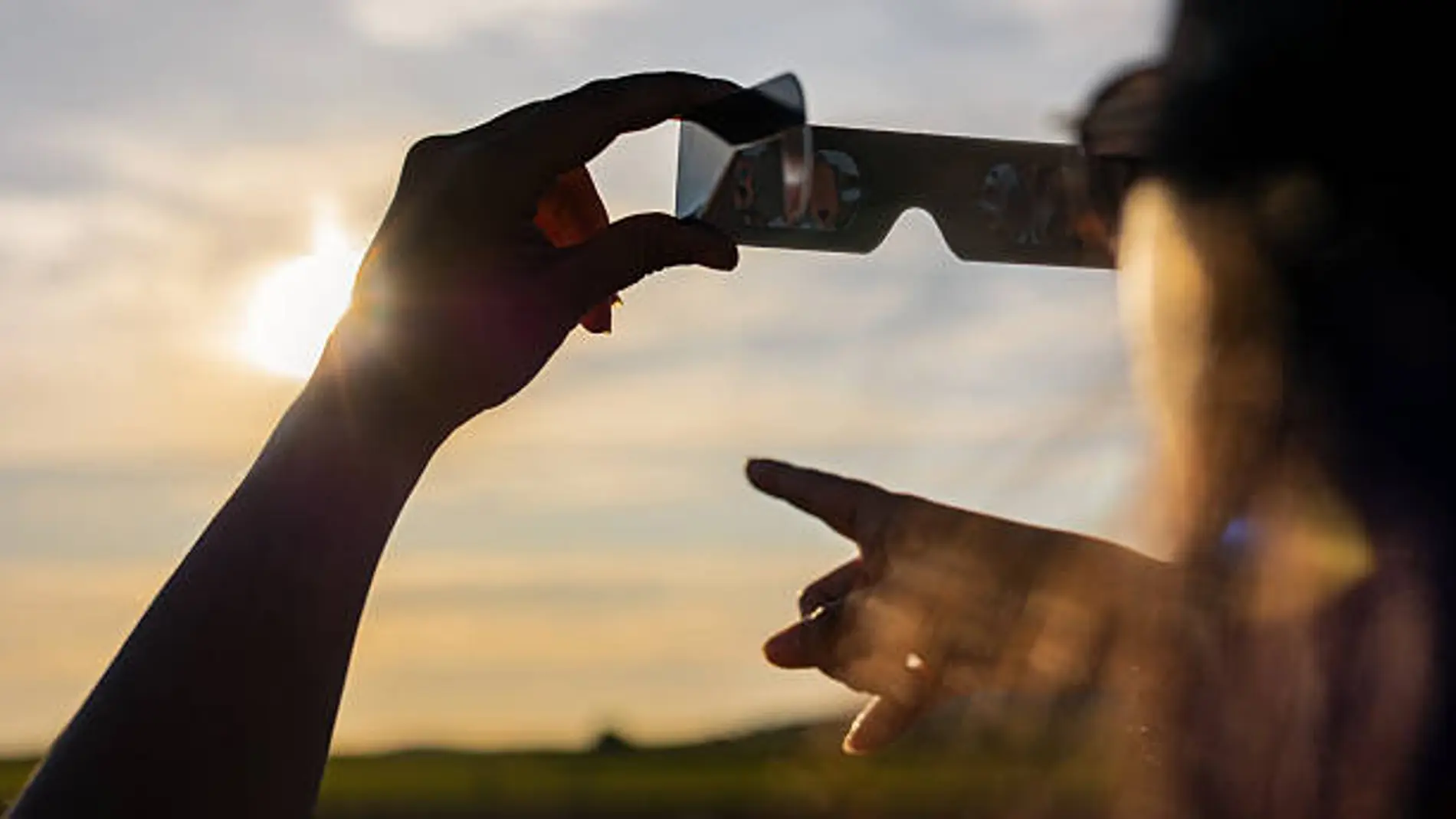
Today the long-awaited solar eclipse will occur, which It will be visible in whole and in part from most points in Spain. A historic astronomical event that has not occurred since 1905 and for which a large number of people will gather at the different official points arranged by the regional governments to observe the phenomenon.
As has been reported in the weeks leading up to this day, in order to see the eclipse safely it is necessary to use some approved glasses with ISO 12312-2 certification to prevent irreversible damage to the retina. However, many have doubts about how to put them on correctly, if they can be put on contact lenses and, above all, when is it possible to remove them.
This is the only time you can observe the total eclipse without glasses.
Given the curiosity that this astronomical phenomenon generates in the population, many want to know when they will be able to take off their glasses to enjoy the darkness generated by the eclipse. The truth is that, although it is best to leave them on throughout the entire phenomenon, experts assure that it is possible to take them off. when it reaches its entirety.
Only then, when the Sun remains completely hidden behind the Moonit is possible to remove the approved glasses to look at the star and observe one of the most anticipated images: the solar crown. This occurs when the satellite only allows us to see the outermost part of the star, creating a white halo in the sky.
Once finished, they can only be removed when it has gotten dark or when you are not going to look directly at the Sun. To do it safely, it is best to look at the ground, with your back to the solar disk, and remove them. Once removed, you will not be able to look at the star at any time.
It can only be done in the following Spanish provinces during the eclipse
However, this can only be done in the areas that are in the strip of totality of the eclipse and in which the Moon hides the Sun 100%, that is, where a total eclipse occurs. According to the National Geological Institute (IGN), the Spanish provinces in which complete darkness will be enjoyed will be: A Coruña, Lugo, Oviedo, León, Zamora, Valladolid, Palencia, Segovia, Burgos, Soria, Santander, Bilbao, Vitoria-Gasteiz, Logroño, Guadalajara, Cuenca, Zaragoza, Teruel, Lleida, Tarragona, Valencia, Castellón and Palma.
To know the exact time it will occur This phase of the eclipse, the Ministry of Transport and Sustainable Mobility, in collaboration with the IGN, has developed an interactive map where you can consult the official schedule and the duration of the entire that will be lived in the area.
It should be taken into account that, while in cities like Oviedo the totality will last 1 minute and 48 seconds, in others like Lleida it will only be seen for 25 seconds. A short period of time, which, Before it ends, you will have to put your glasses back on. approved to continue enjoying the partial eclipse.
Both in Madrid and in the rest of Spain, it will be necessary to keep your glasses on at all times
In the rest of the provinces, there will be a partial eclipse with percentages of even a 99.9%as will happen in Madrid. Although the difference seems minor, the truth is that that 0.1% of the Sun that is not covered by the Moon continues to emit radiation, so approved glasses will continue to be necessary and They should not be removed at any time.
When the observation is complete, a specific procedure must also be followed to remove the glasses without risk of retinal damage. To do this, what is advised by experts is look down at the ground to remove protectionavoiding looking at the sky without it. Likewise, remember that you should not look at the Sun for more than a minute at a time during these sunsets.