
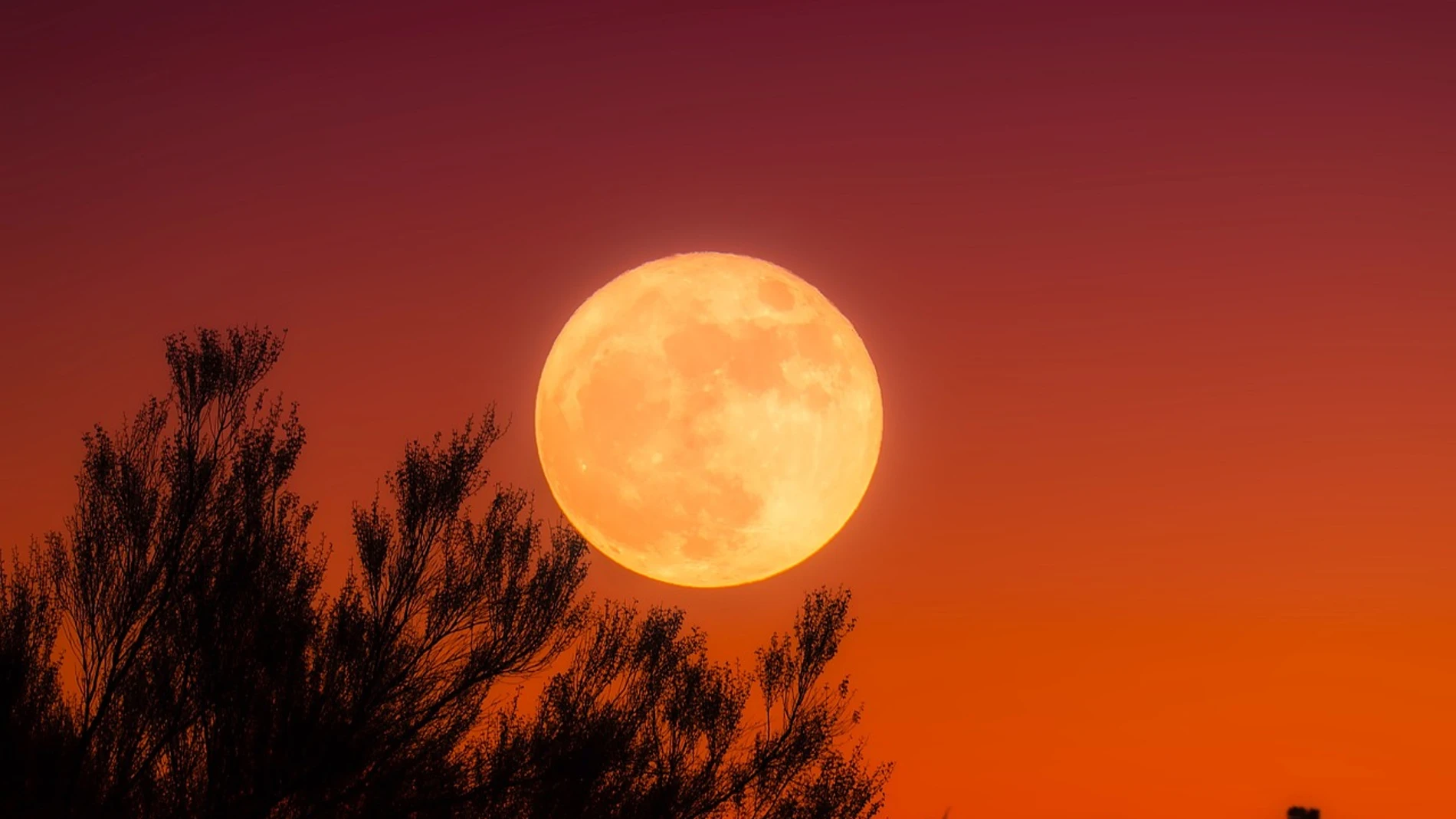
The 2026 Harvest Moon will arrive on Saturday, September 26during the first weekend of fall. This month’s full moon is so named because it is the closest to the September equinox in the northern hemisphere, a relationship with the agricultural calendar that dates back to the time when field work depended on natural light.
In Spain it can be seen with the naked eye, as long as the clouds allow it. To organize the observation, it is advisable to distinguish between the exact moment of the full moon and the time at which the satellite will appear over the horizon in each location.
When will the harvest moon be?
The calendar of the National Geographic Institute places the full moon on September 26 at 6:49 p.m. Spanish peninsular time. In the Canary Islands it will be 17:49. That is the astronomical moment of the phase, but it does not mean that the Moon will rise at that time throughout Spain.
Its output depends on the place from which it is observed. The practical reference will be the setting at sunset on Saturday, when we will have to look towards the eastern horizon. To see it appear between buildings, mountains or over the sea, it will be necessary to consult the local lunar rise time.
Nor is it a phenomenon that lasts a few minutes. Although the full moon has a specific time, the lunar disk will appear practically full on nearby nights, so its image can also be enjoyed during the rest of the weekend.
Why is it called the harvest moon?
According to NASA, this name corresponds to the full moon closest to the beginning of autumn. Its light helped farmers prolong harvesting crops after sunsetwhen they still did not have electric lighting.
The name is not fixedly reserved for September. Depending on how the moon phases fit with the equinox, the Harvest Moon can also occur in October. In 2026 it corresponds to the September full moon.
Why it may appear larger and orange
One of the most striking moments occurs when the Moon is low above the horizon. In that position it can appear much larger than a few hours later, when it is already high in the sky. NASA explains that this impression is known as lunar illusion and it is related to our visual perception.
The yellowish or orange tone has another explanation. Near the horizon, lunar light travels a longer route through the atmosphere, which disperses more of the blue light and allows reddish tones to predominate. Dust and pollution can also accentuate that appearance.
None of these effects are exclusive to the harvest moon. Its name does not imply that it has to look orange or that it is a supermoon, a name related to the satellite’s proximity to Earth.
How to see it from Spain without a telescope
You don’t need astronomical equipment to observe it. A place with clear views Towards the east it will allow you to follow your exit without being hidden by buildings or trees. An open promenade, a beach facing that direction, or an accessible viewpoint can work.
Binoculars allow you to distinguish better the light and dark areas of the surface. However, to appreciate the relief of the craters, NASA recommends also observing other phases. The shadows that appear next to the border between the illuminated and dark part help to recognize details that are less obvious during a full moon.