
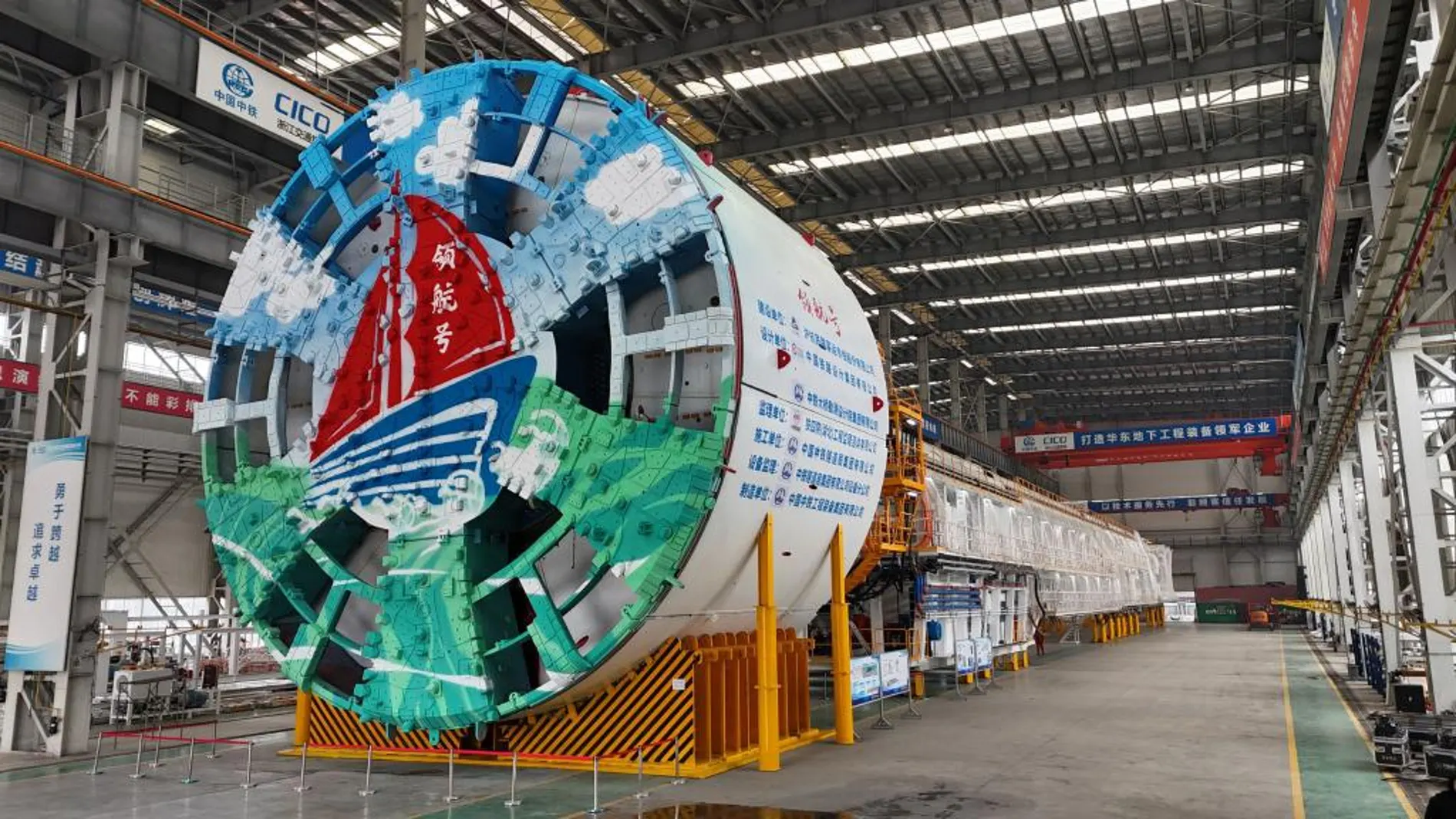
The tunnel boring machine Linghang‘Navigator’ in Spanish, has broken a record by completing this Thursday a continuous excavation of 11,325 kilometers under the Yangtze River after 27 months of work. The machine traveled the entire stretch from a single starting point, without opening intermediate wells or other excavation fronts to shorten the journey. China presents this route as the longest done under a river by a large diameter tunnel boring machine in the 15 meter category, reports Global Times. The record does not imply that it ran without stopping for 27 months, but rather that a single machine completed the entire drilling from the same face, without disassembling it or restarting it from another well.
Linghang was built by China Railway Engineering Equipment Group for the tunnel Chongtai. The shield tunnel boring machine, TBM For its acronym in English, it left the production line on January 27, 2024, finished assembly in March and began excavating on April 29 of that same year. Its cutting head measures 15.4 meters in diameter, the machine reaches 148 meters in length and its weight is around 4,000 tons.
The equipment incorporates the intelligent system I-TBMwhich monitors chamber pressure, trajectory and removal of excavated material. It also has sealing systems prepared to work under high water pressures, a long-lasting main bearing and a cutting head designed to resist wear caused by silt and sand on the river bed.
A shield tunnel boring machine It excavates the ground using a large cutting wheel located on the front. The cylindrical body that surrounds it protects the work area and temporarily holds the ground while the machine removes debris. As you move forward, behind it installs rings formed by prefabricated concrete segments that create the definitive and watertight lining of the tunnel.
One of the main challenges of the work is the pressure. Linghang has come to work at 89 meters under the bed of the Yangtze, where it has endured until 0.9 megapascals. The resulting gallery has an outside diameter of 14.8 meters and will house two tracks in a single tunnel.
That size is also due to the expected speed of the trains. A convoy traveling to 350km/h pushes a large mass of air in front of it. In a tunnel that is too narrow, this air is compressed and generates strong pressure variations, ear discomfort and waves that can affect comfort and infrastructure. A wider section reduces the call piston effect and allows trains to maintain 350 km/h while passing under the river, without having to slow down before entering the tunnel.
Linghang is the largest TBM built for a high-speed railway tunnel, but not the largest in the world in absolute terms. The record recognized by Guinness belongs to the Herrenknecht Mixshield S-880 ‘Qin Liangyu’used in 2015 to drill an underwater road tunnel in Hong Kong. That machine came to have a shield of 17.63 metersaverage 120 meters and it weighed 4,850 tons.
The Chongtai tunnel will have 14.25 kilometers and is part of the high-speed corridor between Shanghai, Chongqing and Chengdu. After a review of the intermediate well located at the end of the 11,325 kilometers excavated, Linghang will set off again to excavate the remaining 1.8 kilometers. Complete drilling is planned before the end of 2026. When the line enters service, trains will be able to cross under the Yangtze at 350 km/h and the journey between Chongming and Shanghai Baoshan station, 63 km, will be reduced to about 17 minutes.