
The Moon has been enduring impacts for more than 4.5 billion years. Asteroids, comets and rock fragments constantly hit it, excavating the thousands of craters that cover its surface. However, The next projectile will not come from the depths of the solar system, but from our own space hangars.
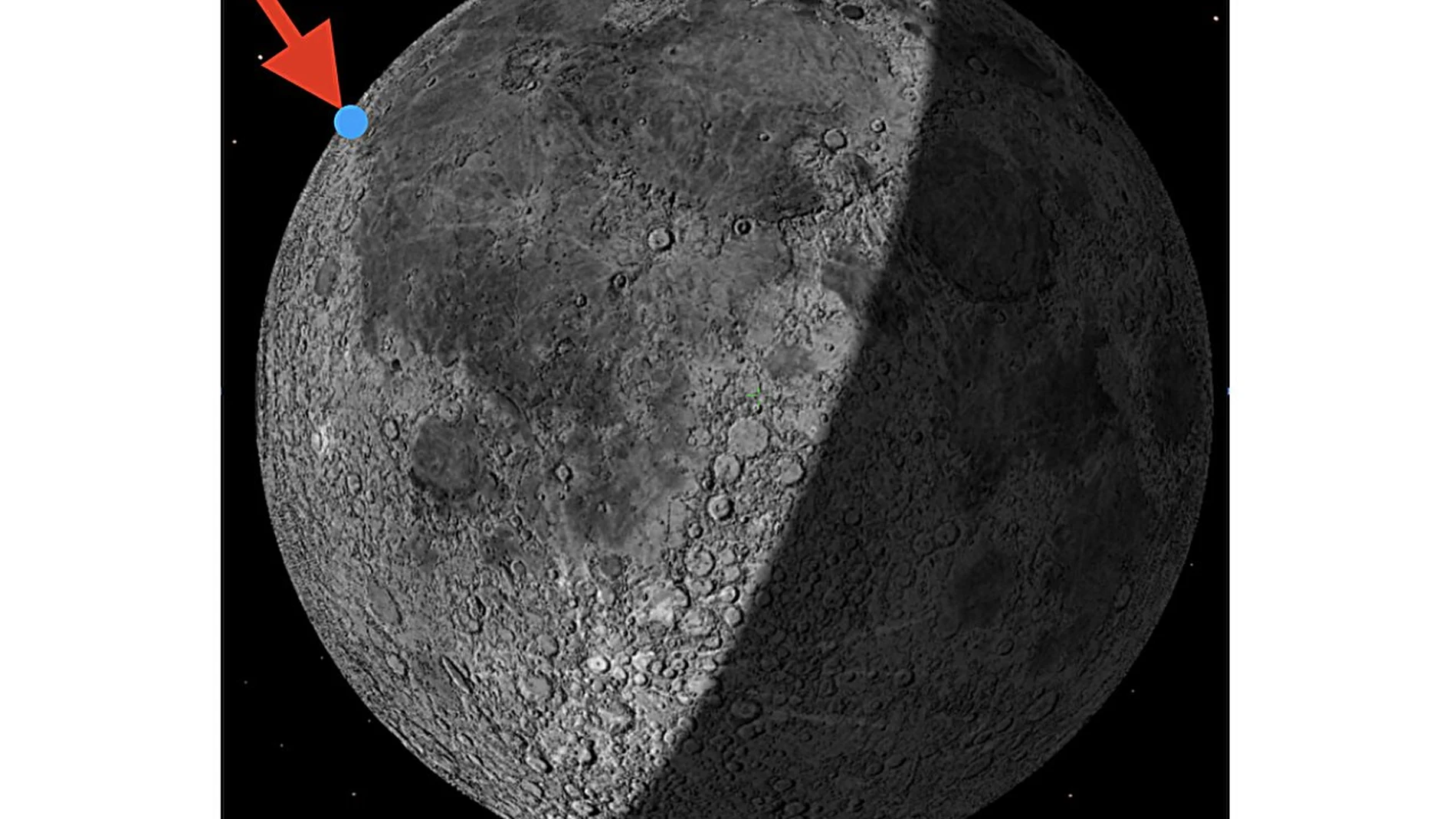
In the coming days, the upper stage of a SpaceX Falcon 9 rocket will accidentally impact the lunar surface after spending more than a year wandering in space. Experts, like Gregory Radisic, a professor at Bond University and a member of the International Space Law Institute, know very precisely where the crash will occur, what speed the rocket will reach and even how much energy it will release when it crashes. What they still don’t know is what that impact will teach us.
According to a recent studythe structure, of some 3,900 kilograms, will collide with the Moon at about 8,500 kilometers per hourapproximately seven times the speed of sound. The blow will release about 118 gigajoules of energy, the equivalent of the explosion of about 28 tons of TNT. It may seem like a huge number, but in astronomical terms it is not. The Moon frequently receives much more violent natural impacts. The extraordinary thing about this case is not the energy, but that, for the first time, scientists know practically all the characteristics of the object before it crashes.
Natural impacts always keep unknowns. Most meteorites arrive without warning and we barely know what their mass or composition was before they collided. Just the opposite happens here. The authors, led by Nancy Chanover, from New Mexico State University, know the dimensions of the rocket, its weight, its speed, its trajectory and the approximate area where it will impact, near Einstein Crater. This information turns the accident into an exceptional scientific experiment.
Simulations predict that the crash will excavate a small crater and launch a huge plume of dust and rock fragments. The main curtain of material could rise between 15 and 20 kilometers, while the central jet would reach between 75 and 100 kilometers in heightremaining visible for several minutes for sufficiently sensitive telescopes. Observing this cloud will allow us to verify to what extent the models that describe the formation of lunar craters are correct. It is a rare opportunity to test decades of theory with an impact whose “bullet” we know in detail.
The story began in January 2025, when a Falcon 9 took off carrying two commercial missions to the Moon. After completing its work, the rocket’s upper stage It was left without enough fuel to return to Earth or to definitively escape into an orbit around the Sun. Since then it has remained trapped in a chaotic trajectory, subject to the gravitational influence of the Earth, the Moon and the Sun, until orbital mathematics dictated an inevitable outcome: ending up crashing into our satellite.
This is not a navigational failure or a deliberate maneuver. It is simply the fate of an object abandoned in a region of space where orbits can become unpredictable over time. Paradoxically, scientists are hardly concerned about this particular crash. The Moon is uninhabited and the planned impact site is far from the areas where recent missions have landed. Besides, The crater it will leave will be small compared to the millions that already exist.
The concern looks much further afield. More and more countries and private companies are sending probes, landers and satellites to the Moon. In the coming years, permanent bases could be established and traffic between Earth and our satellite could drastically increase. Currently, we talk about 130 million pieces with a total weight of 9,500 tons moving at about 27,000 km/haccording to the ESA. Faster and much heavier than the Falcon 9 stage, which barely reaches 3.9 tons.
If each mission leaves behind abandoned rocket stages in unstable orbits, accidental impacts will cease to be exceptions and become a common consequence of space exploration. Thus, the problem is no longer just about managing space debris around Earth. Now a new challenge begins to emerge: to prevent us from also contaminating the space between our planet and the Moon.
Just as roads needed rules when they began to fill with vehicles and oceans began to require navigation routes, the new era of lunar exploration will likely need rules to manage the objects we leave behind. The next impact of the Falcon 9 will be a scientific spectacle fascinating. It will allow us to study how the lunar surface responds to a well-known shock and will help improve the models used for future missions. But it will also be an uncomfortable reminder. Humanity is still learning to travel through space. Now he begins to discover that, even there, You will also have to learn to pick up what you leave behind.