
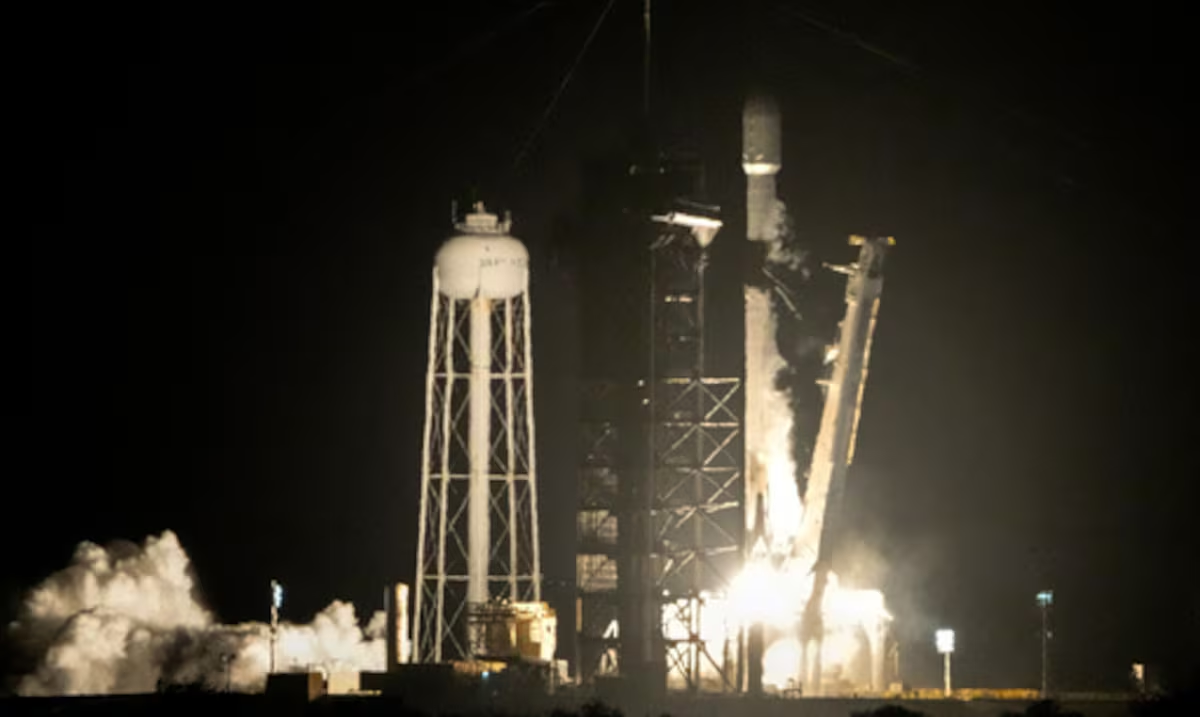
Cape Canaveral, Florida – A rocket SpaceX drifting is on a collision course with the Moon after launching two lunar landers more than a year ago.
The upper stage of the rocket will accidentally crash into the Moon Wednesday, forming a crater and causing a cloud of dust and debris that scientists — and skywatchers — are eager to see.
Space tracking expert Bill Gray predicts an impact at 5,400 mph (8,700 km/h)—seven times the speed of sound—near Einstein Crater on the moon’s sunlit western edge. With the event occurring in the early hours of the morning, the eastern United States and Canada, as well as much of South America, should have the best views.
Although scientists are not overly concerned about this particular piece of space junk, it highlights the growing threat posed by more and more objects accumulating in orbit.
“It’s getting crowded up there,” said Gray, who plans to watch the aftermath from New Brunswick, Canada.
1 / 15 | Meet the crew of NASA’s Artemis II mission. One day (April 1, 2026) before the scheduled launch of the Artemis II mission, the National Aeronautics and Space Administration (NASA) finalized planning for its first manned mission to the Moon since 1972. – EFE Agency
SpaceX never intended to crash into the Moon. However, space experts said the crash could have been avoided if the upper stage had been diverted into orbit around the Sun.
It will be the second decommissioned rocket known to have accidentally crashed into the Moon. In 2022, a fragment from a Chinese rocket caused two craters to form on the far side of the Moon.
Luckily for astronomers, the next collision will take place on the visible side of the Moon and will release energy equivalent to three tons of TNT.
According to experts, the flash of impact, which will last less than a second, will probably be too faint to see. However, the trail of ejected material could extend several miles (kilometers) into space and remain visible through telescopes for dozens of minutes.
“Gravity on the Moon is low and there is no wind to blow away the dust,” said Benjamin Fernando of the Los Alamos National Laboratory, who encourages both professionals and amateurs to make observations.
1/7 | SpaceX capsule lands with the two astronauts who were stranded on the International Space Station. Astronauts Butch Wilmore and Suni Williams, who were stranded in space, landed safely Tuesday afternoon, culminating a long mission that began with a failed Boeing test flight more than nine months ago. – The Associated Press
“Part of the reason we are interested in this event is to find out what degree of danger debris impacts pose to future astronauts,” he added in an email.
Fernando envisions an impact crater nearly 90 feet in diameter and 16 feet deep (27 meters in diameter and 5 meters deep), too small to be visible from Earth, but visible from a spacecraft.
NASA’s Lunar Reconnaissance Orbiter and South Korea’s Danuri lunar orbiter will take images of the impact site before and after the impact. According to Fernando and his team, the Danuri will pass within a mile or two (a few kilometers) of the SpaceX rocket just two minutes before impact.
The abandoned rocket segment — measuring about 40 feet (12 meters) and weighing about 10,000 pounds (4,500 kilograms) — carried two private lunar landers on Jan. 15, 2025.
One of them—Firefly Aerospace’s Blue Ghost—became the first private spacecraft to achieve a completely successful lunar landing. The other, the lander of the Japanese company ispace, crashed.
1/8 | Space operation: astronauts stranded in space begin their journey back to Earth. This image taken from a NASA video shows the SpaceX capsule carrying NASA astronauts Suni Williams and Butch Wilmore before undocking from the International Space Station. – The Associated Press
Since meteoroids and other natural objects give little, if any, warning before hitting the Moon, scientists say there is a lot to learn from observing the well-recorded impacts of man-made objects like the one approaching. NASA launched sections of rockets and lunar modules at the Moon during the Apollo era to perform seismic measurements. Decades later, in 2009, NASA intentionally crashed its LCROSS spacecraft and its upper stage in search of ice near the lunar south pole.
With the Moon becoming the hottest new travel destination, scientists say it’s critical to improve space debris surveillance and traffic control before groups of robots and astronauts arrive.
The United States and China are competing to land astronauts on the Moon in the coming years. Elon Musk’s SpaceX and Jeff Bezos’ Blue Origin are competing to supply the lander for the astronauts of NASA’s Artemis IV mission – whose name has not yet been revealed – who will take over from the 12 astronauts of the Apollo program who set foot on the lunar surface.
1/7 | Photos | Watch the moments before and after SpaceX’s Starship rocket explodes. The Starship rocket took off today from Boca Chica, Texas. The 400-foot-high ship was preparing to go around the world as an initial test by the company SpaceX, which hoped to use this type of vehicle for trips by astronauts and tourists to the moon and then to Mars. On this occasion the rocket did not have a crew. -Eric Gay
“This impact will not be a problem,” retired astrophysicist Jonathan McDowell said in an email. “But in a future in which there are permanent bases on the Moon, similar impacts would be a problem, so we should not leave rocket stages in chaotic orbits of this type.”