
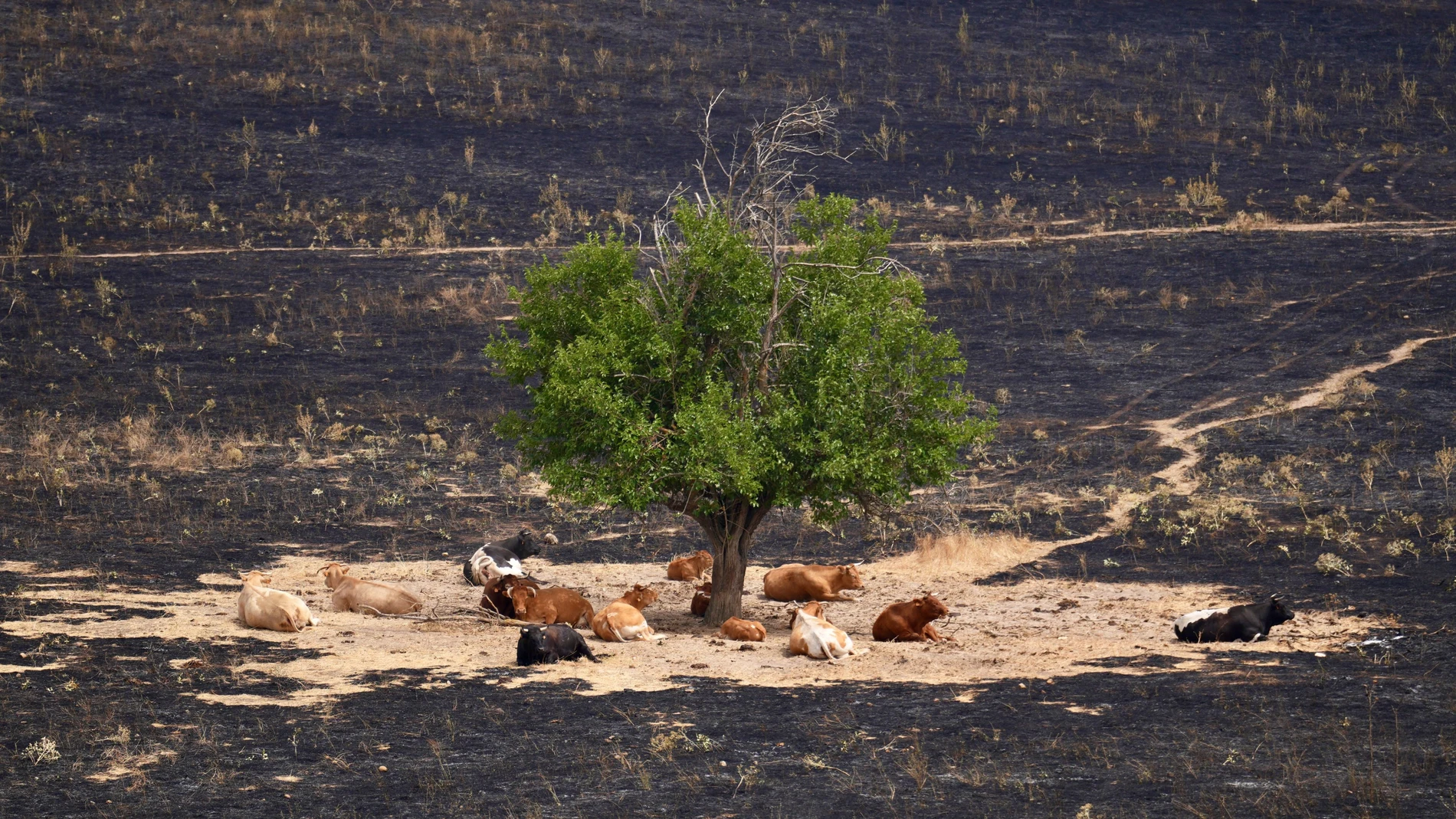
They called it a miracle tree: an oak tree surrounded by cows remained standing despite the fire that surrounded it and that devastated the fields of Tres Cantos a year ago. The cattle, grazing, eating part of the low vegetation and compacting the ground with their paws, served as a natural firebreak while the rest burned. In Legarda (Navarra) they opted for firefighting cows following a severe forest fire in 2022. The animals create natural firebreaks by reducing the accumulation of dry plant material. In Andalusia, the Andalusian Pasture-Firewall Area Network has existed for years.
They are all examples of what to resort to extensive livestock farming to clear weeds is a practice that is spreading and that is transforming what we have traditionally understood by firebreaks: “linear infrastructures arranged on old paths or near the summit lines, where all the vegetation is eliminated and whose function is not to extinguish a fire, but rather to provide anchor points for extinction operations and serve as evacuation routes,” comments Víctor Resco, professor of Forestry Engineering at the University of Lleida, who emphasizes that the current firebreaks are designed for the fires that were in Spain. of the sixties. Now, are they enough? Víctor remembers that they are not a prevention infrastructure. “They are necessary only for humanitarian reasons, but they are not sufficient in themselves because the fires bypass them.”
In some cases, The ashes easily overcome these open strips in the forest. «In the 1940s, many reforestations were carried out that made perfect sense because the problem then was flooding in a country with bare mountains and great runoff. The mountains were repopulated with trees and depopulated by people. Floods stopped being frequent because the growing vegetation stopped the water from rising, but then fires appeared. These reforestations were done very well, based on the knowledge and technique that existed at that time. The problem is not how they were made, but that we have forgotten about them. They are places with a lot of biomass and little management,” he comments.
The voracious forest fires of these years, called sixth generation and capable of consuming more than 10,000 hectares per hour, are almost inextinguishable and “do not respond to a single cause. They are the result of a combination: climate crisis, abandonment of the territory, accumulation and continuity of vegetation and expansion of the urban-forest interface,” the conservation organization WWF considers. The NGO also warns of “the limits of an obsolete firefighting model, focused on extinction and not prevention.” 78% of the resources are invested in putting out the flames once the emergency is declared and only 12% is allocated to prevention, according to their data.
These days, the vice mayor of the town of Sartajada, in the Tiétar valley, launched an open letter in which he remembers a fire in 2022 that affected several hectares. «So, the La Nube del Tiétar farm acted as a natural firebreak thanks to the investment made in clearing and preventive maintenance. The fire stopped where someone had worked the land and advanced where no one had,” he comments and talks about the situation of the mayor, admitted “after an accident during surveillance work on the rural roads of the municipality, in many cases, abandoned by the institutions that should maintain them.”
Management examples
«We would have to manage 5% of the forest landscape, three times the burned area, that is, around one million hectares. Works executed at different scales and in strategic locations,” says Víctor Resco. Other experts, such as Juli G. Pausas, researcher at the Higher Council for Scientific Research, say frankly that “it is illusory to want to conserve the vegetation of the 20th century with the climate of the 21st century,” he states in an article in The Conversation. WWF establishes a kind of catalog of actions to undertake such as «recover agroforestry mosaics, support extensive livestock farming and traditional crops and generate viable economic activity in rural areas. Promote adaptive forest management, prescribed burning and ecological restoration, differentiating areas that require intervention from those in which conservation and natural dynamics should be prioritized.
After a severe fire in the Sierra de Gata-Las Hurdes, in Extremadura, near Portugal, a project called “Mosaico” was launched with which a new landscape is being designed that recovers, in certain areas, agroforestry practices to reduce the density of vegetation and, with it, the spread of fires. «The objective is to break continuity and recover the mosaic, which is the traditional structure of the Mediterranean landscape, and make productive firebreaks, areas that stop fires and that can be economically sustained. Another example is the Pau Costa Foundation’s Fire Herds, which promote extensive livestock farming. At the level of urban protection we have several cases of prescribed irrigation, as they do in Riba-roja de Turia, in Valencia. “They use a kind of giant sprinkler to protect urban centers,” says Resco, who emphatically states that “fires have been on Earth for 400 million years. “We are not going to get rid of them, but we have to learn to live together, manage the landscapes and the mountains so that, when there is one, it burns with low intensity.”
It is mistakenly said that the forest must be cleaned and with this it has been understood that the soil must be stripped of any type of vegetation, but Víctor Resco clarifies that it is about managing fuel. «Managing one hectare saves us from spending four euros in losses, which is what we are doing now. In this sense, he gives the example of Galicia, where the administration can act ex officio if a private property has been abandoned for some time. And, when we talk about forests, we talk about managing both public and private properties. «Fuel management should be declared of national interest because it is true that you design a private property and the owner of that land, even if he does not use the property, can prevent you from entering to do prevention work. This also happens in protected spaces. The manager tells you that you cannot create a firewall or carry out a prevention action. “Fuel management should be a priority of national interest.”
What to do after the fire
Resco warns of reforestation, especially those that have to do with CO₂ absorption programs, if in the end it is planted but no maintenance is done. Furthermore, he states that «At first it is better to wait for natural regeneration. It may be necessary to help, obviously, but it is better to wait to see what species emerge. We tend to see burned spaces as cemeteries, but there are those who consider them a kindergarten of new trees. But be careful, he warns: «The other important issue is that what is lost is lost. “Reforestation is more effective when the forest is still green and not burned.”