
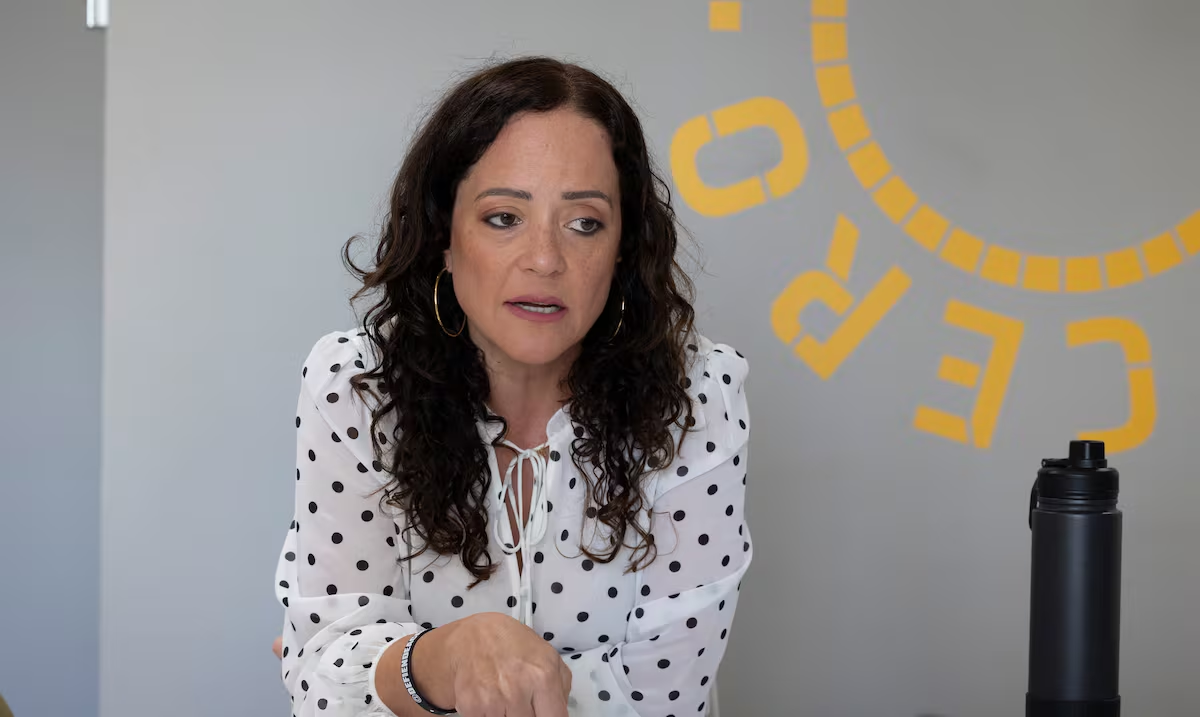
Washington D.C. – The Puerto Rican organization Kilómetro Cero has joined an alliance of human rights, justice and data organizations that seeks to “reduce dependence on large technology corporations and develop independent capabilities to work with large-scale language models.”
The Technological Freedom Cooperative brings together organizations from Puerto Rico, the United States, Canada, Mexico and Europe.
“It is a fact that large technology companies are part of the machinery of state repression that affects, every day and everywhere, the lives and rights of the most marginalized communities. We cannot allow corporate interests to put at risk data sets that are fundamental for accountability for state violence and access to justice”he stated Mari Mari Narváezexecutive director of Kilometer Zerowhich promotes the protection of life, freedoms and dignity in the pursuit of public safety.
The Technological Freedom Cooperative It is made up of Human Rights Data Analysis Group (HRDAG), Invisible Institute, Innocence & Justice Louisiana, Data Cívica and Kilómetro Cero, with the support of the John D. and Catherine T. MacArthur Foundation.
According to its members, “The alliance will provide distributed systems for data support and local Artificial Intelligence (AI) infrastructure for organizations dedicated to documenting human rights violations, state violence, wrongful convictions and other abuses of power.”
The Cooperative maintained that human rights organizations often preserve irreplaceable data on state violence in systems controlled by large technology corporations that may be subject to government pressure.
The coalition recalled that Microsoft reportedly revoked the account of International Criminal Court (ICC) chief prosecutor Karim Khan after the United States imposed economic sanctions on him for investigating possible war crimes in Gaza.
The intention is to preserve data, build local AI infrastructure, and develop technical expertise alongside civic groups.
“Civil society cannot depend on big technology companies to resist state pressure and protect sensitive data”he pointed out Patrick Ball Director of Research at HRDAG, emphasizing the importance of being able to maintain “control over our data and our tools, to be able to demand accountability in future justice processes and beyond.”
Monica Meltisexecutive director of Data Cívica, noted that “at a time when technological power is increasingly concentrated, our response is to try to take part of that power and share the risk between organizations from different geographies.”